


Six US banks have failed in 2026, outpacing the five failures recorded in 2023. Yet their combined $1.43 billion in assets pale against the $552.54 billion lost during the SVB and Signature Bank crisis, which exposed deep weaknesses across the regional banking sector.
🔑 Key takeaways
- Six banks failed in 2026, versus five in 2023.
- Combined assets of the 2026 cohort stand at $1.43 billion, versus $552.54 billion in 2023.
- Nano Banc ($736M) is the largest 2026 failure, closed on September 25.
- The FDIC’s problem bank list counts 47 institutions in Q2 2026, within the historical 1–2% range.
- Polymarket assigns just a 5% probability of failure by year-end 2026 to KeyBank and US Bank.
The six 2026 failures in detail
Nano Banc, based in Irvine, California, became the sixth bank failure of the year on September 25. With $736 million in assets, it is the largest 2026 failure. The FDIC estimated the cost to the Deposit Insurance Fund (DIF) at $114 million. Sunwest Bank (Utah) assumed nearly all deposits and acquired approximately $476 million of assets.
California’s regulator, Rohit Chopra, cited “repeated violations” and prior actions against mismanagement, while highlighting the elevated level of uninsured deposits at the institution.
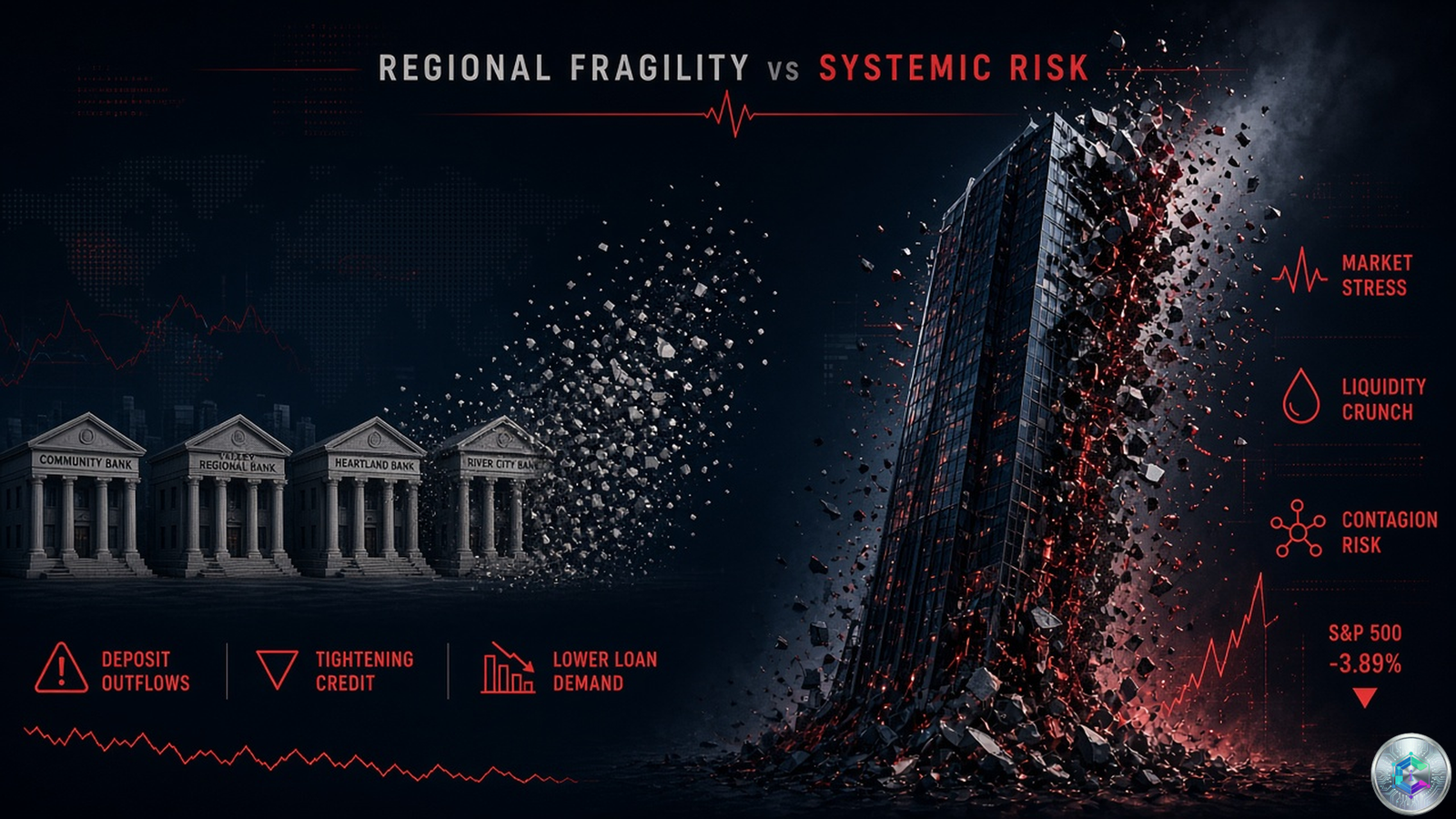
The five other 2026 failures span a wide range of profiles, from micro-banks to mid-sized institutions:
| Bank | Date | Location | Assets ($M) | Acquirer |
|---|---|---|---|---|
| Metropolitan Capital Bank & Trust | January 30 | Chicago, IL | 261.1 | First Independence Bank |
| Community Bank and Trust – West Georgia | May 1 | LaGrange, GA | 288 | Anchor Bank |
| Kentland Federal S&L Association | July 10 | Kentland, IN | 3.73 | Kentland Bank |
| Small Business Bank | July 17 | Lenexa, KS | 73 | The Farmers State Bank of Oakley |
| Tioga-Franklin Savings Bank | August 21 | Philadelphia, PA | 68 | Second Federal S&L of Philadelphia |
| Nano Banc | September 25 | Irvine, CA | 736 | Sunwest Bank (UT) |
Several of these institutions showed documented structural fragilities. Kentland Federal, described by the FDIC as “the smallest standalone bank in the country,” reported just $3.73 million in assets. The OCC (Office of the Comptroller of the Currency) found that unsafe practices had drained earnings and capital, offering no reasonable prospect of restoring adequate capital.
For Small Business Bank, Kansas regulators described years of continuous operating losses that eroded equity until the bank became critically undercapitalized. Tioga-Franklin had previously been subject to an FDIC consent order covering weaknesses in management, capital planning, liquidity, and credit administration.
Common root causes
Most 2026 cases share a common thread: failed governance and poorly controlled risk-taking, rather than an external macro shock. Metropolitan Capital also showed impaired capital and unsafe conditions per Illinois regulators. The FDIC Inspector General is currently conducting a material-loss review of Community Bank and Trust – West Georgia.
2023: the banking apocalypse without an equivalent
The comparison with 2023 is starkly disproportionate. That year, five banks failed but their combined assets reached $552.54 billion. Three failures alone defined the year:
- Silicon Valley Bank (March 10): over $209 billion in assets at end-2022, the second-largest bank failure since the FDIC was founded.
- Signature Bank (March 12): roughly $110.4 billion in assets, ranked fourth largest failure on an inflation-adjusted basis.
- First Republic Bank (May 1): acquired shortly after by JPMorgan Chase.
“Six banks in 2026 exceed every annual count since 2020, yet $1.43 billion in assets is nothing compared with the $552.54 billion lost in 2023.”
CryptoSlate, September 2026
The SVB episode also rattled the crypto ecosystem. Circle, issuer of the USDC stablecoin, held $3.3 billion in reserves there, briefly destabilizing the token’s peg before the FDIC guaranteed all deposits. Heartland Tri-State Bank (July 28) and Citizens Bank (November 3) rounded out the 2023 tally. FDIC annual figures show four failures in 2020, none in 2021 or 2022, two in 2024, and two in 2025.
A broadly resilient sector
The raw count may look alarming, but sector-wide indicators remain within historical norms. The FDIC’s problem bank list counted 47 institutions as of June 30, 2026, down from 54 in March and 60 at end-2025. That corresponds to roughly 1.1% of insured banks, well within the normal 1–2% range outside crisis periods.
What the FDIC list really measures
An FDIC official commented cautiously:
“This does not give the sector a clean bill of health, because a bank can leave the list by failing just as it can by recovering or merging.”
FDIC official, 2026
Q2 2026 results
FDIC figures confirm the nuance. Community banks posted 8.2% higher profits versus the prior quarter, while industry-wide earnings reached $90.1 billion. The regulator describes capital and liquidity as “solid.” Notably, four of the six 2026 failures occurred between July and September, after the Q2 snapshot. The DIF cost for Nano Banc ($114M) may still evolve as the FDIC divests retained assets.
Losses are real even when apocalypse is not. The $1.43 billion in combined assets should not be treated as vanished money: loans can still be repaid and securities sold. At Tioga-Franklin, the acquirer assumed all deposits; at West Georgia, the deal transferred nearly all insured deposits, with customers above the insurance cap receiving specific notices of their rights as uninsured depositors.
Polymarket sees no wave on the horizon
Polymarket’s prediction market on US banks likely to fail by year-end 2026 reflects this relative calm. KeyBank and US Bank top the list with just 5% probability each. Total trading volume stands at $77,507 since the market opened on April 8, 2026. Resolution is expected around April 30, 2027.
Conclusion
The 2026 tally of US bank failures illustrates one key point: the raw count can climb without systemic risk following. With $1.43 billion in combined assets against $552.54 billion in 2023, the sector emerges reinforced from this series of localized incidents, driven mainly by governance or asset-management issues rather than a broad liquidity shock.
Scenarios for the coming quarters remain open. The concentration of failures in the third quarter (four out of six) calls for vigilance without signaling systemic stress. Upcoming FDIC indicators and the resolution of the Polymarket market, expected April 30, 2027, will provide further insight into the trajectory of US regional banks.
Sources
- CryptoSlate – Six US banks have failed in 2026 but the numbers look nothing like 2023
- FDIC – Failed Bank List
- Polymarket – Which banks will fail by end of 2026
- Bankrate – List of failed banks
- American Banker – 15 most recent bank failures
- Pew Research – Most U.S. bank failures have come in a few big waves
This article is published for informational and educational purposes only. It does not constitute investment advice. Do your own research (DYOR) before any decision.

