


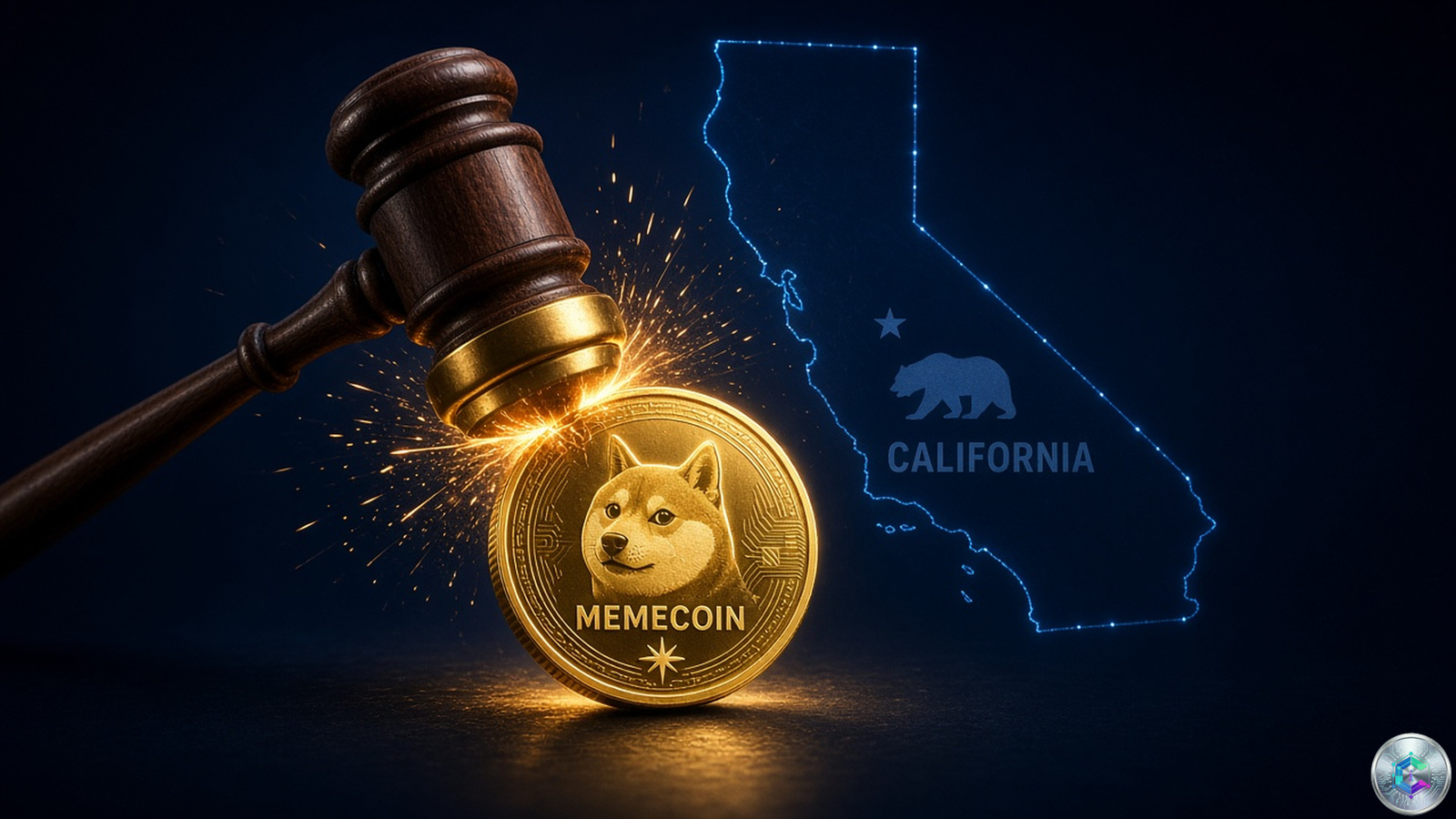
California became, on Sunday September 28, 2026, the first US state to ban elected officials from launching memecoins. By signing bill AB 2409, Governor Gavin Newsom closed the door on turning a public mandate into a speculative money machine — three weeks before the measure reaches crypto exchanges operating in the state.
🔑 Key takeaways
- AB 2409 prohibits California officials and public employees from issuing memecoins.
- From January 1, 2027, exchanges may not list for California residents any memecoin issued after that date by a federal, state or local official.
- The bill passed unanimously: 118 in favor, zero against across both chambers.
- Enforcement is civil — injunctions and disgorgement — with no criminal penalties.
- The memecoin market now stands at $27.1 billion, down from a $150 billion peak in December 2024.
A law forged in the shadow of $TRUMP
AB 2409 was born from a textbook case: the launch of the $TRUMP memecoin by Donald Trump, three days before his January 2025 inauguration. The token surged from under $1 to $75 within days, lifting its market cap to $14 billion. It now trades around $2.03, down more than 80% from its peak. According to blockchain analytics firm Nansen, 988,905 buyers collectively lost $3.81 billion. Trump’s annual financial disclosure lists $636 million in royalties from the same token.
Governor Newsom did not mince words in his statement titled “The Opposite of Trump.”
“While the scam that is Donald Trump continues to hurt American families, California is fighting to make our economy work for people, not the powerful. No official should profit off their office — and we’re putting stronger protections in place to ensure it doesn’t happen in our state.”
Gavin Newsom, Governor of California
The episode was also marked by unverified rumors about the president’s health, which briefly spiked the price before a White House denial — illustrating how acutely sensitive these assets are to online sentiment.
AB 2409: scope, definitions and timeline
Introduced by Assemblymember Avelino Valencia, the law defines a memecoin as a digital asset whose value rests primarily on public hype, speculation or community engagement, rather than on practical utility. It prohibits any public officer (elected or appointed, including legislators) and any public employee with decision-making authority over public contracts from issuing such an asset.
From January 1, 2027, digital asset service providers — i.e., crypto exchanges — will be barred from offering to California residents any memecoin issued after that date by or in partnership with a federal, state or local official. The measure does not apply retroactively to tokens already in circulation.
Key definitions in the bill
AB 2409 codifies five terms: “digital asset,” “digital asset exchange,” “public employee” (an agent of a state or local entity with authority over contracts), “public officer” (any elected or appointed state or local official) and “stablecoin” (a fiat-pegged digital asset).
A unanimous legislative path
Debated on the Assembly floor on May 27, 2026, the bill was strengthened in committee before sailing through. The final tally — 40 senators and 78 assemblymembers, 118 in favor and zero against on August 26, 2026 — reflects rare bipartisan consensus. The bill reached the governor on September 3 and was signed on September 28.
| Step | Date | Outcome |
|---|---|---|
| Bill introduced | 2026 | Avelino Valencia (author) |
| Floor debate | May 27, 2026 | Scope expanded in committee |
| Senate vote | August 26, 2026 | 40-0 |
| Assembly vote | August 26, 2026 | 78-0 |
| Presented to governor | September 3, 2026 | — |
| Signed into law | September 28, 2026 | AB 2409 enacted |
Civil enforcement only
The state attorney general, a district attorney, a city attorney or a county counsel may bring an action to obtain an injunction and disgorgement of ill-gotten funds. No criminal penalties are contemplated. The bill is backed by California Common Cause and drew no formal opposition within the filing window.
“AB 2409 prohibits California public officials from issuing crypto-memecoins and prevents platforms from listing a memecoin using a public official’s likeness.”
Avelino Valencia, bill author
Federal counterparts: Clarity Act, Gillibrand and the MEME Act
At the federal level, Democratic Senator Kirsten Gillibrand (NY) renewed on July 3, 2026 a proposal to bar members of Congress, the president and their spouses from launching or sponsoring digital assets like $TRUMP. She tied the measure to the “Clarity Act,” a crypto market structure bill.
In parallel, a group of House Democrats introduced the “Modern Emoluments and Malfeasance Act” (MEME Act), which bars the president, vice president, members of Congress, senior executive officials and their families from issuing, sponsoring or endorsing any security, commodity, future or digital asset. The bill carries criminal and civil penalties and would apply retroactively — directly targeting revenue from $TRUMP and the Melania Meme Coin.
Rep. Sam Liccardo (D-CA), the bill’s author, captured its spirit succinctly:
“Let’s make corruption criminal again. It’s appalling that we have to look to Argentina’s criminal justice system as an example of how an independent prosecutor should treat a case of blatant public corruption like this.”
Sam Liccardo, U.S. Representative (D-CA)
The MEME Act counts roughly two dozen co-sponsors, including Ro Khanna, Eric Swalwell, Ted Lieu, Eleanor Holmes Norton, Kevin Mullin, Raúl Grijalva, Shri Thanedar, Norma Torres, Andre Carson, Scott Peters, Darren Soto, Sarah Elfreth, John Garamendi, Nanette Barragán, Johnny Olszewski, Dan Goldman and Adam Smith. In a Republican-controlled Congress, however, its odds remain slim.
A memecoin market in deep retreat
The segment now stands at $27.1 billion, sharply below its $150 billion peak in December 2024. The two historical pillars of the market illustrate the depth of the correction.
| Asset | All-time high | Drawdown from peak |
|---|---|---|
| Dogecoin (DOGE) | May 2021 | -90% |
| Shiba Inu (SHIB) | October 2021 | -95% |
| $TRUMP | January 2025 (~$75) | -80%+ (~$2.03) |
| Total memecoin market cap | $150B (Dec. 2024) | -82% (~$27.1B) |
The market remains extremely volatile and largely unregulated at the federal level — fertile ground California now aims to contain at the state level.
Conclusion: a precedent, not a global fix
With AB 2409, California draws a clear ethical line: a public office cannot become a speculative financial product. The unanimous vote, the swift timeline and the backing of good-governance groups like California Common Cause make it a legislative precedent that other states — New York, Illinois or New Jersey — could easily imitate.
The blind spot remains: the law does not cover already-issued tokens and cannot reach federal officials. Until Congress passes an analogous bill — the Clarity Act, the MEME Act or something equivalent — presidents, senators and their families will still be able to launch memecoins. For exchanges, however, the calculus changes on January 1, 2027: distributing a political memecoin to a California resident becomes a concrete legal risk, with injunctions and disgorgement on the table. Pressure will now flow through compliance channels, not just public opinion.
Sources
- CoinDesk
- California Senate Judiciary Committee — AB 2409 analysis
- CalMatters Digital Democracy
- StartupFortune
- Yahoo Finance
- Rep. Sam Liccardo — MEME Act
This article is for informational and educational purposes only. It does not constitute investment advice. Do your own research (DYOR) before making any decision.

