


Global markets flipped into risk-off mode on Tuesday after the expiration of the 60-day US-Iran ceasefire. The 30-year US Treasury yield touched 5.321%, a 19-year high, while Brent crude broke above $91. Bitcoin and Ether held nearly flat through the bond rout.
🔑 Key takeaways
- US 30-year Treasury yield reaches 5.321%, highest in 19 years
- Brent crude climbs to $91.06 after a $2+ jump on Monday
- MSCI Asia-Pacific ex-Japan +0.8%, KOSPI +3%, Nikkei -0.3%
- Bitcoin steady near $64,398, Ether at $1,911
- ING and Westpac flag the absence of soothing remarks from Washington
30-year US Treasury hits a nearly two-decade peak
Pressure on the US yield curve intensified as Asian markets reopened on Tuesday. The 10-year Treasury yield added 0.8 basis point to 4.728%, while the 30-year leg climbed 0.6 basis point to 5.3146%, its highest level in over two decades. Earlier in the session the long bond had touched 5.321%, a level last seen in 2007 according to Fidelity.
Two recent Treasury auctions stood out: the 10-year deal priced at a yield of 4.683%, the highest in 19 years, and the 30-year at 5.216%, a 25-year peak. According to Anthony Saglimbene, chief market strategist at Ameriprise Financial, those auctions served as “a reminder that the landscape is changing.”
“Last week’s Treasury auctions were a reminder that the landscape is changing. On the long-end issuance, investors are increasingly focused and concerned about the growing amount of US debt and the lack of fiscal discipline.”
Anthony Saglimbene, Chief Market Strategist at Ameriprise Financial
In Asia, Japan’s 10-year government bond yield rose 2.5 basis points to 2.945%, a three-decade peak. In Europe, the 10-year German Bund hit its highest level since May 2011 and the French 10-year OAT a 17-year record, with futures on both contracts selling off during Asian hours.
Oil and gold: global supply under strain
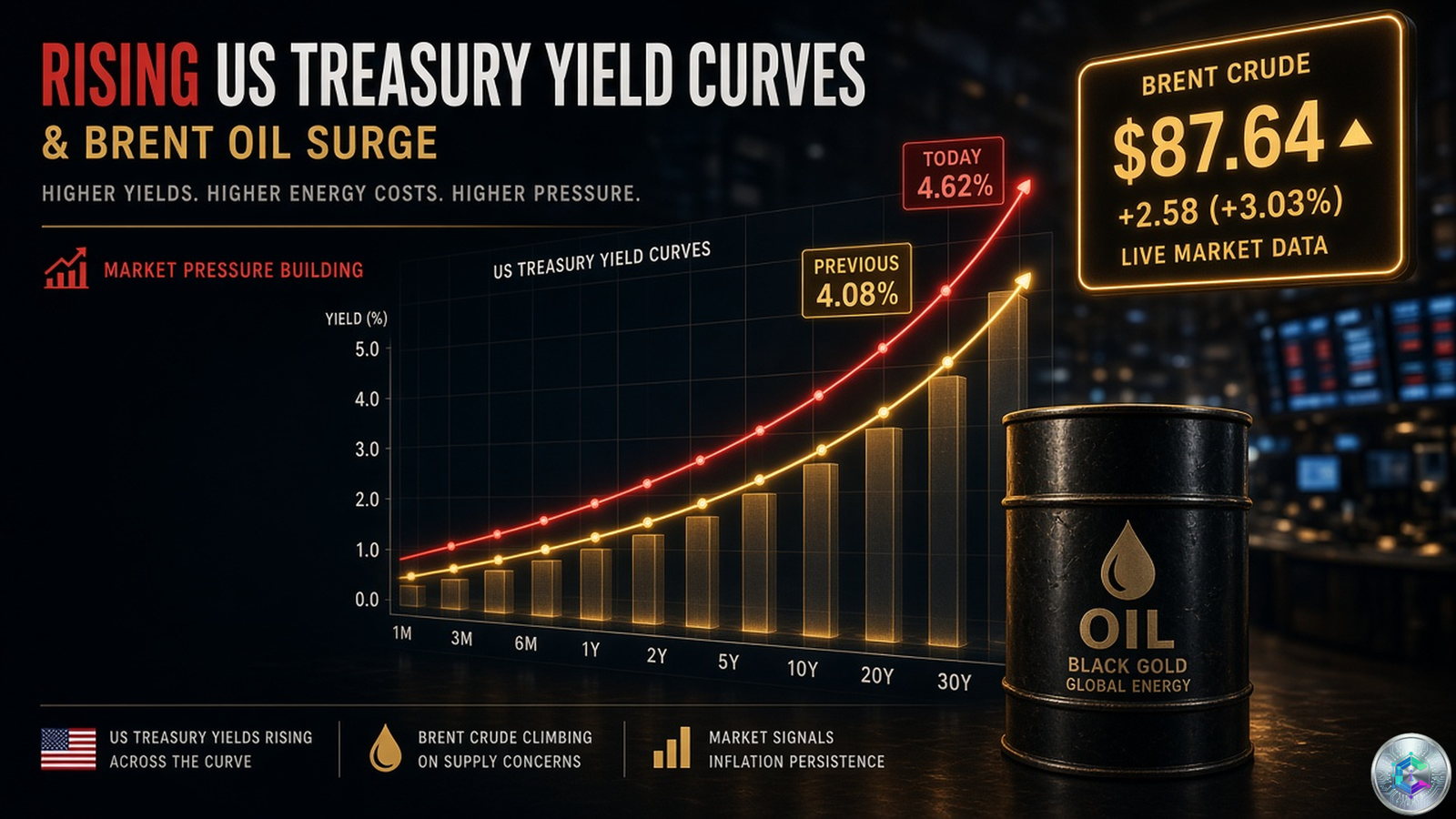
Oil prices extended their rally as traders refocused on supply risks tied to the effective closure of the Strait of Hormuz. Brent traded at $91.06 a barrel (+0.2%) at the Asian reopen, after a $2+ jump on Monday. Brent has posted a year-on-year gain this year unmatched in more than 40 years, according to CME Group data.
Gold also kept climbing, up 0.1% to $4,420.07, extending gains for a third straight session. The yellow metal remains a preferred hedge against the combination of US debt, geopolitical tensions and monetary uncertainty.
Vasu Menon, head of investment strategy at OCBC, points out that capital competition from AI hyperscalers, the rise of the US budget deficit and Fed Chair Kevin Warsh’s shift toward a more opaque policy stance are all feeding long-end yields higher.
“The rise in long-dated US Treasury yields is a risk investors need to keep in mind going forward. Bond investors are best positioned to manage that risk by leaning toward shorter-duration paper.”
Vasu Menon, Head of Investment Strategy at OCBC
Asia and Wall Street: split markets under the Iran shock
The MSCI Asia-Pacific ex-Japan index rose 0.8%, lifted by South Korea’s KOSPI which jumped more than 3% after Seoul’s market reopened following a holiday. Japan’s Nikkei 225 slipped 0.3% and e-mini S&P 500 futures traded flat. On Wall Street on Monday, the S&P 500 lost 0.5% and the Nasdaq Composite 0.3%, as disappointing US economic data — including an unexpected drop in retail sales — led markets to scale back bets on an imminent Fed move.
The US dollar index hovered near a two-month low at 99.527, underscoring waning confidence in the greenback despite its safe-haven status. Bitcoin rose 0.1% to $64,398.48 and Ether 0.3% to $1,911.40, showing relative resilience through the bond rout.
| Index / asset | Change | Level |
|---|---|---|
| MSCI Asia-Pacific ex-Japan | +0.8% | — |
| KOSPI (South Korea) | +3% | — |
| Nikkei 225 | -0.3% | — |
| S&P 500 (Monday) | -0.5% | — |
| Nasdaq Composite (Monday) | -0.3% | — |
| Bitcoin | +0.1% | $64,398 |
| Ether | +0.3% | $1,911 |
| Gold | +0.1% | $4,420 |
| Brent | +0.2% | $91.06 |
“Markets adopted a general risk-off tone as President Trump reaffirmed he was not interested in extending the truce with Iran, with renewed Middle East tensions pushing oil prices higher and complicating sentiment.”
Westpac analysts, research note
ING analysts note that moves above 4.65% on the US 10-year have usually been followed by soothing remarks from the Trump administration, generally focused on an imminent resolution of the Iran conflict.
“This time, we are not hearing the same thing. In fact, the latest indications do not point to an imminent resolution, with the fragile 60-day truce now expired.”
ING analysts, research note
Strait of Hormuz and 2026 scenarios: Charles Schwab maps four outcomes
The Strait of Hormuz, through which roughly 4.5% of annual global trade transits according to Bloomberg, remains effectively closed. Fertilizers, helium for semiconductor production, precious metals, aluminum, cement and naphtha for plastics are among the most exposed commodities.
Even if the truce holds, damage to regional energy infrastructure — LNG facilities, production, exploration and refining capacity — is significant and restart can take months or more. Engineering constraints and storage capacity limits risk extending the supply shock well beyond the duration of the hostilities.
Charles Schwab outlines four scenarios for 2026: a benign case (imminent end of the conflict, unlikely given the cumulative impact), a moderate case (lasting de-escalation and gradual normalization of energy flows), an adverse case (limited strikes keeping energy prices elevated into H2 2026) and a severe case (prolonged conflict, acute commodity shortages, global recession).
The MSCI ACWI ex-US index has already dropped more than 10% in March, while the S&P 500 lost 5%. A five-week consecutive weekly decline in the S&P 500 has only happened twice in the past 15 years, in 2022 and 2011, according to Charles Schwab data.
Conclusion: persistent volatility without conflict clarity
Absent more clarity on the fundamental impacts of the Iran war, market volatility is likely to stay elevated, with the potential for sharp but short headline-driven swings. Investors will now track three catalysts: the evolution of the Strait of Hormuz, the Fed’s stance under Kevin Warsh and the trajectory of long-dated US Treasury auctions.
The resilience of Bitcoin and Ether, despite the rise in real yields, suggests crypto remains for now on the sidelines of this geo-economic shock — a pattern that could shift if inflation expectations surge or the dollar keeps eroding.
Sources
- Reuters – Global markets wrapup, 18 August 2026
- Fidelity – Treasury yields analysis, 17 August 2026
- Euronext – Oil and bond yields live coverage
- Charles Schwab – Iran war scenarios for global equities
- TradingView – Reuters news wire
This article is published for informational and educational purposes only. It does not constitute investment advice. Do your own research (DYOR) before making any decision.

