

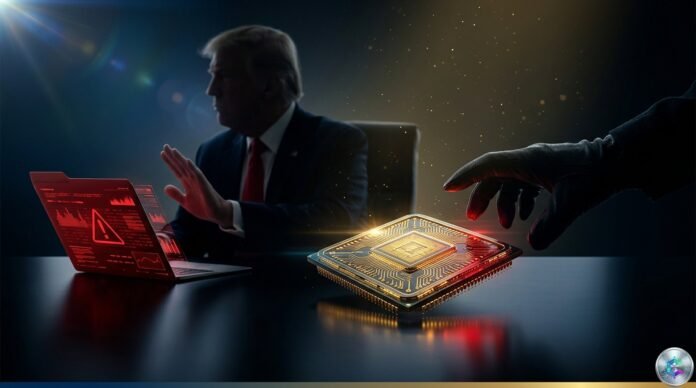
The New York Times reports that Donald Trump was told roughly a year before the disclosures that a Chinese national with direct access to Jensen Huang, Nvidia’s CEO, was passing information to Beijing, and that he chose not to act. The case goes to the heart of the US-China technology rivalry and the security of AI chip exports.
🔑 Key takeaways
- According to the NYT, Trump reportedly decided not to act on intelligence that Alice Huang was passing information to Beijing.
- The reported reasons: fear of hurting Nvidia chip sales and disrupting US-China trade negotiations.
- Billions of dollars in AI chip purchases are at the centre of the federal investigation into Megaspeed.
- Trump, Nvidia and the Chinese embassy dispute the allegations or how they are being framed.
An alert that reached the White House
The newspaper relies on people briefed by US intelligence agencies, who spoke on condition of anonymity. According to them, Trump was warned that Beijing was receiving reports from someone with direct access to Jensen Huang. That person is reportedly Alice Huang, also known as Huang Le, a Chinese national with no family relation to the Nvidia executive and a former executive at Megaspeed, a Singapore-based cloud and data centre provider.
According to these sources, Trump reportedly “chose to do nothing” with the information, at least in part out of fear of hurting Nvidia’s chip sales or disrupting trade dealings between Washington and Beijing. Concerns also centred on the possibility that Alice Huang could give Beijing intelligence on Nvidia and influence Trump’s AI policy.
In May 2026, Marco Rubio, Secretary of State and national security adviser, reportedly placed the intelligence in a classified report. Before Jensen Huang boarded Air Force One for a trip to Beijing, Rubio passed the information along, as Huang had been invited to join the presidential delegation. The NYT cites at least one more warning within seven months, while LiveMint reports at least two warnings in total.
Megaspeed, massive purchases and diversion suspicions
Alice Huang was initially suspected of helping Chinese entities evade US export controls to obtain cutting-edge Nvidia chips. Reported figures vary: The Guardian cites $4.8 billion in highly sensitive AI chips bought while she led Megaspeed, while The Primary mentions a $2 billion purchase initiative over twelve months. The sources do not establish whether these describe the same purchases or different periods.
| Item | Reported figure | Source |
|---|---|---|
| AI chip purchases | $4.8 billion | The Guardian |
| Purchase initiative | $2 billion over 12 months | The Primary |
| Nvidia write-downs | About $4.5 billion | Nvidia, as reported |
| Communication period | Spring 2025 to autumn 2026 | Briefed sources |
Megaspeed also rented computing capacity to Chinese companies, with facilities in Malaysia and Indonesia. Investigators feared the processors could be redirected to Chinese military programmes, state surveillance or national AI development. LiveMint reports that some chips reached data centres in Southeast Asia and that other shipments are suspected of having been smuggled into China.
The federal investigation began in 2024 at the Commerce Department, where investigators found Nvidia hardware packed and ready for shipment rather than installed in data halls. The Justice Department took over the case in early 2026. Corporate records indicate that director James Tan lives in China and holds his stake through an offshore company. After federal attention intensified, Alice Huang’s name was removed from Megaspeed’s filings.
“These concerns should have prompted technology suppliers to reexamine hardware allocations.”
Aaron Bartnick, former deputy director for technology security and governance under the Biden administration
Nvidia pushes back, Beijing calls it political smear
Asked about the briefing, Trump said on November 9, “No, I wasn’t told about it at the time.” According to the South China Morning Post, he also said he had not heard about it when asked whether Rubio had briefed him. He said he did not believe US national security was threatened, and made sweeping remarks about Chinese women that drew criticism as stereotyping. He later said he had briefly raised the matter with Xi Jinping at the Asia-Pacific Economic Cooperation summit in Shenzhen.
“We’re spying on China. They’re spying on us.”
Donald Trump, President of the United States, interview with Fox News
Nvidia spokesman John Rizzo firmly rejected the claim that its proprietary technology had been compromised. He said executive interactions with Alice Huang were ordinary business practice, noting that Jensen Huang meets thousands of customer representatives every year. The company says the diversion allegations against Megaspeed were “thoroughly reviewed and refuted” the previous year, that its internal controls found no evidence of diversion, and that Megaspeed was an ordinary regional customer with no compliance warning. Based on the available reporting, the revelations weighed on the share price, though no percentage was given. Beijing’s blocking of certain US processor imports, including the H200 approved for export earlier in 2026, had already led Nvidia to book roughly $4.5 billion in inventory write-downs on products destined for the Chinese market.
On the substance, the accounts diverge. According to The Primary, the absence of a defensive briefing for Jensen Huang was meant to avoid compromising surveillance by alerting Alice Huang. The Guardian reports that no official explanation was provided. Officials doubted he was entirely unaware of the operation, but the briefings presented to Trump indicated he had no knowledge of her suspected role. Liu Chang, spokesperson for the Chinese embassy in Washington, called the accusations “completely unfounded” and denounced a “baseless political smear campaign” targeting Chinese commercial companies. LiveMint also reports that customs records could link Alice Huang’s activities to those of her business partner Kang Wei, with whom she was often presented, and to companies involved in suspicious chip trafficking.
A political alignment that raises questions
The relationship coincides with a growing alignment between Trump and Nvidia. Treasury Secretary Scott Bessent summed up the administration’s stance by saying the president is “totally aligned” with Jensen Huang. According to The Primary, an agreement gave the federal government 25% of revenue from certain semiconductor sales in exchange for modified export permissions. Huang lobbied for loosening restrictions on certain product categories, pledged $500 billion to domestic manufacturing and contributed at least $20 million to the fund for the construction of the new White House ballroom. Several trade sanctions and Commerce Department export investigations reportedly slowed or stalled in the same period.
Jensen Huang had resigned in early November 2026 following revelations about a separate business matter. According to LiveMint, Nvidia’s board initially rejected the idea of his return. On November 21, Trump said the company should take back this brilliant man, accept his apology and let him return to work. The Guardian later reported that Huang was reinstated as chief executive the following Monday, after pressure from the White House and shareholders. Politicians from across the spectrum have requested additional intelligence briefings, and a follow-up session has reportedly been postponed by the administration.
“The White House was warned, had many chances to act, and simply did not act.”
Julia Curlee, former CIA officer who worked on the National Security Council under Trump and Biden
Julia Curlee describes the affair as “a public policy decision rather than an intelligence decision.” She draws a parallel with the Rosenberg case, the couple executed after being convicted of passing atomic secrets to the Soviet Union, and argues that the technology at the heart of the rivalry with China was diverted on an industrial scale. She also links this stance to other files, including military operations against Iran and the dismissal of Lieutenant General Jeffrey Kruse after a report contradicted Trump’s claims about Iranian nuclear sites destroyed in June 2025.
Conclusion: outlook and scenarios
The core facts remain to be established: the espionage accusations have not been confirmed in court, and the purchase figures reported by the media do not match. Three scenarios stand out. In the first, the Justice Department investigation leads to prosecutions and reinforces demands for tighter oversight of compute suppliers, with a direct impact on Nvidia’s supply chain. In the second, the case stalls without public follow-up, the reputational risk gradually fades and the effect on results remains limited to the China exposure. In the third, congressional pressure leads to stricter export rules and due-diligence obligations for regional intermediaries.
For investors, the key point remains Nvidia’s dependence on the Chinese market and the predictability of US export policy. The next items to watch are any further congressional briefings, filings linked to Megaspeed and Beijing’s responses to sales restrictions.
Sources
- Ars Technica, report on intelligence Trump ignored
- The Guardian, Huang reinstatement and investigation
- The New York Times, presidential warnings and briefings
- The Primary, warnings and revenue-sharing deal
- South China Morning Post, Trump’s reactions
- LiveMint, warnings and customs records
Cet article est publié à titre informatif et éducatif. Il ne constitue en aucun cas un conseil en investissement. Faites vos propres recherches (DYOR) avant toute décision.

