


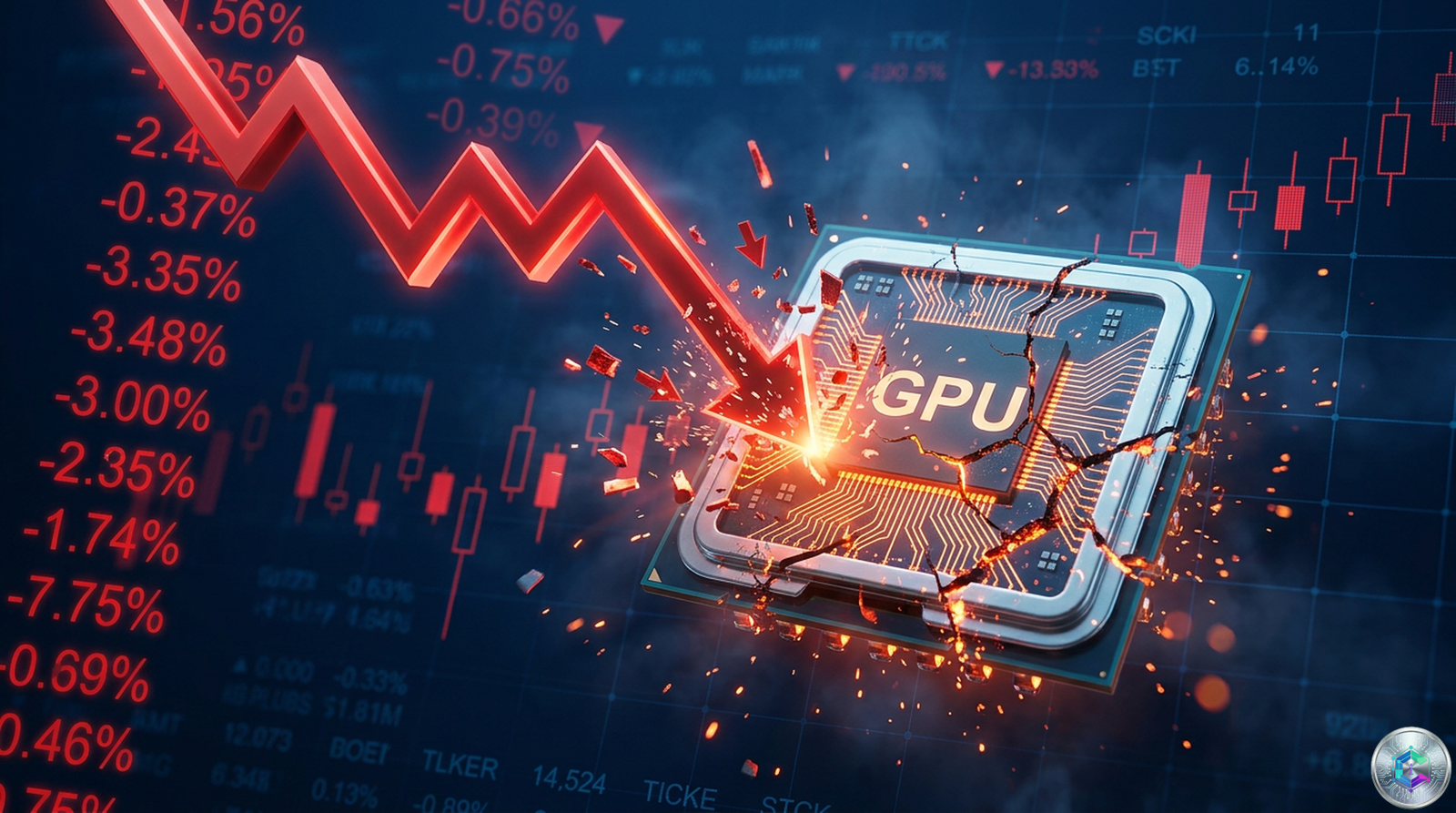
DeepSeek’s R1 reasoning model and its predecessor V3 triggered one of the sharpest sell-offs in Nvidia’s recent history. Beyond the market reaction, the central question is technical: can a frontier model be trained with fewer chips and far less money? The available data supports a nuanced answer that separates claimed performance, published costs and full development costs.
🔑 Key takeaways
- DeepSeek claims performance close to OpenAI o1 at a far lower cost of use.
- The $5.576 million figure only covers the final pre-training of V3, excluding earlier research and ablation experiments.
- US export restrictions pushed Chinese teams to optimise less powerful chips.
- Nvidia lost $589 billion in market value on January 27, 2025, before a partial rebound of about 9% the next day.
A model built under constraint
On January 20, 2025, DeepSeek released R1, an open-source reasoning model. Its predecessor V3 had already been described in a technical report published in December 2024. According to Peter Cohan of Forbes, US restrictions on China’s access to Nvidia’s most advanced AI chips paradoxically helped DeepSeek, while American rivals had access to the manufacturer’s latest processors. His summary: “Scarcity breeds innovation.” The models challenge the assumption that cutting-edge AI always requires more powerful and expensive GPUs (graphics processing units).
The Wall Street Journal, cited by Forbes, describes R1 as a close rival to OpenAI’s o1, built faster, with fewer and less powerful chips, and by skipping steps considered essential in the United States. DeepSeek’s technology nonetheless remains behind those of OpenAI and Google. On January 25, Chatbot Arena, a platform hosted by researchers at the University of California, Berkeley, ranked V3 and R1 among the top ten models for chatbot performance. Stanford adds that V3 sits at the level of GPT-4o and R1 at that of o1.
Performance and pricing: putting the numbers in context
The figures published around R1 are numerous, but they do not all come from the same methodology. The table below groups them by source.
| Indicator | Reported value | Source |
|---|---|---|
| Benchmark quality | Matches OpenAI o1 | Stanford |
| Speed | Nearly twice as fast | Stanford |
| Cost of use | 90% cheaper, or 3 to 5% of the o1 price | Stanford; Forbes via VentureBeat |
| API pricing | $0.14 per million tokens | Newsweek |
| OpenAI subscriptions | $20 to $200 per month | Newsweek |
The discrepancy is notable: Stanford points to a 90% reduction, while Forbes, via VentureBeat, cites 3 to 5% of the o1 price. The sources provide neither a common method nor an explanation that reconciles the two percentages. Stanford also notes that o1 Pro gives better answers, even though R1 matches o1 on benchmark tests.
Adoption followed. R1 was the most downloaded trending model on HuggingFace, with 109,000 downloads according to VentureBeat. Its search feature was judged superior to those of OpenAI and Perplexity, with only Google Gemini Deep Research considered comparable. Marc Andreessen, a Silicon Valley venture capitalist, wrote on X on January 24:
“DeepSeek R1 is one of the most amazing and impressive breakthroughs I’ve ever seen.”
Marc Andreessen, venture capitalist, Silicon Valley
On the corporate side, price matters. Anthony Poo, co-founder of a Silicon Valley start-up that uses generative AI to forecast financial returns, told the Wall Street Journal:
“OpenAI’s model is the best in terms of performance, but we also don’t want to pay for capabilities we don’t need.”
Anthony Poo, co-founder of a Silicon Valley start-up
In September 2024, his company switched from Anthropic Claude to DeepSeek after tests showed similar performance for roughly a quarter of the cost. According to Forbes, such cost cuts can attract businesses, even though more than a trillion dollars could be invested in AI without a decisive chatbot application having emerged.
Training cost: $5.576 million, a partial figure
The V3 technical report details the computing effort: 2,048 Nvidia H800 GPUs and 2.788 million GPU hours were needed for pre-training, context extension and post-training of a 671-billion-parameter model. The announced cost of $5.576 million assumes a rate of $2 per GPU hour. Forbes, citing CNBC, places this training at about two months. For comparison, Dario Amodei, CEO of Anthropic, cited in 2024 a range of $100 million to $1 billion to train his company’s models.
What the figure leaves out
The Wall Street Journal contrasts DeepSeek’s cluster of more than 2,000 chips with the tens of thousands used for comparable models. The $5.576 million figure, however, excludes earlier research and ablation experiments (tests that remove components to measure their contribution). Gregory Allen of the Center for Strategic and International Studies considers the total cost “far higher,” because the published amount only covers the final successful training run. Anonymous experts cited by Reuters point to earlier stages using more chips, with an investment that could exceed $1 billion. A source at an AI company told Wired that roughly 50,000 Nvidia chips may have been used.
| Item | Published estimate |
|---|---|
| Final V3 training | $5.576 million, for 2.788 million GPU hours |
| GPU purchases, per Stanford | $80 million and $50 million (two estimates) |
| A100 chips bought in 2020 | 10,000 units |
| H800 fleet | 50,000 units, a slowed-down version of the H100 |
Stanford also indicates that DeepSeek probably had access to Chinese and foreign cloud services. Comparing the final usage cost with the hardware investments of large US companies is therefore not a direct comparison, since GPUs also serve inference. Stanford notes there is no solid evidence contesting DeepSeek’s figures, but that presenting its model unilaterally as “the most economical” understates the omitted costs. In short, the $5.576 million relates to the final training of V3 and does not prove the development cost of R1.
Restrictions, optimisation and the Jevons effect
DeepSeek began in 2023 as a side project of Liang Wenfeng, who ran the quantitative hedge fund High-Flyer, valued at $8 billion. The fund used AI to spot “patterns likely to affect stock prices,” and Liang was already accumulating thousands of Nvidia chips in 2021. DeepSeek recruited young graduates and PhD students from China’s leading universities, with a flat organisational structure, aiming at artificial general intelligence. Stanford considers it unlikely that DeepSeek’s success was planned by the state, unlike the expansion of Huawei.
US restrictions sit at the heart of the debate. According to Forbes, the ban on exporting H100s, then Nvidia’s most powerful chips, forced Chinese companies to optimise the H800. In a July 2024 interview with 36Kr, Liang said:
“We believe AI technology in China will not forever follow in the footsteps of its predecessors.”
Liang Wenfeng, founder of DeepSeek
He stressed the need to build in China an ecosystem comparable to the one that allowed Nvidia to dominate. The Financial Times reports that a founder of a rival company believes Liang’s team “already knew how to solve this problem.” According to Newsweek, DeepSeek had stockpiled 10,000 H100s before the US controls of October 2022, although it is unclear whether these chips were used to develop its models.
Technically, H800s transfer data at half the rate of H100s, or 600 gigabits per second, and generally cost less, according to Karl Havard, sales director at Nscale. To build R1, DeepSeek re-architected its training to make the most of this reduced speed, according to Zihan Wang, a former employee of the company and a computer science PhD student at Northwestern University. Sources diverge on the exact configuration: one mentions A100s, the V3 report mentions H800s, and Forbes mentions a possible stock of H100s.
This optimisation raises an economic question. The Jevons effect describes the case where “increased efficiency in the use of a resource often leads to higher total consumption.” Applied to AI, it suggests that cheaper inference could boost overall demand for computing, and therefore for chips, rather than reduce it.
Market and demand: an open question
On January 27, Nvidia fell 18%, losing $589 billion in market capitalisation in one of the largest declines in the history of the US technology market. The stock recovered about 9% the following day. Its market capitalisation still stood at $3.16 trillion on January 29, which exposed its valuation to a possible drop in demand for its most advanced chips.
| Indicator | Level as of January 29, 2025 |
|---|---|
| Market capitalisation | $3.16 trillion |
| Forward price-to-earnings ratio | 27.7x |
| Expected EPS (consensus) | $2.95, versus $1.30 the previous year |
Several players could revise their purchases. Meta planned in March 2024 to buy 350,000 H100s, at a unit price between $20,000 and $40,000. After DeepSeek’s announcement, Meta and Alphabet, which reportedly spent tens of billions on the latest Nvidia chips, could scale back purchases while they verify DeepSeek’s claims and the feasibility of cheaper methods. A JPMorgan note of January 26 considered it possible that DeepSeek spent more and used open models; its claims of $5.6 million and of exclusive use of older chips would therefore be imprecise.
Satya Nadella, CEO of Microsoft, called DeepSeek’s new model “absolutely impressive” at the World Economic Forum on January 22, adding: “We need to take the developments in China very seriously.” Donald Trump described DeepSeek as “a wake-up call for our industries” and “a very positive development,” because “instead of spending billions and billions, you’ll spend less.” He had just revoked executive order 14110 of October 30, 2023, before the White House announced the $500 billion Stargate AI infrastructure project with OpenAI, Oracle and SoftBank. As of the sources’ date, he had not addressed the persistent restrictions on advanced semiconductors and other equipment exported to China.
Nvidia replied on January 26: “We decline to comment.” Nvidia researcher Jim Fan recalled on X the pioneering chess programs “built from scratch, without first imitating human grandmasters.” According to Forbes, if new start-ups replicate DeepSeek’s strategy, demand for the most expensive Nvidia chips could decline and revenue growth could slow in the short term. No definitive conclusion was available, however, on the effect of DeepSeek on future demand.
Outlook and scenarios
The DeepSeek case alone does not show the end of demand for GPUs. It shows that the cost of high-performing AI depends heavily on computing methods and on chip access constraints, and that published figures must be read within their exact scope: final training run, cost of use, or total investment.
Three scenarios remain open. In the first, higher efficiency and mass adoption revive total computing demand, which would favour chip suppliers. In the second, major players reduce orders while they verify the methods, creating short-term pressure on revenue. In the third, new start-ups replicate DeepSeek’s strategy and durably weigh on demand for the most expensive chips. Tracking hyperscaler orders and technical publications will be decisive.
Sources
- Forbes, Peter Cohan (January 26, 2025)
- Stanford, Taking stock of the DeepSeek shock
- ClearanceJobs (January 29, 2025)
Cet article est publié à titre informatif et éducatif. Il ne constitue en aucun cas un conseil en investissement. Faites vos propres recherches (DYOR) avant toute décision.

