

Solana’s Alpenglow upgrade, which targets cutting transaction finality from around 12.8 seconds to roughly 150 milliseconds, is now live on the public devnet and testnet. Anza announced the milestone on September 25, 2026, one day after the separate testnet completed its own transition, marking a significant technical step for the ecosystem.
🔑 Key takeaways
- Alpenglow is live on both the public devnet and testnet since September 25, 2026
- Targeted finality: ~150 ms versus the current ~12.8 s under TowerBFT
- New Votor protocol: a single voting round if 80% of stake participates
- 20+20 resilience model: tolerates 20% adversarial stake plus 20% offline
- Mainnet timing still tentative: Solana roadmap targets October 2026
How Votor replaces TowerBFT
The current TowerBFT mechanism requires validators to vote on blocks across 32 consecutive slots (fixed block-production intervals) before reaching full finality, a process that takes roughly 12.8 seconds with a 400-millisecond slot time. Alpenglow introduces Votor, a new protocol that lets validators exchange votes directly and aggregate them into cryptographic certificates.
Under favorable conditions, Votor can finalize a block after a single round of voting. If the 80% stake threshold is not reached on the first round, the protocol falls back to a second round with a lower threshold. This architecture produces the 150-millisecond target, a figure derived from simulations rather than a guarantee for every block.
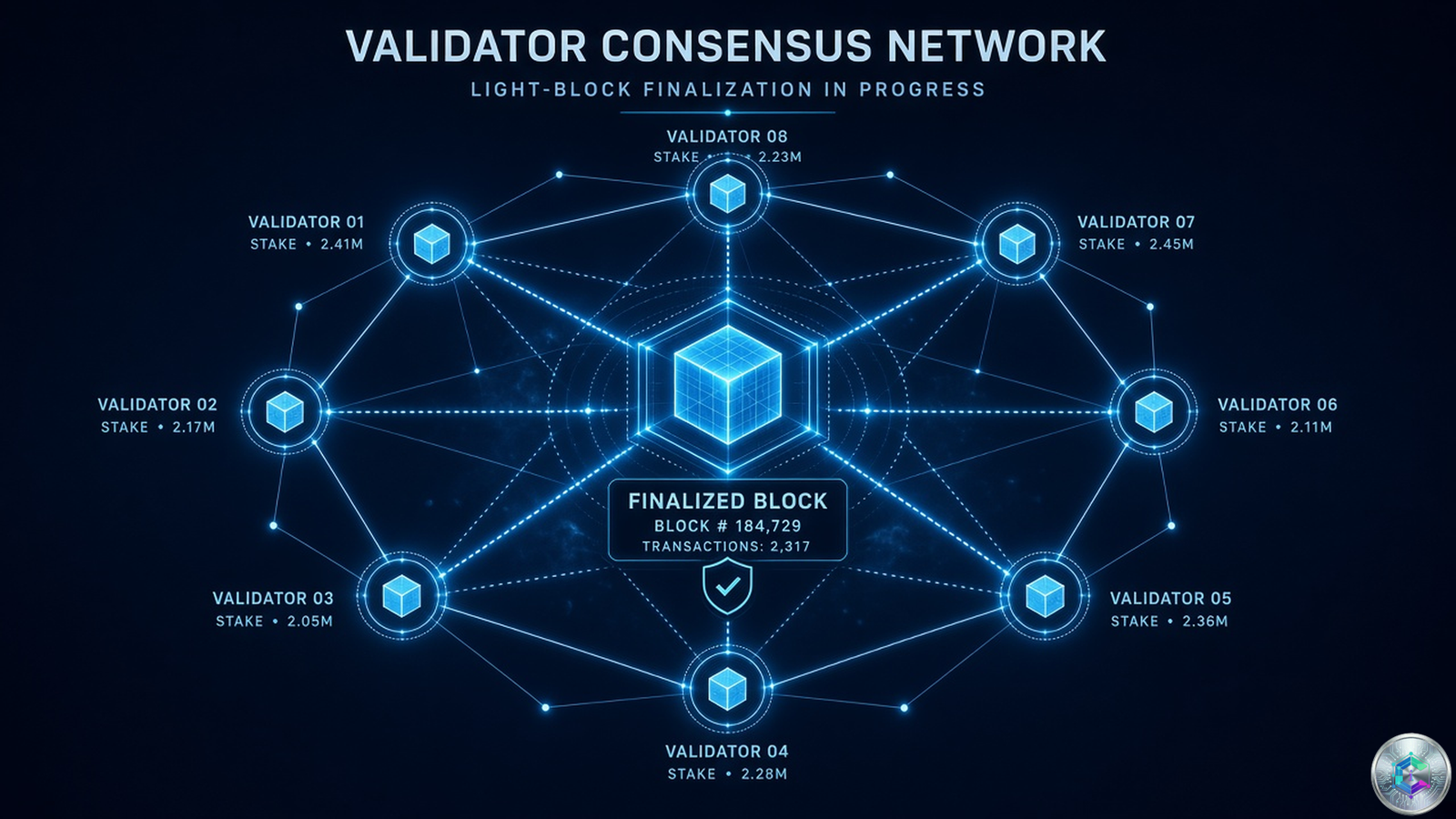
The « 20+20 » resilience model differs from traditional one-third Byzantine fault tolerance systems. It keeps the network functional even if up to 20% of stake is adversarial and another 20% is offline. Developers argue this trade-off enables much faster single-round finalization while preserving solid security guarantees.
Staged rollout and client status
Anza, the firm developing Solana’s core software, recommended Agave 4.3 to all mainnet validators on September 21, 2026. The release had first been deployed to operators representing 10%, then 25% of SOL securing the network. Anza’s software calendar tentatively lists September 28 for the resumption of feature activations on mainnet, though it is not confirmed as the Alpenglow launch.
Solana’s official roadmap targets Agave 4.3 and Alpenglow for October 2026, with no firm date. The current deployment covers Votor only; Rotor, the redesigned block distribution system meant to replace Turbine, is slated for a later phase.
Alternative validator clients Firedancer and Frankendancer, developed by Jump Crypto to strengthen client diversity, are not yet part of the initial Alpenglow test. The first migration will therefore run entirely on Agave, raising questions about client diversity at the very moment it is supposed to be a long-term reliability goal.
How it compares to other networks
A 150-millisecond finality would place Solana among the fastest general-purpose networks. For context:
| Blockchain | Indicative finality | Network type |
|---|---|---|
| Solana (Alpenglow) | ~150 ms (target) | General-purpose L1 |
| Sui | ~480 ms (benchmarks) | General-purpose L1 |
| Avalanche C-Chain | <1 s | Shared L1 |
| Avalanche dedicated L1 | <100 ms | Subnet |
| Ethereum | >12 s (slot) | General-purpose L1 |
Solana’s distinct edge is combining sub-second finality with one of the most established public smart-contract ecosystems, already hosting major DEXes, stablecoins, memecoins and payment applications.
Real-world ecosystem implications
Shorter finality primarily benefits systems that cannot rely on optimistic confirmation. A crypto exchange receiving a deposit can credit funds faster once it knows the transaction is final. Cross-chain bridges that must confirm an asset has been locked or burned on one network before releasing assets on another also benefit from the accelerated certainty. Institutional trading platforms handling tokenized securities, stablecoins or collateral share the same need for fast finality.
“Validator votes will no longer be recorded as transactions inside blocks, which will lower the reported total transaction count even though on-chain user activity stays unchanged.”
Solana Foundation, communication to data providers
Data providers and services building transaction histories must adapt their comparisons and keep rival candidate blocks separate until the network selects one, since mixing their contents would produce an incorrect record. Applications that simply submit transactions and read account balances do not require any migration.
Alpenglow does not directly raise execution speed or TPS (transactions per second). The Solana Virtual Machine, programs, transactions and fee system remain essentially unchanged. Only the way validators agree on the finality of a block is being modified. Wallet-side processing and exchange-specific deposit checks can still add waiting time beyond the theoretical 150 milliseconds.
Shorter slots as a complement
Solana is also cutting slot times from 400 ms to 200 ms through Agave 4.2 in a gradual rollout to monitor skipped blocks and network stability. Mainnet slot times have already drifted toward 250 ms, with 200 ms as the final target. The combination of shorter slots and dramatically faster finality makes the network feel more responsive overall, without changing its raw throughput capacity.
Conclusion
Alpenglow’s move to the second public testnet is a major technical milestone for Solana, but the mainnet activation timeline remains uncertain. Three scenarios are emerging: a successful launch as early as October 2026 per the roadmap, a delay if testing surfaces instabilities, or a phased migration that activates Votor before Rotor. In every case, client diversity remains a blind spot until Firedancer joins the test, and data providers will need to adapt their tooling before sub-second finality becomes a daily reality.
Sources
This article is for informational and educational purposes only. It does not constitute investment advice. Do your own research (DYOR) before making any decision.

