


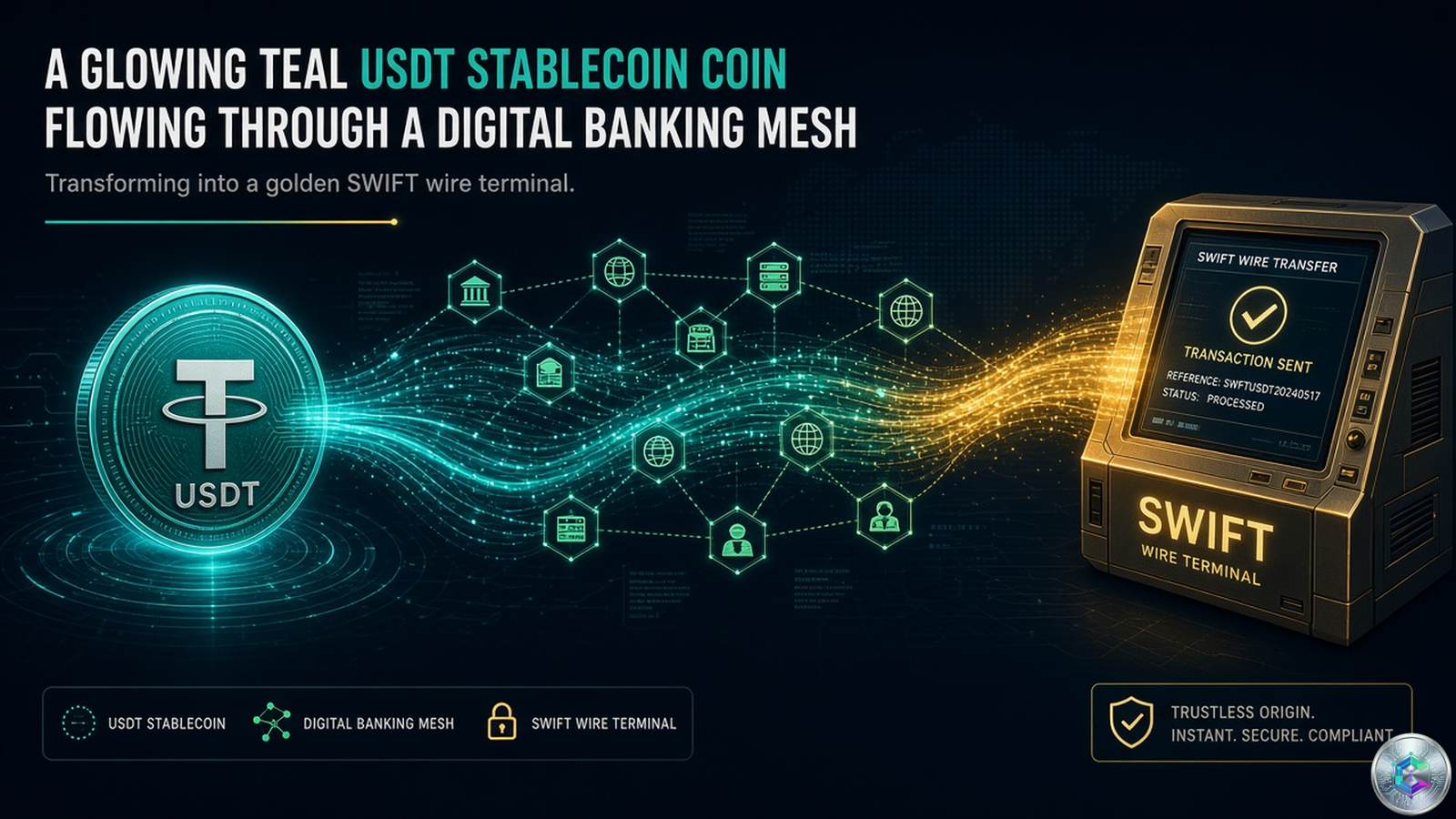
A7 International, the cross-border settlement platform backed by Russian bank PSB, launched on October 13, 2026 a new service allowing foreign invoices to be paid in USDT while the beneficiary receives the funds through a conventional SWIFT wire transfer in fiat currency, charged at a flat 0.3% fee.
🔑 Key takeaways
- Official launch: October 13, 2026 at 1:13 PM Moscow time
- Flat 0.3% commission for both corporates and individuals
- USDT on the TRON network converted into SWIFT wires in USD, EUR, CNY or AED
- 15,000 corporate clients, ~2,000 daily transactions, ~19% of Russian corporate FX settlements in 2025
- Context: FinCEN sanctions against the A7 network imposed on October 1, 2026
The A7 International service and how it works
The product unveiled on October 13, 2026 aims to function as a working bridge between digital assets and traditional banking rails. The sending client deposits USDT on the TRON network, and A7 then orchestrates a SWIFT wire in US dollars, euros, Chinese yuan or UAE dirhams to the foreign supplier’s account. Additional currencies are available upon prior arrangement with the commercial team, the company said.
The minimum stated execution time is one business day. Once the transaction is closed, the client receives a SWIFT message (MT103 or equivalent) confirming the payment, along with the customs and foreign-exchange documents required to book the entry on the company ledger.
Onboarding is mandatory through the a7.biz portal. Individuals complete a KYC (Know Your Customer) check, while corporates undergo KYB (Know Your Business) verification. After registration, the user uploads the invoice in PDF or image format. An integrated algorithm extracts the relevant fields — invoice number, amounts, IBAN coordinates — and pre-fills the payment request.
PSB Bank in the background: A7’s Russian ecosystem
A7 was founded in 2024 with the support of PSB Bank (Promsvyazbank), one of Russia’s main state-owned banks, historically exposed to the defense sector and already under international sanctions. The new service fits into PSB’s broader strategy of providing Russian exporters with a functioning payment channel despite Western restrictions.
In 2025, the platform processed over 10 trillion rubles in transactions and captured roughly 19% of Russian corporate foreign-exchange settlements, according to the official release. In October 2025, ACRA assigned the company a domestic credit rating of AA(RU) with a stable outlook, a high level on the Russian national scale that underscores the group’s financial solidity.
| Indicator | Value | Source |
|---|---|---|
| Corporate clients | ~15,000 | A7 / Chainwire |
| Daily transactions | ~2,000 | A7 |
| 2025 volume | 10+ trillion RUB | A7 |
| Share of Russian corporate FX settlements | ~19% | A7 |
| ACRA rating (Oct 2025) | AA(RU) / stable | ACRA |
| Countries served | 100+ | A7 |
AI-driven governance and routing
Payment orchestration sits on top of an algorithmic engine designed to profile the risk of each transaction. A7 CEO Ilan Shor detailed the mechanism in the press release:
“The system works as follows: artificial intelligence analyzes the sender and the beneficiary, the jurisdictions, and the key risk factors of the transaction. From the verification results, a payment risk profile is established and the available processing options are determined. The system compares compliance requirements with the capabilities of the existing payment infrastructure. It then recommends the optimal payment route, weighing cost, speed, reliability and applicable restrictions. Routing adapts dynamically to changing conditions and channel availability.”
Ilan Shor, CEO of A7
On the shareholder side, Petr Fradkov, chairman of the board at PSB Bank, added:
“We are presenting not just a new product in our lineup, but a new image of A7. We have adapted our service so it can be used remotely from anywhere in the world. That is precisely the key demand from market participants today. They want to transfer money across the globe in a few clicks, in the shortest possible timeframes — directly from their smartphone, without lengthy paperwork, without hidden fees or unjustified fund freezes. And we are turning that demand into a convenient, competitive product.”
Petr Fradkov, Chairman of the Board, Bank PSB
US sanctions and unanswered questions
The A7 International launch came just twelve days after a US Treasury action. On October 1, 2026, OFAC (the Office of Foreign Assets Control) designated the A7 network, adding the platform to its sanctions list. According to the Financial Crimes Enforcement Network (FinCEN), sub-agents operating on behalf of A7 processed more than $17 billion in transactions between January 2025 and June 2026.
Shortly after, FinCEN proposed a rule that would prohibit US-covered financial institutions from handling any funds involving identified sub-agents. The public consultation period remains open until November 4, 2026. The A7 International announcement does not directly address these sanctions, nor does it explain how its SWIFT-based settlements would function under such restrictions.
A7 has likewise not disclosed the identity of the corresponding banks tasked with executing the wires, nor the technical method used to convert USDT into fiat currency. The platform’s terms and conditions note that blockchain and processing fees may be added on top of the headline 0.3% commission, meaning the final cost of any payment can vary depending on configuration.
Conclusion: a real-world test for hybrid payments
With A7 International, the Russian platform is betting on the growing appetite of Russian exporters — and their counterparties — for dollar-pegged stablecoin settlements. The capture of 19% of Russian corporate FX flows in 2025 demonstrates a captive market, but the October 1, 2026 US sanctions create major uncertainty over the sustainability of the SWIFT leg itself.
The optimistic scenario hinges on A7’s ability to find correspondent banks outside OFAC’s reach and convince Western companies that transactions processed through its portal do not expose them to secondary-sanctions risk. The pessimistic scenario would see the SWIFT integration progressively erode as global banks cut links with PSB, pushing A7 to migrate toward fully stablecoin-based corridors.
Sources
- CryptoSlate – Meet A7 International
- PrimeXBT – Sanctioned Russian payment network A7 launches USDT-to-SWIFT service
- Markets Insider – A7 to unveil a service
- CryptoBriefing – A7 to unveil a service
- Kalkine Media – A7 to launch USDT-to-SWIFT payment service
- CoinStats – A7 to unveil a service
This article is published for informational and educational purposes. It does not constitute investment advice in any form. Do your own research (DYOR) before making any decision.

