


On September 7, 2026, Revolut completed the first secure payment fully initiated by an artificial intelligence agent in France, in partnership with Visa and merchant Cleverbridge. Conducted in real-world conditions, the test paves the way for a new era of online commerce where AI assistants could handle the entire purchase flow while preserving consumer consent.
🔑 Key Takeaways
- Revolut and Visa tested the first AI-driven payment in France on September 7, 2026
- Visa’s test AI agent initiated the transaction at merchant Cleverbridge
- Visa Payment Passkey (VPP) handled cardholder authentication
- 51% of the French population uses generative AI tools for purchase decisions
- Revolut launched EURR, a euro-pegged stablecoin, in late August 2026
A Transaction Fully Driven by AI
UK-based neobank Revolut announced on Monday, September 7, 2026, that it had completed the first secure payment initiated by an artificial intelligence in France. The operation was carried out in partnership with the Visa network as part of a real-world test conducted at merchant Cleverbridge.
The stated goal was to “better understand how this type of payment could work in real purchase situations, while ensuring customer consent, issuer controls and the maintenance of existing protections,” Revolut said in a statement.
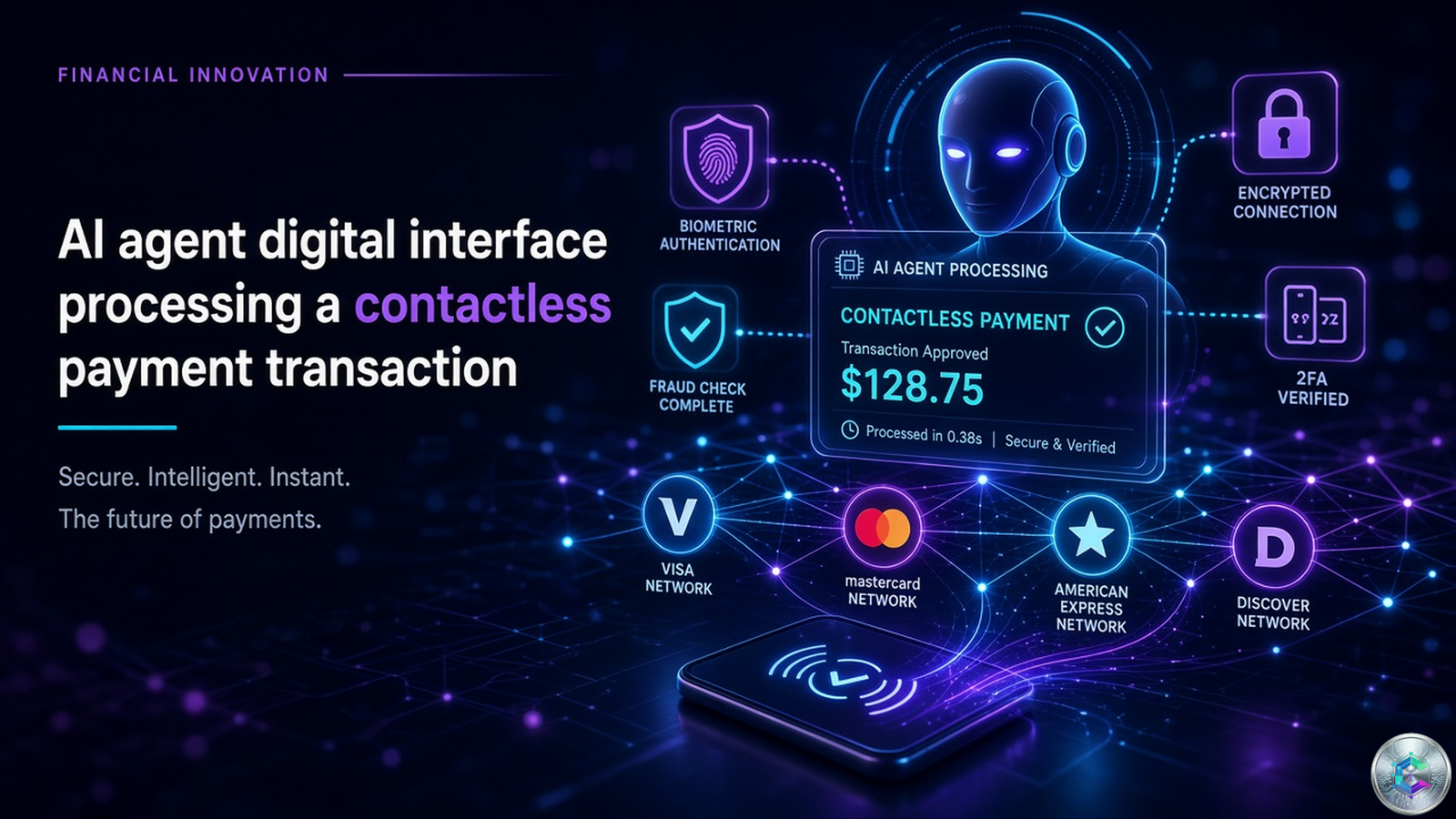
In practice, an AI agent acting with the customer’s explicit authorization handled the entire purchase journey, from product selection to final payment validation. During this exercise, Visa’s test agent initiated the transaction at Cleverbridge, while the Visa Payment Passkey (VPP) system handled cardholder authentication.
“This operation marks an important step toward the future of AI-powered commerce.”
Revolut, official statement
The test focused on everyday payment scenarios, aiming to “shape the future of payment” and make daily financial experiences “simpler, faster and more intuitive,” while keeping users “fully in control of their decisions,” the fintech added.
Visa Adapts Its Infrastructure to Autonomous Agents
To carry out this experiment, Visa clarified that the transaction was executed “using the existing payment infrastructure,” which includes card security, identity controls and real-time fraud monitoring.
The AI agent therefore does not replace existing banking security measures but plugs into them as an intermediary between consumer and merchant. Earlier in the year, the payments giant had rolled out a dedicated interface for AI agents to facilitate the initiation and authentication of autonomous transactions.
This approach allows Visa to demonstrate that its existing infrastructure can accommodate these new forms of payment without compromising security. It also reinforces the network’s strategy of positioning its interface as a standard for AI-driven transactions as intelligent assistants become a new point of contact in the purchase journey.
The Visa-Mastercard Duel Over AI Agents
This test is not a world first, but it is part of a fierce European competition between the two major card networks. Spanish bank Santander had already completed in March 2026, in partnership with Mastercard, the first end-to-end payment in Europe executed by an artificial intelligence agent.
| Criterion | Revolut + Visa | Santander + Mastercard |
|---|---|---|
| Date | September 7, 2026 | March 2026 |
| Country | France | Spain |
| Network | Visa | Mastercard |
| Merchant | Cleverbridge | Not disclosed |
| First of its kind | In France | In Europe |
This dual initiative positions the Visa-Mastercard duel on the terrain of autonomous agents, with each player seeking to impose its interface as the de facto standard for AI-driven transactions. The race to become the reference authentication layer for conversational agents is now open.
A French Context Ripe for Generative AI
The experiment takes place against a backdrop of rapidly growing use of generative AI tools by French consumers. According to the 2026 Digital Barometer cited by Revolut, 51% of the French population uses generative AI tools to search, compare or decide on a purchase.
This figure illustrates the growing demand for AI-assisted shopping solutions, a phenomenon payment players are racing to integrate into their offerings. Conversational assistants are becoming a new commercial touchpoint, sitting between the traditional search engine and the merchant site, and forcing card networks to redefine their authentication protocols.
Revolut, a Fintech in Full Expansion
For Revolut, this operation adds to a series of recent developments that confirm the fintech’s ambition to compete with traditional banks on all fronts. Founded in 2015, the company reached a valuation of $115 billion (approximately €100 billion) following a secondary share sale in July 2026.
It also obtained a banking license in France in early August 2026, as well as conditional approval in the United States in early September. In addition, Revolut launched in late August its first euro-pegged stablecoin, EURR, expanding its offering into the digital asset ecosystem and demonstrating its willingness to operate at the crossroads of traditional payments and decentralized finance.
Conclusion: Toward Fully Autonomous Commerce
Although this first transaction remains an experiment and is not yet available to the general public, it offers a concrete glimpse of the possible evolution of online shopping. As banks and card networks refine their protocols to accommodate autonomous agents, the scenario of an AI assistant making purchases on behalf of a user could become widespread, provided consumer consent and control are preserved.
The coming months will be decisive: it remains to be seen whether Mastercard responds with new European partners, how regulators will frame these transactional agents, and whether consumers will accept delegating part of their purchasing decisions to a machine. The race is on, and the Visa-Mastercard duel could well reshape the payment experience as we know it.
Sources
This article is published for informational and educational purposes only. It does not constitute investment advice. Do your own research (DYOR) before making any decision.

