


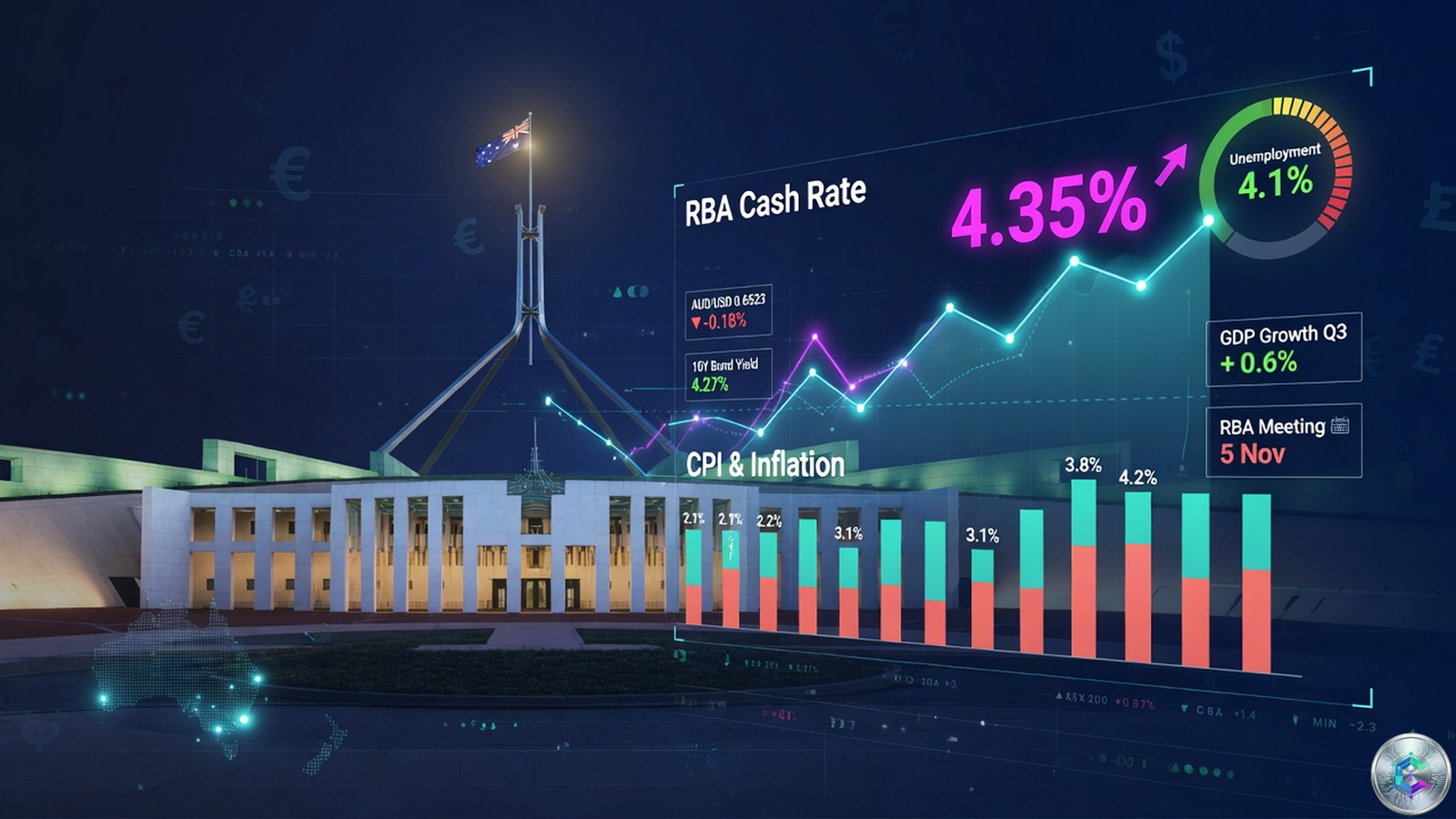
The Reserve Bank of Australia has chosen caution by maintaining its cash rate at 4.35% during its June and August 2026 meetings. This wait-and-see approach comes as inflation remains above the 2-3% target while signs of economic slowdown begin to emerge.
🔑 Key Takeaways
- Cash rate held at 4.35% in June and August 2026, following three consecutive hikes earlier in 2026
- Annual inflation at 4.2% in April 2026, still above the 2-3% target
- Quarterly GDP growth at +0.3%, slowing from +0.9% in Q4 2025
- Governor Bullock does not rule out further hikes if inflation fails to decline
- Economists expect rate cuts in 2027
A Unanimous Decision Amid Uncertainty
On June 16, 2026, the Reserve Bank of Australia announced the hold on its cash rate at 4.35%. This decision, made unanimously by the board, aligned with economist expectations surveyed by Reuters. The central bank justified its stance by stating that inflation remained “still too high” while acknowledging that financial conditions had tightened and signs of economic slowdown were beginning to appear.
Michele Bullock, Governor of the RBA, highlighted during her subsequent press conference that the board had not even considered a rate hike at this meeting. However, she warned that further increases were not off the table: “If we need to raise again, we will,” she stated. The Governor added that Australia’s inflation problem would not be resolved even if oil supplies normalized and a peace deal between the United States and Iran came to fruition.
“That will help, I think, in terms of making sure inflation is not surreal, but we still need to make sure that this inflation problem we had before the conflict is dealt with.”
Michele Bullock, RBA Governor
Economic Indicators: Slowdown Confirmed
The Australian economy showed signs of weakness at the time of this decision. The country’s gross domestic product grew by 2.5% in the first quarter of 2026 year-on-year, missing expectations and maintaining the same pace as the previous quarter. On a quarterly basis, GDP growth stood at +0.3%, versus the 0.5% forecast in a Reuters poll, marking a slowdown from the 0.9% growth recorded in the fourth quarter of 2025.
| Indicator | Value | Expectation/Context |
|---|---|---|
| Q1 2026 GDP (YoY) | +2.5% | Stable vs Q4 2025 |
| Q1 2026 GDP (QoQ) | +0.3% | vs +0.5% expected |
| Unemployment Rate | 4.5% | Increasing |
| April 2026 Inflation | 4.2% | Above 2-3% target |
The unemployment rate rose to 4.5%, although Michele Bullock estimated that the labor market remained “slightly tight” and the central bank did not expect an economic contraction. “We do not want to push the economy into recession, we want to slow it down enough to bring the inflation rate down,” she explained.
“We do not want to push the economy into recession, we want to slow it down enough to bring the inflation rate down.”
Michele Bullock, RBA Governor
Impact on Households and the Property Market
On the economic front, businesses have begun signaling to the RBA that they were hesitant to raise prices, amid a slowdown in household spending. Consumers reduced their non-essential purchases in the first quarter of 2026 while drawing down savings to cover essential expenses like electricity and fuel.
| Scenario | Amount |
|---|---|
| Average mortgage | 745,000 AUD |
| Typical rate | 6% |
| Monthly payment before 2026 hikes | 4,114 AUD |
| Monthly payment after hikes | 4,467 AUD |
| Monthly increase | +353 AUD |
For an owner-occupier with an average new mortgage of 745,000 Australian dollars at the typical rate of 6%, the rate hikes over the year pushed monthly payments from 4,114 to 4,467 Australian dollars, an increase of 353 AUD per month. Treasurer Jim Chalmers welcomed the rate hold decision, telling reporters: “It does not make people’s lives easier, but it does not make it harder either.”
Market Reactions and Expectations
Market reactions to the June decision were mixed. The S&P/ASX 200 index ended marginally higher, rising from 8,890 to 8,914 points. The Australian dollar weakened, falling from 70.54 to 70.49 US cents, a decline of 0.3%. The foreign exchange and equity markets began pricing in a reduced probability of further rate hikes.
“A further rate hike later in 2026 is therefore firmly on the table. The RBA has little choice but to wait and see how much further the economy slows and when oil supplies return to normal.”
Stephen Smith, Deloitte Access Economics
Commonwealth Bank and ANZ maintained their forecasts that interest rates had peaked and would be lowered in 2027. Belinda Allen, economist at Commonwealth Bank, estimated that the RBA offered a “balanced” outlook on the slowing economy. At ANZ, Adam Boyton, head of Australian economics, estimated that the risk of a rate hike in August was not negligible, but that rate cuts were the most likely outcome.
Conclusion: Between Hawks and Doves
The next RBA Monetary Policy Board meeting was scheduled for August 10-11, 2026, when new economic projections and inflation developments would be reviewed. The central bank stated in its June communiqué that “the resolution of the Middle East conflict is at an early stage, and there are plausible scenarios where inflation is higher and activity lower than projected in the May central projection.”
The institution also warned: “A prolonged period of uncertainty could also result in weaker growth among Australia’s major trading partners and in Australia itself.” Governor Bullock acknowledged the existence of divergences among economists. Bond market expectations indicated a probability of approximately 55% of a further rate hike by December 2026, illustrating the uncertainty surrounding the future trajectory of Australian monetary policy.
Sources
- Reuters – Australia’s central bank keeps interest rates at 4.35%
- CNBC – Australia central bank holds rates as CPI
- The Guardian – RBA interest rate announcement
- ABC News – Reserve Bank keep rates on hold June 2026
- Bloomberg – RBA set for hawkish hold
This article is published for informational and educational purposes. It does not constitute investment advice in any way. Conduct your own research (DYOR) before making any decisions.

