


Former French finance minister Bruno Le Maire proposes funding a €150 to €250 monthly rise in net pay through a three-point VAT increase and a new tax on artificial intelligence. Speaking on BFM TV, he framed the plan as a way to narrow the gap between gross and net wages. The base, rate and expected yield of the AI tax have not been specified.
🔑 Key takeaways
- A three-point VAT increase, presented as raising about €40 billion.
- An AI tax whose base, rate and targeted companies remain undefined.
- A net pay gain of €150 to €250 per month, a range some outlets narrow to €150 to €200.
- Opposition from the National Rally, which challenges both the fairness and the arithmetic of the plan.
- A backdrop of €3.5 trillion in public debt and a 2026 deficit target of 5.0% of GDP that may be missed.
A VAT increase at the core of the proposal
The main lever is a three-point increase in VAT, which Le Maire estimates would bring in roughly €40 billion in additional revenue. He based this on a value of €13 billion per point, which gives about €39 billion, rounded to €40 billion. He defended the choice by contrasting a model built on production and labour with one resting exclusively on consumption. He also referred to keeping a reduced VAT rate on essential goods.
“a model based on production and work and no longer a economic model based exclusively on consumption”
Bruno Le Maire, former Minister of the Economy and Finance
| Item | Announced amount or effect | Status |
|---|---|---|
| Three-point VAT increase | about €40 billion | Proposal announced |
| Value of one VAT point | about €13 billion | Estimate given by the politician |
| Net pay gain | €150 to €250 per month | Disputed (€150 to €200 per Capital) |
| AI tax | not quantified | Base and rate undefined |
The projected net pay gain varies across sources. Cryptoast reports €150 to €250, while Capital and its Threads post cite €150 to €200, the same figure Le Maire used in his interview with lawmaker Jean-Philippe Tanguy. A €50 monthly gap materially changes any estimate of the real effect on purchasing power.
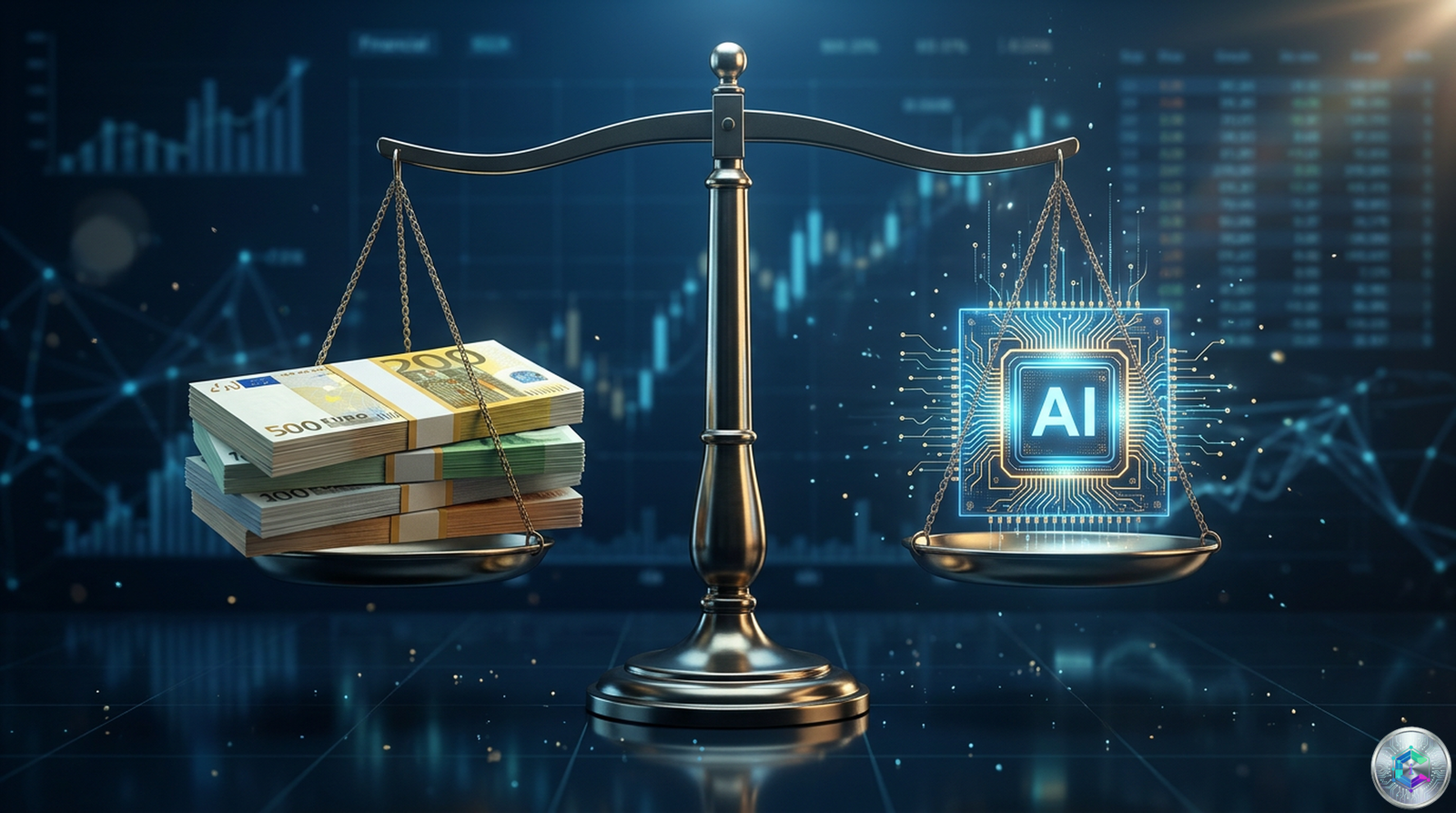
An AI tax without legal parameters
The second component mainly targets large US artificial intelligence companies. Le Maire draws a parallel with the digital services tax he introduced in 2019, set at 3% of French revenue for Google, Amazon, Meta and Apple. In his view, such a levy makes affected firms contribute to fiscal fairness and generates revenue for the state.
The mechanism would resemble that tax in several respects, applying to the value of activity generated in France by companies that capture a large share of AI profits. However, no rate, tax base or revenue estimate has been communicated so far.
Open questions
- Base: revenue, value added or activity generated locally?
- Rate: no level has been announced, unlike the 3% of the digital services tax.
- Scope: the companies concerned have not been identified.
- Yield: no estimate of expected proceeds has been published.
Such a measure would expose France to a possible trade dispute with the United States. The timing also coincided with a major sector event: Anthropic, maker of the Claude assistant, publicly filed its IPO prospectus. According to Cryptoast, the company was due to list on the Nasdaq weeks later and become the world’s seventh most valuable company. The sources reviewed report no measurable share price reaction, no change in valuation and no official response from the companies involved.
A budget debate under heavy constraints
The proposal forms part of a broader programme outlined by Le Maire, including a manifesto titled “Manifesto for a different France” published on 25 August. According to BFM Business and Yahoo Finance, public debt stands at €3.5 trillion, and the goal of cutting the public deficit to 5.0% of GDP in 2026 may not be met. He aims eventually to return to a 3% deficit.
In a BFM TV interview on 26 August, he sketched the following measures:
- keep the corporate income tax surcharge for large companies and the high-income contribution;
- raise the social VAT from two to three points;
- keep the tax on the Gafam technology giants;
- raise the tax on imported and polluting products;
- de-index the income tax scale.
“The real underlying issue is that our social model will no longer be financed by work.”
Bruno Le Maire, BFM TV, 26 August
He also proposes strengthening the powers of the finance ministry in budget arbitrations, including a veto over public finance matters and limits on parliamentary amendments that would raise spending.
National Rally lawmaker Jean-Philippe Tanguy disputes the approach. In his view, employees, retirees and families, who would benefit from higher net pay, would also pay three extra VAT points on consumption, including fuel, gas, heating oil, electricity and food. He argues the plan “will not hold up” because it raises VAT on diesel, which he does not consider an essential product. He instead backs a VAT cut proposed by Marine Le Pen.
“Politically, it is possible, but accounting-wise, there is a problem.”
Jean-Philippe Tanguy, National Rally lawmaker
Reactions, industrial context and regulation
Comments under the Cryptoast article show significant opposition. Several readers denounce “one tax too many”, argue that France should invest heavily in AI, and fear that taxed firms will pass costs on to subscribers. These remarks are reader comments, not an established market reaction.
Le Maire describes AI as the most important industrial revolution in history, citing factories, manufacturing and semiconductors. He says he works with ASML, the Dutch chipmaker, where he has been an adviser since 2025. He argues that the United States is “taking everything” and calls on Europe to “keep profits for ourselves”.
The Revue des Deux Mondes reports that, at the time of its article, global AI regulation remained absent amid competition between the United States and China and a weakening of multilateral institutions. It quotes Jacob Coxon, a British researcher who left Anthropic after working at OpenAI: “Neither company is acting responsibly.”
Outlook and scenarios
The proposal combines two instruments whose effects depend on parameters that remain unknown. In a first scenario, the VAT increase is adopted without an AI tax, limiting trade friction but raising the question of how the burden falls on households. In a second, the AI tax is defined on the model of the digital services tax, with a set rate and base, which would likely open a dispute with Washington. In a third, the plan remains an orientation, lacking budgetary and European agreement.
For financial observers, the reading stays cautious: no legal parameters are fixed, no yield estimate has been published and the sources report no share price reaction. Monitoring will focus on budget legislation and the government’s position. Le Maire has said he will not run in the 2027 presidential election, so his proposals are, for now, the contribution of a former minister to public debate.
Sources
- Cryptoast, article on the AI tax and net pay proposal
- Capital, Threads post
- Yahoo Finance France
- Capital, article on VAT and net salaries
- BFM TV, Bruno Le Maire interview
- Revue des Deux Mondes, Bruno Patino on AI
Cet article est publié à titre informatif et éducatif. Il ne constitue en aucun cas un conseil en investissement. Faites vos propres recherches (DYOR) avant toute décision.

