


The European Central Bank (ECB) is preparing to integrate its reserves into tokenized financial markets. The institution wants to make the euro a native, programmable asset on distributed ledgers, without relying on private or foreign infrastructures, and has already moved into the production phase.
🔑 Key Takeaways
- Isabel Schnabel outlined three architectures to anchor ECB reserves on blockchain
- Project Pontes, launched September 21, links DLT (distributed ledger technology) platforms to TARGET services
- Dollar-pegged stablecoins exceed $300 billion versus less than €1 billion for euro stablecoins
- The Council and Parliament have set their positions on the digital euro; trilogue negotiations are underway
- A twelve-month pilot is planned for H2 2027, targeting technical readiness for a potential 2029 issuance
Schnabel defends central bank money against stablecoins
Speaking in London and at the Jackson Hole Economic Policy Symposium on August 28, ECB Executive Board member Isabel Schnabel argued for placing central bank reserves directly on distributed ledgers. In her view, tokenized finance needs a settlement asset that is both perfectly safe and able to absorb sudden surges in liquidity demand — a role only central bank money can fulfil.
Schnabel acknowledges the contribution of stablecoins to digital payments but rejects their claim to act as the ultimate settlement asset. Her reasoning aligns with economist Darrell Duffie, whose Jackson Hole paper stressed that a private stablecoin issuer lacks the sovereign capacity to create liquidity in a panic.
“Stablecoins must be understood first and foremost as complements to central bank money, not substitutes.”
Isabel Schnabel, ECB Executive Board Member
Piero Cipollone, another Executive Board member, had warned as early as March about the risks of dependency on foreign infrastructures. Against this backdrop, the ECB is now structuring its response around concrete projects.
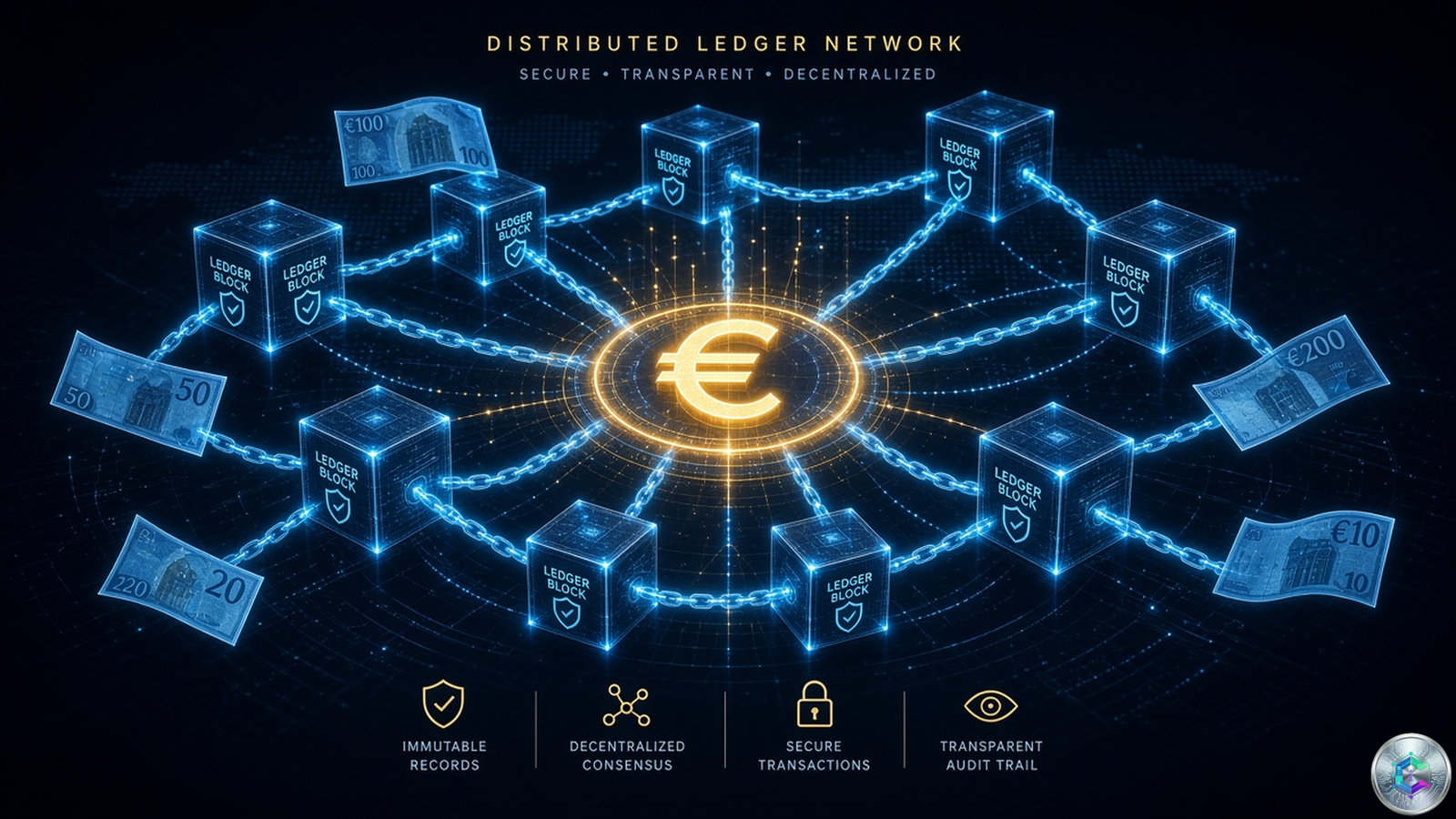
Three architectural paths under study
The ECB distinguishes three main options for placing reserves on the blockchain. Whichever architecture is chosen, the institution wants to preserve the two-tier monetary system, in which the central bank provides the reference money to lenders, who then extend deposits and credit to their customers.
| Option | Description | Implication |
|---|---|---|
| 1. Direct issuance | The ECB issues tokenized reserves on a programmable ledger | Maximum integration, deeper technical commitments |
| 2. Gateway (Pontes) | Reserves stay in TARGET2, linked to DLT platforms | Compatibility with existing systems, legal finality preserved |
| 3. Delegated issuance | A private intermediary deposits 100% of reserves and issues tokens against them | Stablecoin-like model, but fully backed by the ECB |
Option 2, embodied by Pontes, has been favoured for now: it limits operational risk while opening tokenized markets to central bank money.
Pontes and Appia move into the operational phase
Launched on September 21, Pontes settles transactions on tokenized assets in central bank money, linking DLT platforms to the Eurosystem’s TARGET services. At this stage, the legal finality of the cash leg remains anchored in TARGET2. Christine Lagarde described the project as a step toward a “more integrated, innovative and resilient European financial market”. Pontes will subsequently integrate smart contracts and operate on a 24/7 basis.
In parallel, project Appia is designing the architecture of a future tokenized European financial market: cross-network interoperability, monetary policy, collateral management and cross-border transactions. The ECB plans to publish a blueprint for this ecosystem in 2028, choosing between a single shared European ledger and several interoperable systems.
“If Europe does not build its own digital roads, it risks depending exclusively on those built by others.”
Piero Cipollone, ECB Executive Board Member
These developments draw on the Eurosystem’s 2024 experiments.
| Metric | Eurosystem 2024 Experiment |
|---|---|
| Total amount | €1.6 billion |
| Participants | 64 |
| Jurisdictions covered | 9 |
| Use cases | 58 |
| Duration | 6 months |
The digital euro, a parallel legal track
Distinct from Pontes and Appia (which target wholesale finance), the digital euro project is advancing on the legislative front. The Council of the EU set its negotiating position on December 19, 2025, followed by the European Parliament on July 9, 2026. Trilogue negotiations have begun. As of September 10, 2026, Christine Lagarde indicated that several technical issues remained under discussion, including the level of the holding cap (tested up to €3,000) and the remuneration model.
A twelve-month pilot is scheduled for H2 2027, with 36 payment service providers already selected, including both banks and non-bank actors. On September 15, 2026, the ECB launched a call for online and mobile merchants to join the pilot (applications open until October 27). The goal: be technically ready for a potential first issuance in 2029.
The ECB estimates the investments required from the banking industry at between €4 and €5.8 billion in total (between €1 and €1.44 billion per year over four years). The European Banking Federation considers the holding cap and the reuse of existing payment infrastructure decisive in limiting the project’s impact.
Toward a programmable European money
With more than $300 billion in dollar-pegged stablecoins in circulation versus less than €1 billion for their euro-denominated counterparts, the imbalance is striking. By bringing its reserves onto distributed ledgers, the ECB aims to take control of the euro’s distribution infrastructure in tokenized finance.
If the legislation is adopted by end-2026, the ECB says it wants to be ready for a possible 2029 issuance. The actual issuance decision, however, remains contingent on the formal adoption of the legal framework by the Governing Council.
Sources
- Cryptoast – ECB: three scenarios for central bank money on blockchain
- CoinShares – The dollar went on-chain, the euro went to committee
- Yellow.com – ECB wants euro reserves on blockchain
- Toute l’Europe – Digital euro FAQ
- Banque de France – Eurosystem introduces central bank money on distributed ledger
- Les Échos – ECB to connect the euro to financial markets on blockchain
This article is for informational and educational purposes only. It does not constitute investment advice. Do your own research (DYOR) before making any decision.

