


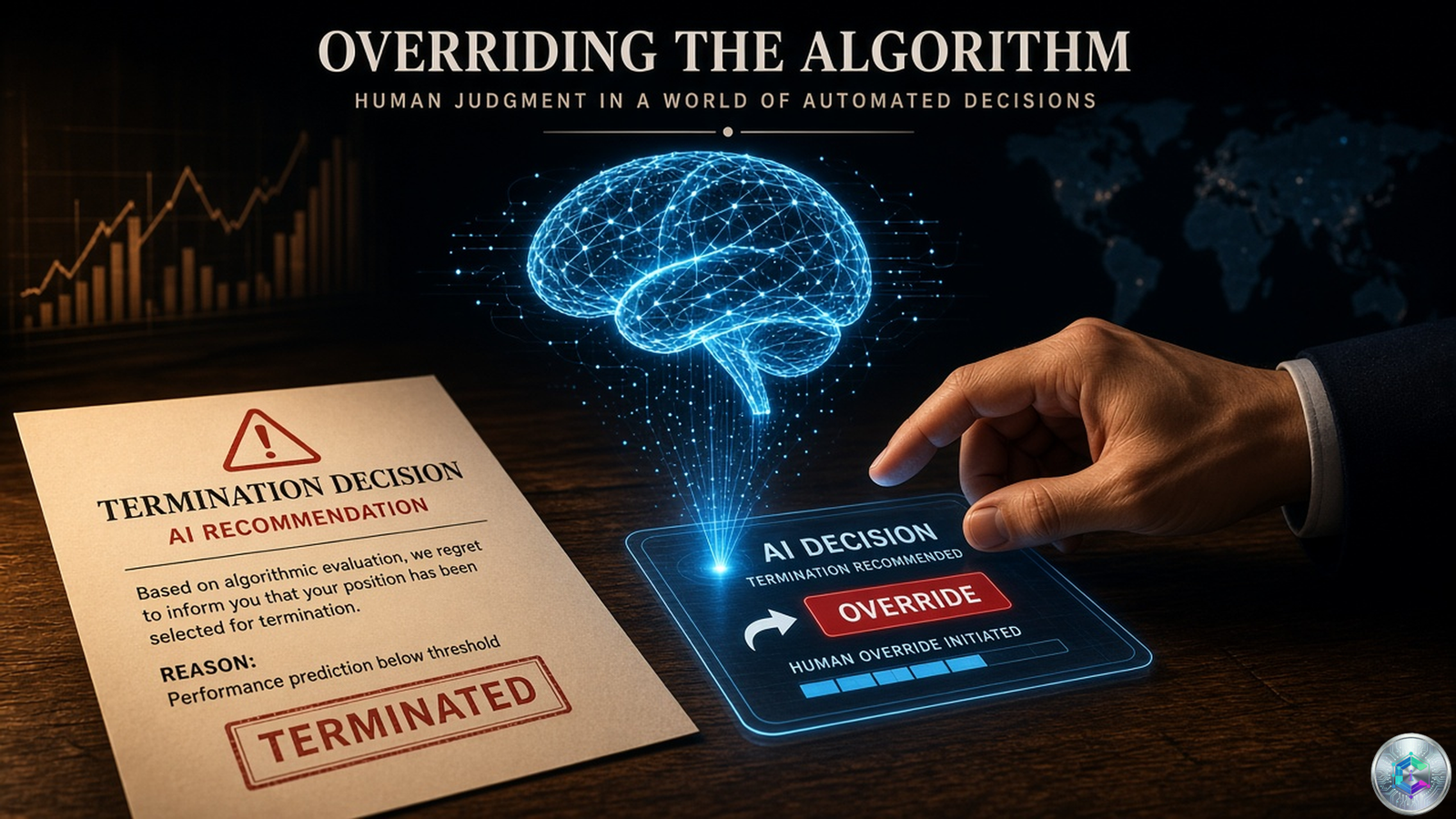
California Governor Gavin Newsom signed SB 947 on December 30, 2026, known as the \”No Robo Bosses Act,\” prohibiting employers from making termination or disciplinary decisions based solely on automated decision systems (ADS) powered by artificial intelligence. The law makes California the first state to formally regulate AI use in employment decisions, amid rising public concern over automated workforce management.
🔑 Key Takeaways
- SB 947, the No Robo Bosses Act, signed December 30, 2026, effective January 1, 2027
- Bans employers from relying exclusively on automated decision systems to fire or discipline workers
- Requires human reviewer corroboration and detailed written notice when ADS drives the decision
- $500 civil fine per violation, with punitive damages and attorney fee reimbursement available
- Also bans surveillance tools in workplace restrooms and full AI delegation of core legal work
A Landmark Law to Regulate AI in the Workplace
SB 947, nicknamed the \”No Robo Bosses Act,\” was signed by Governor Gavin Newsom on December 30, 2026. The law prohibits companies from making termination, disciplinary, or declassification decisions based exclusively on automated decision systems (ADS). It takes effect on January 1, 2027, and represents California’s response to the absence of federal regulation on this issue.
In an official statement, Newsom declared that \”AI should expand opportunity — not come at the expense of workers and families,\” adding that recent statements from the Trump administration claiming the AI industry could self-regulate were \”bulls*it.\” He emphasized the need to act in the absence of federal leadership.
Obligations Imposed on Employers
The law imposes several specific obligations on California employers.
- Prohibition on using an ADS alone to decide on termination, disciplinary action, or declassification
- Full transparency requirement when a mass layoff plan, relocation, or termination is caused by an AI system
- Prohibition on surveillance tools in workplace restrooms
- Prohibition on attorneys \”fully handing over core legal work,\” such as drafting briefs, to AI
Mandatory Human Review
When an employer relies \”primarily\” on an ADS for a termination or disciplinary decision, the law requires a human reviewer to corroborate the decision using supplementary information such as management assessments, peer reviews, and personnel records.
Furthermore, the affected employee must receive a separate written notice in the company’s usual language of communication, including:
- Identification of the ADS vendor and product name
- Description of the employee data used and the ADS result
- A human contact capable of explaining the decision
Sanctions and Enforcement Mechanisms
Sanctions are clear: a $500 civil fine per violation, enforceable by the California labor commissioner, through private civil actions brought by employees or their union representatives, and by public prosecutors. In disputes, employees can seek punitive damages and attorney fee reimbursement.
A Winding Legislative Journey
This text is the result of a complex legislative process. On October 2, 2025, Governor Newsom had vetoed bill SB 7, the precursor to SB 947, over concerns about the bill’s scope and potential overlap with existing employment and discrimination laws.
Following that setback, Senator Jerry McNerney reintroduced the bill in February 2026, after removing the notice period requirement and the provision extending protections to gig platform workers. On September 29, 2026, the California Senate passed SB 947 by a vote of 29 to 9; the Assembly subsequently approved it by a wide margin before Newsom signed it on December 30, 2026. The law takes effect on January 1, 2027.
Warning Signs That Prompted the Law
The development of this regulation was motivated by several significant warning signals.
- Employees of Meta reported that the company used biased AI tools that \”disproportionately selected\” workers on medical or family leave as candidates for layoffs
- According to HR Dive, 25% of executives report using AI to make job cut decisions \”often or all the time\”
- An OECD survey published in late 2025 revealed that 90% of American executives said their company had adopted at least one AI tool to train, monitor, or evaluate workers — a rate significantly higher than other developed countries
- A Gallup poll published in July 2026 shows 39% of Americans believe AI does more harm than good, up from 31% in 2025, an eight-point increase
- A Pew Research Center study published in August 2026 found that 71% of respondents think AI \”will take people’s jobs,\” up about seven points from two years ago
The Meta Lawsuit and Walmart/Amazon Concerns
Meta is currently the subject of a lawsuit filed in July 2026, in which former employees allege that AI-assisted systems were used to classify and select employees for layoffs, disproportionately affecting those who had taken medical or family leave. Meta disputes these allegations. In May 2026, a survey by nonprofit United for Respect showed that Walmart and Amazon employees were increasingly worried about the automation of human resources decisions, an attempt to convince Walmart shareholders to disclose AI practices that ultimately failed.
Political, Union, and Industry Reactions
Reactions to the law range from enthusiastic union support to technology industry criticism.
\”No worker should ever be fired or disciplined by a machine, AI or not. Artificial intelligence systems have the potential to boost productivity, but they’ve also made errors and misjudgments and exhibited bias. AI must remain a tool controlled by humans, not the other way around.\”
Jerry McNerney, California Senator, bill author
Lorena Gonzalez, President of the California Federation of Labor Unions (AFL-CIO) and the bill’s lead sponsor, emphasized: \”When working people organize, we get results. Workers across California have demanded that our state lead the way in regulating AI in our workplaces. And today, we see that begin to happen.\”
On the industry side, Robert Singleton, Head of Public Policy at the Chamber of Progress for California and the Western U.S., criticized the bill’s vague wording: \”The bill’s obligations generally apply when an employer ‘primarily relies’ on an automated decision system, but that critical term is never defined. Employers are given no objective standard for determining when a technology has moved from merely informing a decision to being a primary basis for it.\” He warned that this uncertainty could discourage adoption of tools that improve consistency, identify security risks, or assist managers.
Conversely, Steve Hilton, the Republican candidate for governor of California, expressed his support in an open letter: \”Employers should not be allowed to use AI to decide whether someone is fired, demoted, loses regular hours, or is shut out of the program they rely on for income.\” The Electronic Frontier Foundation (EFF) called the law a \”strong step toward giving workers the protections they need in workplaces using automated decision systems.\”
Comparison With Other Jurisdictions
California is not the first to regulate AI use in the workplace, but it goes further than existing initiatives.
| Jurisdiction | Text | Status | Scope |
|---|---|---|---|
| California | SB 947 | Effective 1/1/2027 | Bans exclusive AI use for firing |
| Illinois | Public Act 103-0804 | In effect since January 2026 | Requires notification, no ban |
| Federal | Markey/Schatz bill | No Congressional action | Proposes similar protections |
| New York | Bill proposal | Not adopted | AI datacenter construction ban only |
Illinois enacted Public Act 103-0804, in effect since January 2026, requiring employers to notify workers when AI is used for certain employment decisions, but stopping short of banning exclusive AI use for terminations. At the federal level, Senators Ed Markey (D-Mass.) and Brian Schatz (D-Hawaii) introduced a bill of the same name in June 2026, but it has not advanced in Congress. Other states like New York, Louisiana, and New Jersey have proposed similar legislation without yet adopting it. New York did, however, ban the construction of new AI datacenters early in the year, indicating a statewide trend toward limiting technology expansion.
Conclusion: California as a Regulatory Laboratory
With SB 947, California becomes the first state to formally ban exclusive reliance on AI for termination and disciplinary decisions, mandating a human reviewer and transparency obligations. California companies will need to adapt their HR processes and technology systems to comply with this unprecedented framework.
Three trajectories emerge for the months ahead: potential adoption of similar texts in other states and at the federal level; possible legal disputes over the vague definition of \”primarily relies\”; and mounting pressure on major technology companies already facing lawsuits. The California law could serve as a normative model in response to AI’s rise in the labor market.
Sources
This article is published for informational and educational purposes. It does not constitute investment advice in any way. Do your own research (DYOR) before making any decision.

