

US midterm elections have hardened the climate around artificial intelligence and its physical infrastructure. As Anthropic prepares its stock market debut, the timetable is tightening, the targeted valuation has been cut and the Nasdaq suffered its worst session since April 2025. This analysis breaks down the political, financial and regulatory factors now weighing on the offering.
🔑 Key takeaways
- In ten states, voters rejected 40 of 41 local measures aimed at limiting data center construction, and more than one voter in two said AI data centers were a crucial or major factor in choosing their congressional representative.
- The amended prospectus discloses purchase and lease commitments totaling about $895.4 billion.
- The targeted valuation now sits between $1 trillion and $1.5 trillion, down from the $2 trillion envisaged a few months ago.
- The Nasdaq fell 5.5% on Thursday, November 5, its worst day since April 2025.
A Listing Timetable Under Pressure
The timing of the offering remains uncertain. On November 5, Reuters reported that four people familiar with investor discussions doubted that the roadshow could start the week of November 9 as planned, allowing a listing in November. Pricing had been expected the following week. On November 7, CNBC still described a potentially historic listing targeting mid-November on the Nasdaq.
The main change concerns valuation. Investors now see the company at $1 trillion to $1.5 trillion, compared with a $2 trillion target considered only a few months ago. Some investors view $1.5 trillion as the top of the acceptable range. The Wall Street Journal also reported that some investors doubt Anthropic could reach a $1.5 trillion market value on the public market.
Founded by Dario Amodei with several researchers from OpenAI, Anthropic is best known for its Claude models and for selling products and services to businesses. It could become the first pure-play AI company to go public, which would put its executives under a harsh spotlight and could create new billionaires and millionaires. Reena Aggarwal, a finance professor at Georgetown University, noted that a listing alone increases public exposure, and that AI is such a hot topic that Anthropic will be even more closely watched.
Data Centers Become the Main Friction Point
Anthropic and OpenAI depend on next-generation data centers to train their models and serve customers, while racing to expand capacity quickly. The amended prospectus filed that week discloses purchases and leases totaling about $895.4 billion, the vast majority tied to computing and infrastructure. In its risk factors, Anthropic notes that opposition to data center development has organized in more jurisdictions, and that its growing visibility could draw particular scrutiny to projects associated with it.
The election turned this unease into political fact. According to an NBC News exit poll, more than one voter in two said AI data centers were a “crucial” or “major” factor in choosing their congressional representative. Democrats also won Senate seats in Texas and Ohio. Meta’s president told a Wall Street Journal conference that building data centers would now be harder after the elections.
The TeraWulf project illustrates the tension. The company announced a credit support agreement with Google for the debt financing behind a roughly $19 billion, 20-year lease signed with Anthropic at the Justified Data campus in Hawesville, Kentucky. TeraWulf also signed a definitive construction agreement with Fluor.
| Indicator | Figure | Context |
|---|---|---|
| Purchases and leases (S-1/A) | $895.4B | Vast majority tied to computing |
| TeraWulf-Anthropic lease | about $19B over 20 years | Hawesville campus, Kentucky |
| Local measures rejected | 40 of 41 | Ten states, only exception Harwood (North Dakota) |
| Targeted valuation | $1T to $1.5T | Versus $2T previously envisaged |
“People don’t want a data center near them if it only hosts AI meant to profit a big tech company. What Anthropic is doing by going public at such a high valuation is leaning further into that caricature of the big company and the billionaire. I expect that won’t go over well with the public.”
Maura Austin, behavioral scientist, University of Virginia
A survey published Monday by the University of Southern California found that 71% of respondents did not trust large technology companies at all to act in society’s interest on data center development. Nicole Greene, an analyst at Gartner, argued that strong emotions, whether fear or enthusiasm, bring heavier scrutiny.
A Technology Market in Retreat
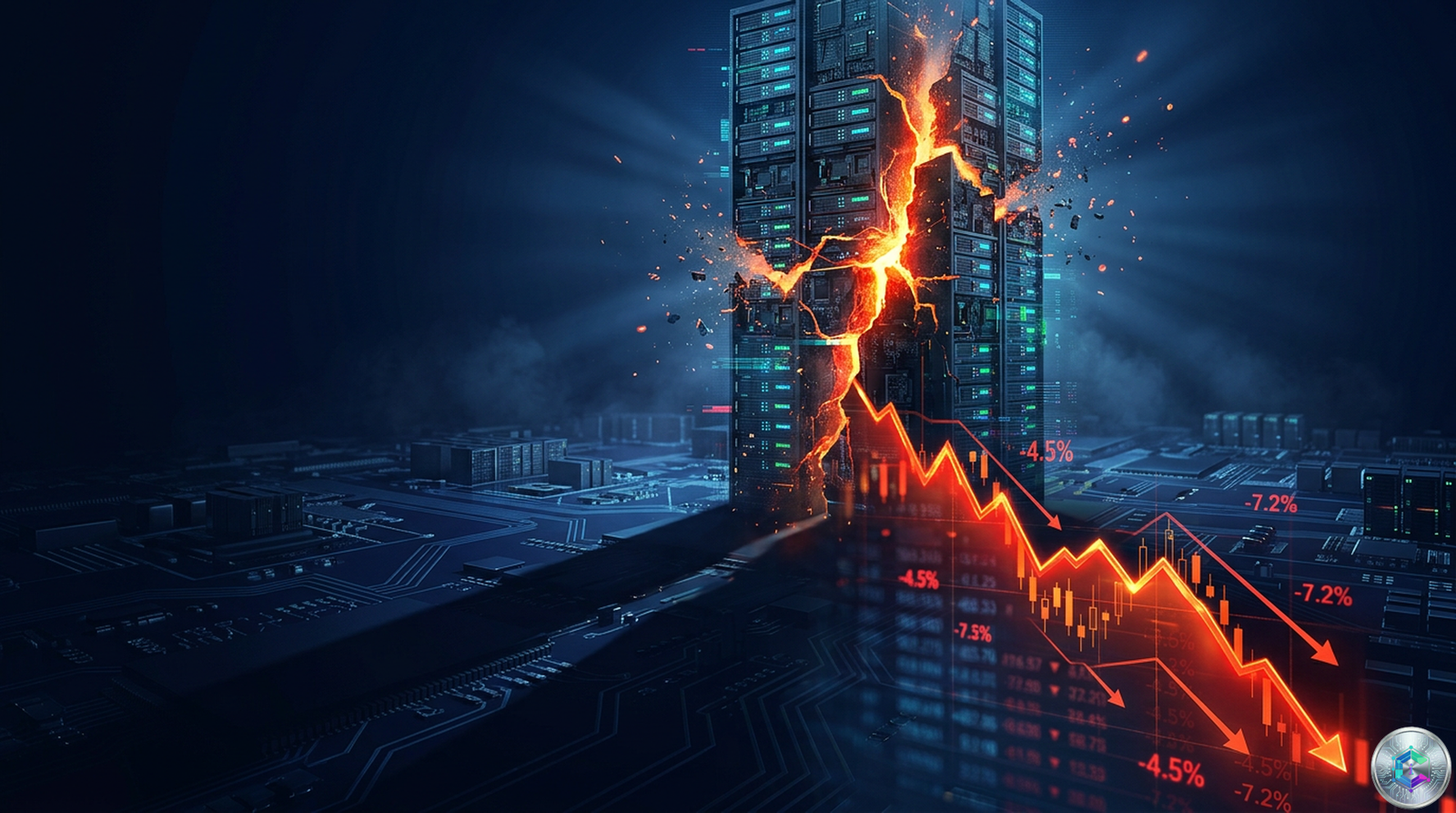
The market reaction was brutal. On Thursday, November 5, the Nasdaq lost 5.5%, its worst day since April 2025 and, according to CNBC, its sharpest decline in 19 months. After its worst month since March 2025 in October, the index was falling again in early November.
Nvidia saw its market capitalization shrink by nearly $450 billion, with its stock down more than 9%. Qualcomm also lost more than 9%, while AMD, Micron and Applied Materials fell double digits. CoreWeave recorded a second straight day of declines, SpaceX and Tesla dropped more than 9%, and the largest cloud providers lost between 2% and 4%.
| Stock or indicator | Move | Note |
|---|---|---|
| Nasdaq (Thursday, November 5) | -5.5% | Worst session since April 2025 |
| Nvidia | more than -9% | Nearly $450B of market value erased |
| CoreWeave, Nebius, IREN | about -50% over one month | Each lost half its market value |
| Technology vs S&P 500 | -10.7% over one month | Worst monthly underperformance since May 2002 |
| S&P 1500 stocks | more than 50 names down 10% or more | Mostly technology stocks |
Vanda Research recorded the heaviest retail selling since the Covid pandemic, while credit default swaps covering CoreWeave and SpaceX hit records, signaling rising expectations of future defaults. Meta turned negative on free cash flow last quarter, joining Alphabet and Amazon. Higher rates, rising capital needs and concerns about debt and revenue explain the sell-off, well beyond the electoral result.
Demand nonetheless remains strong. Qualcomm says the market faces a supply problem rather than a demand problem, Intel’s data center revenue jumped 78%, and AMD’s data center sales more than doubled. Investors nevertheless doubt that this growth is sustainable and that buyers can use the added capacity efficiently.
“We are now seeing something like a buyers’ strike in tech.” He added: “The elastic is starting to get too tight.”
Keith Lerner, chief investment officer, Truist Advisory Services
Valuation and Disclosure Risks
Investors are pushing for better terms before committing. According to Reuters’ four sources, Anthropic may have to accept a steeper discount to secure the necessary commitments, given its record quarterly losses, its capital needs and its obligations to AI infrastructure partners. Investors are also waiting for October revenue, which was left blank in the updated S-1, to gauge whether sales can rebound after recent slowing.
On Thursday, Wall Street and Silicon Valley discussed postponing the deal after two days of selling in AI-linked stocks. A delay could fuel concerns about the health of the ecosystem, especially as ballot initiatives to restrict data centers have crystallized political opposition. The filing also contains a discrepancy the sources cannot resolve: one summary of the filing describes sharply rising revenue and spending, while Reuters reports a recent slowdown, and detailed figures are not available to verify the gap.
In its amended S-1/A filed on November 2, Anthropic acknowledges it has already used AI to develop new models whose capability jumps were not anticipated. The company warns that growing use of AI in its own research and development could advance capabilities faster than its safety, alignment and security measures. Key points include:
- Internal estimates suggest it could soon reach the threshold of “dramatically accelerated progress attributable to AI” defined in its internal policy.
- No current model is designated as having crossed that threshold.
- Anthropic does not believe Claude could be used fully autonomously to design and build successive generations of frontier models without significant human oversight.
TechCrunch reminded readers that an S-1 is both a regulatory disclosure and a marketing document. Some analysts argued that Anthropic, as SpaceX did before it, could benefit from strong demand from retail investors. Anthropic declined to comment on investor doubts.
“It’s not like these companies won’t be part of the future. They will go public. Investors will still be very interested in them. Valuations have climbed for a long time in the private market, and we will probably see a pullback.”
Rick Meckler, partner, Cherry Lane Investments
Outlook and Scenarios
Three scenarios stand out. The first assumes the timetable holds with a discount, around $1.5 trillion. The second involves a delay, with Anthropic waiting for a more resilient market able to absorb a deal that some estimate could reach $100 billion. The third, the least favorable, is prolonged pressure on AI-linked assets, with knock-on effects for listing candidates such as Nscale, Aggreko and SB Energy, and contagion to a broader market heavily concentrated in mega-cap technology names.
Companies that already hold computing capacity could emerge stronger. Michael Alfaro, director of investments at Gallo Partners, argued that firms already holding computing capacity will win, because any new data center building will face a question mark. Greg Kuhl, global real estate equities portfolio manager at Janus Henderson, said experienced operators with strong balance sheets, public or private, will be best placed to work with municipalities.
“The bar to develop these projects in these locations will be higher. Development will be harder.”
Greg Kuhl, portfolio manager, global real estate equities, Janus Henderson
Sources
- CNBC, November 7, 2026
- Reuters, November 5, 2026
- The Creator’s AI
- Yahoo Finance
- The Globe and Mail
- New York Post, November 5, 2026
Cet article est publié à titre informatif et éducatif. Il ne constitue en aucun cas un conseil en investissement. Faites vos propres recherches (DYOR) avant toute décision.

