


Hanwha Investment & Securities (code 003530) has completed a tokenized securities platform running on the Avalanche blockchain, built with blockchain technology provider FairSquare Lab. The initiative, reported on September 6 by multiple industry sources, positions the Korean brokerage at the forefront of a local financial sector that is rapidly gaining regulatory structure.
🔑 Key takeaways
- Hanwha Investment & Securities has finished a tokenized securities platform on Avalanche and Hyperledger Besu, built by FairSquare Lab.
- South Korea’s Financial Services Commission (FSC) has published a three-phase roadmap starting on February 4, 2027.
- The Korea Securities Depository is building multi-chain infrastructure compatible with Hyperledger Besu, Fabric, and Avalanche.
- Phase 1 covers private money-market funds, private bonds, unlisted shares issued via trust, and fractional products offered to the public.
- High-net-worth individuals and family offices are the initial target, with a 100 million won annual net purchase cap per OTC platform.
A multi-network platform built by FairSquare Lab
The platform was designed by FairSquare Lab, a blockchain technology firm hired by Hanwha. It runs on multiple networks, including Avalanche, a high-throughput public blockchain, and Hyperledger Besu, an enterprise blockchain (permissioned, meaning access is restricted to authorized participants). This multi-network approach reflects a strategy aimed at meeting regulatory requirements while preserving technical flexibility.
Tokenized securities are financial instruments (stocks, bonds, funds) digitized by being recorded on a blockchain. Multiple institutions share the same distributed ledger and jointly manage rights-related information, including issuance, transfer, and redemption.
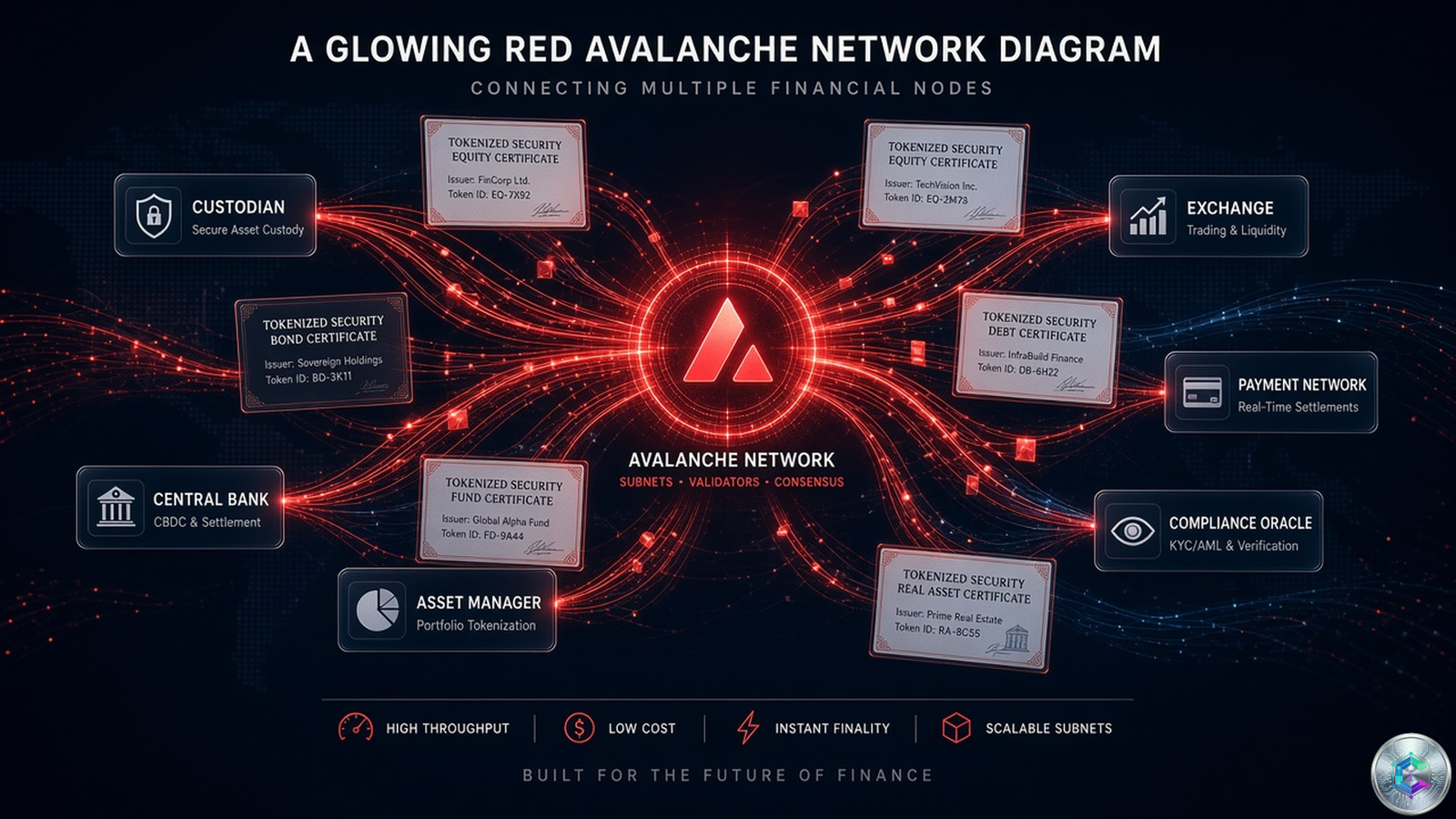
Other players, such as Mirae Asset Securities (code 006800), had already adopted enterprise blockchains like Hyperledger Besu. Hanwha goes further by integrating Avalanche, which allows the configuration of independent subnetworks with restricted validators, a model usable as a dedicated network for financial institutions.
“The platform was designed to run on multiple networks, including Avalanche and Hyperledger Besu, allowing the firm to reconcile regulatory compliance with technical flexibility.”
Blockchain industry source, cited on September 6
A three-phase regulatory roadmap
South Korea’s Financial Services Commission (FSC) published its “Policy Directions for Tokenized Securities” at the third meeting of its public-private council, chaired by Vice-Chairman Kwon Dae-young. The timeline is structured around three phases rather than a single wholesale migration.
Key roadmap milestones
| Phase | Effective date | Scope |
|---|---|---|
| Phase 1 | February 4, 2027 | Private money-market funds, private bonds, unlisted shares via trust, fractional products offered to the public |
| Phase 2 | Flexible, market-driven | Extension to all publicly offered securities |
| Phase 3 | To be determined | Connecting on-chain settlement to stablecoins, pending South Korean legislation |
Underlying shares remain, during phase 1, on the existing electronic securities system. According to the FSC, the phase 2 timeline remains flexible and will depend on market demand and system stability.
Revisions to subordinate regulations are expected by the end of September 2026. The immediate milestone remains February 4, 2027, when the amended Electronic Registration Act takes effect.
The Korea Securities Depository’s infrastructure
The Korea Securities Depository (KSD) is also preparing its own infrastructure, capable of connecting to multiple blockchain technologies. According to its published guidelines on standard requirements for distributed ledgers of tokenized securities, the depository is building a platform compatible with Hyperledger Besu, Hyperledger Fabric, and Avalanche.
Participation in the distributed ledger is limited to electronic registration institutions and account management institutions. The KSD participates directly in each ledger to manage total issuance volumes and electronic registration data.
According to a depository official, the inclusion of Avalanche was not decided preemptively: it followed requests filed by several companies through the consultative body on tokenized securities. If a firm wishes to adopt a new distributed ledger technology, technical support and a connection remain possible after prior consultation.
Samsung SDS was selected in May 2026 to build the depository’s tokenized securities platform, with delivery scheduled for February 2027. That contract, however, does not name Avalanche: the KSD publishes selection criteria for connecting broker-operated ledgers to its systems.
Target market and regulatory guardrails
Hanwha’s platform initially targets high-net-worth individuals and family offices, with a focus on private market assets such as hedge funds and real estate. The market potential is significant: estimates value the Korean tokenized securities market at $250 billion by 2030.
The regulatory framework also establishes several guardrails for retail traders. Each OTC platform faces an annual net purchase cap of 100 million won. Additionally, each subscription is limited to 30 million won or 5% of the issuance, whichever is lower. Issuers’ account managers must hold 4 billion won in share capital and meet staffing and IT standards.
Existing investment houses will not need a new license to handle tokenized securities. OTC platforms, however, will need to consult the Financial Supervisory Service beforehand. The main barrier is therefore regulatory compliance rather than obtaining a new permit.
Avalanche marketing vs. official policy
An important distinction must be drawn. Avalanche’s official account posted that South Korea was bringing “its entire capital markets infrastructure on-chain, powered by Avalanche,” with a follow-up linking to the Korean commission’s release. However, the FSC document does not name Avalanche. The “powered by Avalanche” framing comes from Avalanche’s marketing, not from the Korean government’s chain-agnostic (blockchain-independent) policy.
No signed agreement between Avalanche and the FSC or the KSD has been made public. No primary quote from Ava Labs leadership confirming an official selection was identified. Regulators have also expressed reservations about public blockchains: in March, an FSC official questioned who would pay the gas fees (transaction costs on the blockchain) and whether authorities could exercise sufficient oversight of such a network.
Market reaction remained muted. AVAX had already climbed about 4.4% on September 3, the day before the announcement. On announcement day, the token traded near $7.50 and ended roughly flat, with around $193 million in 24-hour volume. The official post drew only about 14,000 views shortly after publication.
A Korean landscape with multiple competing rails
The broader Korean picture shows several competing rails rather than a single national blockchain mandate. Koscom operates KoSTO, a shared broker platform that counted around 12 signatory firms in August. On August 21, Shinhan Asset Management signed a memorandum of understanding with the Solana Foundation for a tokenized short-term bond fund. The Korea Exchange is separately preparing a pilot for tokenizing listed equities.
Avalanche has secured genuine Korean partnerships, but these are separate from the FSC’s timeline: the KRW1 stablecoin proof-of-concept with Woori Bank and POSCO International’s receivables pilot. None of these projects represents the commission’s capital markets infrastructure.
Conclusion: real adoption, narrative to recalibrate
Hanwha’s initiative illustrates concrete technology adoption in the Korean market, but the “all of Korea on Avalanche” narrative needs to be put into perspective. The KSD’s multi-network strategy, the FSC’s three-phase timeline, and parallel partnerships (Solana, KoSTO) sketch a pluralistic ecosystem. For investors and observers, attention should now turn to the effective February 2027 delivery and the subordinate regulation revisions expected by the end of September 2026.
Sources
- The Block — South Korea’s Hanwha develops tokenized securities platform on Avalanche (September 7, 2026)
- Seoul Economic Daily — Hanwha Securities builds Avalanche-based token securities (September 6, 2026)
- OurCryptoTalk — South Korea tokenized securities roadmap (September 2026)
- Algorithm Substack — South Korea market structure note (September 2026)
This article is for informational and educational purposes only. It does not constitute investment advice. Do your own research (DYOR) before making any decision.

