


Global bond markets suffered a fresh wave of heavy selling on Tuesday, pushing long-term yields to multi-year highs as surging energy prices, persistent inflation fears and renewed geopolitical tensions converged. The breach of the symbolic 3% threshold by Japan’s ten-year yield — a level not seen since 1996 — epitomizes a regime change reshaping fixed income markets worldwide.
🔑 Key takeaways
- Japan’s 10-year government bond yield breaks 3% for the first time since 1996
- The U.S. 10-year Treasury yield pierces 4.75% resistance and settles at 4.78%
- Brent crude tops $91/barrel; European gas hits a 3.5-year high
- Strategists warn of a global bond market regime change with JGBs losing their anchor status
- Rate hikes are expected this week in New Zealand and next week in the eurozone
The Japan shock: a symbolic barrier shattered
Japan’s 10-year government bond (JGB) yield broke through the 3% mark in Asian trade on Tuesday, the first time it has traded above that level since 1996. The breach — a generational milestone — marks a psychological pivot point for fixed income investors worldwide.
Two structural forces are driving the move. First, fiscal worries tied to Prime Minister Sanae Takaichi‘s growth-through-spending program weigh on Japan’s already-staggering public debt. Second, the Bank of Japan continues normalizing monetary policy, lifting the structural cost of long-term funding.
Global contagion: U.S., Europe, Australia
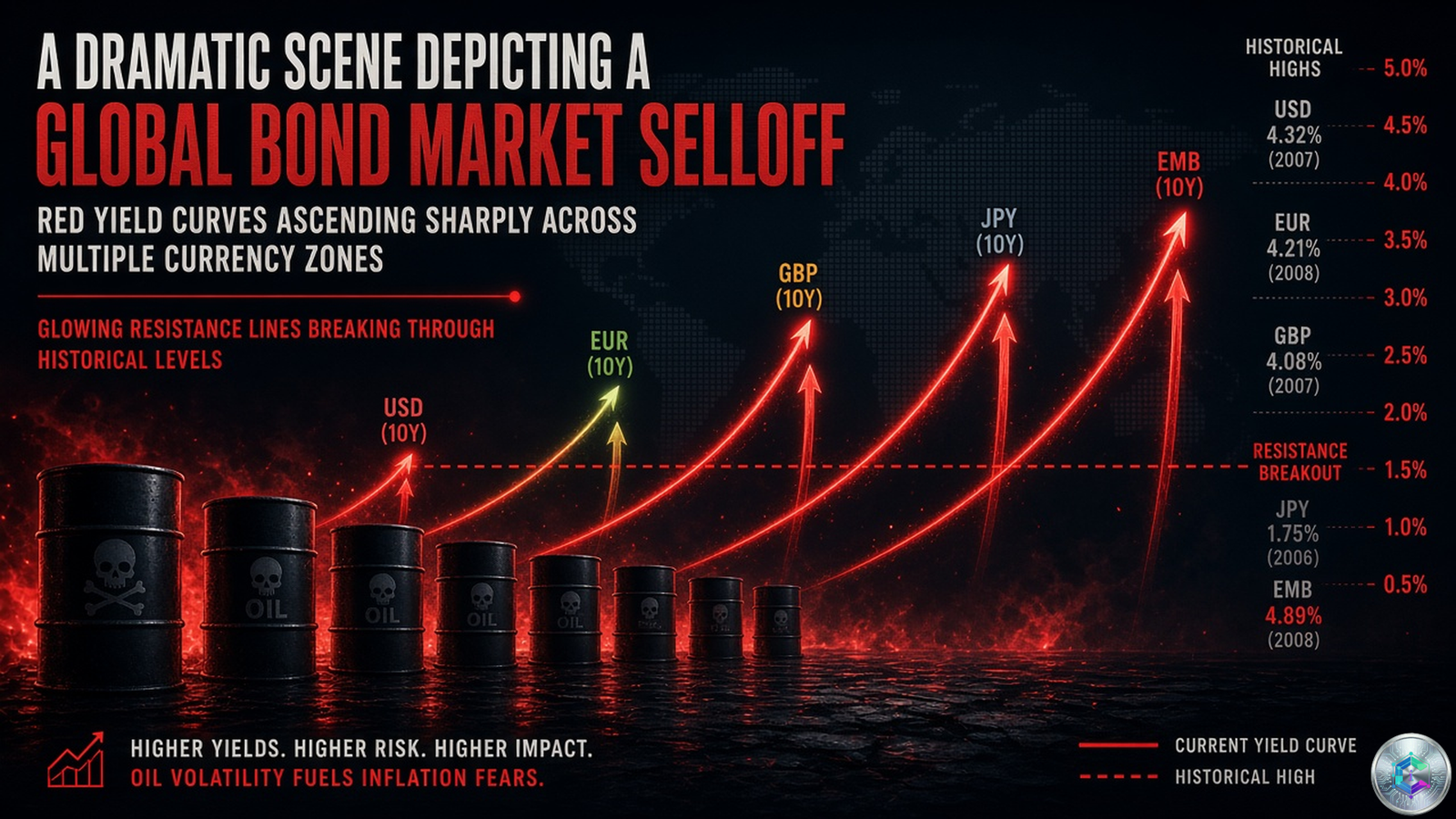
The shockwave quickly spread beyond Japan. In the United States, the 10-year Treasury yield broke through technical resistance at 4.75% to settle at 4.78%, the highest level since early 2025. This benchmark dictates the pricing of virtually every asset class globally. The yield rose by 2.2 basis points during the session.
In Europe, long-dated German bunds and French OATs printed price lows not seen in fifteen years. Bund futures set a fresh fifteen-year low in Asia, while French OAT futures hit their lowest level since launch in 2012. In Australia, the 10-year yield posted its largest single-session jump in five months.
10-year yield snapshot
| Country / Region | 10-year yield | Historical reference |
|---|---|---|
| Japan | > 3.00% | Highest since 1996 |
| United States | 4.78% | Highest since early 2025 |
| Germany (bund) | 15-year price low | Futures in record territory |
| France (OAT) | Lowest price since 2012 | Contract record low |
| Australia | Largest gain in 5 months | Uptrend resumes |
Oil and gas reignite inflation pressure
The main trigger for the bond selloff sits in energy markets. Brent crude prices broke above $91 per barrel in Asia on Tuesday, fueled by geopolitical tensions — U.S. threats of further strikes on Iran and intensifying Russia-Ukraine combat — and by expectations of seasonal demand heading into the Northern Hemisphere winter. Wheat prices also moved closer to three-year highs as the Ukraine conflict escalated.
In Europe, the benchmark gas price closed the summer at its highest level in three and a half years, with inventories sitting at record seasonal lows. The combination is feeding inflation expectations and pushing central banks to maintain — or even tighten — their hawkish stance.
“The macro mix is turning less forgiving for long-duration and risk assets. Hawkish monetary policy, renewed geopolitical and inflationary risks, and rising fiscal concerns are converging to keep upward pressure on global term premia and long-end yields.”
Wee Khoon Chong, Asia-Pacific macro strategist at BNY
Strategists sound the alarm
The flood of senior strategist comments underscores the magnitude of the shock. Tai Hui, chief market strategist for Asia-Pacific at J.P. Morgan Asset Management in Hong Kong, warned about inflation risks heading into the fourth quarter: “The drawdown in inventories and seasonal fuel demand into the Northern Hemisphere winter mean the direct impact on global inflation is tilted to the upside.”
Fred Neumann, chief Asia economist at HSBC, noted that the rise in Japanese bond yields reflects both domestic fiscal concerns and global pressure on long-term funding costs: “From that perspective, the rise in Japanese yields is not an outlier, although — given Japan’s larger public debt — the country potentially faces added pressure from rising debt-service costs.”
Prashant Newnaha, senior rates strategist at TD Securities in Singapore, went further, calling it a true regime change: “JGBs have been the anchor of global fixed income for a long time. That has now flipped.” A prolonged selloff in Japanese bonds could, he added, trigger a global fixed-income reassessment.
From a Japanese perspective, Masahiko Loo of State Street Investment Management framed the move as normalization rather than crisis: “Markets are repricing for a higher inflation regime, a higher neutral rate, and growing confidence that the Bank of Japan still has further to go.” He also noted that Japan is gradually stepping back as a marginal buyer of foreign bonds, contributing to rising term premia worldwide.
Andrew Lilley, chief rate strategist at Barrenjoey in Sydney, attributed the dynamics to a Federal Reserve policy reassessment: “I think the Fed hikes in September and I think this is the start of a three-hike cycle at a minimum. If the Fed doesn’t hike, term premia have to go up… and this dynamic suggests it may have let things get somewhat out of hand.”
Ryutaro Kimura of BNP Asset Management in Tokyo captured the prevailing sentiment: “The bond market is, in a sense, sounding the alarm against fiscal expansion. There’s now a certain sense of resignation, tinged with helplessness, in the face of rising rates.” He added that the 3% psychological level could attract some demand, with Japanese bond auctions recording strong bid-to-cover ratios.
On the fiscal side, Vasu Menon of OCBC in Singapore warned that higher borrowing costs will inflate Japan’s debt-service bill, potentially crowding out government spending as a larger share of revenue is absorbed by interest payments. Shigeto Nagai of Oxford Economics emphasized the cross-border nature of the move: “Concerns about long-term interest rates in major economies feed off each other across borders, driving a global rise in interest rates.” Eiji Doke of SBI Securities in Tokyo added nuance: “BoJ rate-hike expectations will likely pressure yields mainly in the short-to-medium end, while fiscal-policy concerns will weigh particularly on the super-long sector.”
Conclusion: a new rate regime takes shape
Tuesday’s session marks a decisive step in the restructuring of the global bond landscape. The simultaneous breach of key psychological thresholds in Japan, the United States and Europe reflects a regime change in which persistent inflation, massive public debt and monetary normalization converge to impose a structural floor on long-term yields.
Markets are pricing in a rate hike in New Zealand as soon as Wednesday, followed by an expected move next week in the eurozone. In the United States and Japan, the implied probability of a hike this month is now above 50%. The euro held steady at $1.1619 and the yen at 159.76 per dollar, while U.S. equity futures were flat after modest Wall Street declines on Monday and Asian markets closed in negative territory (Nikkei -0.2%, Hang Seng -0.7%). Against this backdrop, risk assets — equities, credit, emerging markets — remain exposed to a meaningful repricing risk if the current dynamic extends.
Sources
- Reuters — Global Markets
- TradingView — Bond selloff deepens
- MarketScreener — Analysts react
- Euronext — Bond selloff coverage
- Channel News Asia
This article is for informational and educational purposes only. It does not constitute investment advice. Do your own research (DYOR) before making any decision.

