


World Chain becomes the first production Layer-2 to combine Flashblocks with the Block Access Lists defined by EIP-7928. The deployment merges two previously separate innovations into a single pipeline, slashing confirmation latency to 300-500 milliseconds and unlocking parallel transaction execution across the Ethereum stack.
🔑 Key takeaways
- World Chain now streams Block Access Lists (BAL) every 200 ms via Flashblocks.
- The architecture pairs a Rollup-Boost sequencer sidecar with a Flashblocks module on the Reth fork.
- Confirmation latency drops from roughly 2000 ms to about 300-500 ms for end users.
- EIP-7928 enforces BAL at the block level, unlike the optional access lists from EIP-2930.
- Open debate continues around the estimated 40 KiB overhead and a 2x block-size inflation.
Flashblocks: preconfirmations every 200 ms
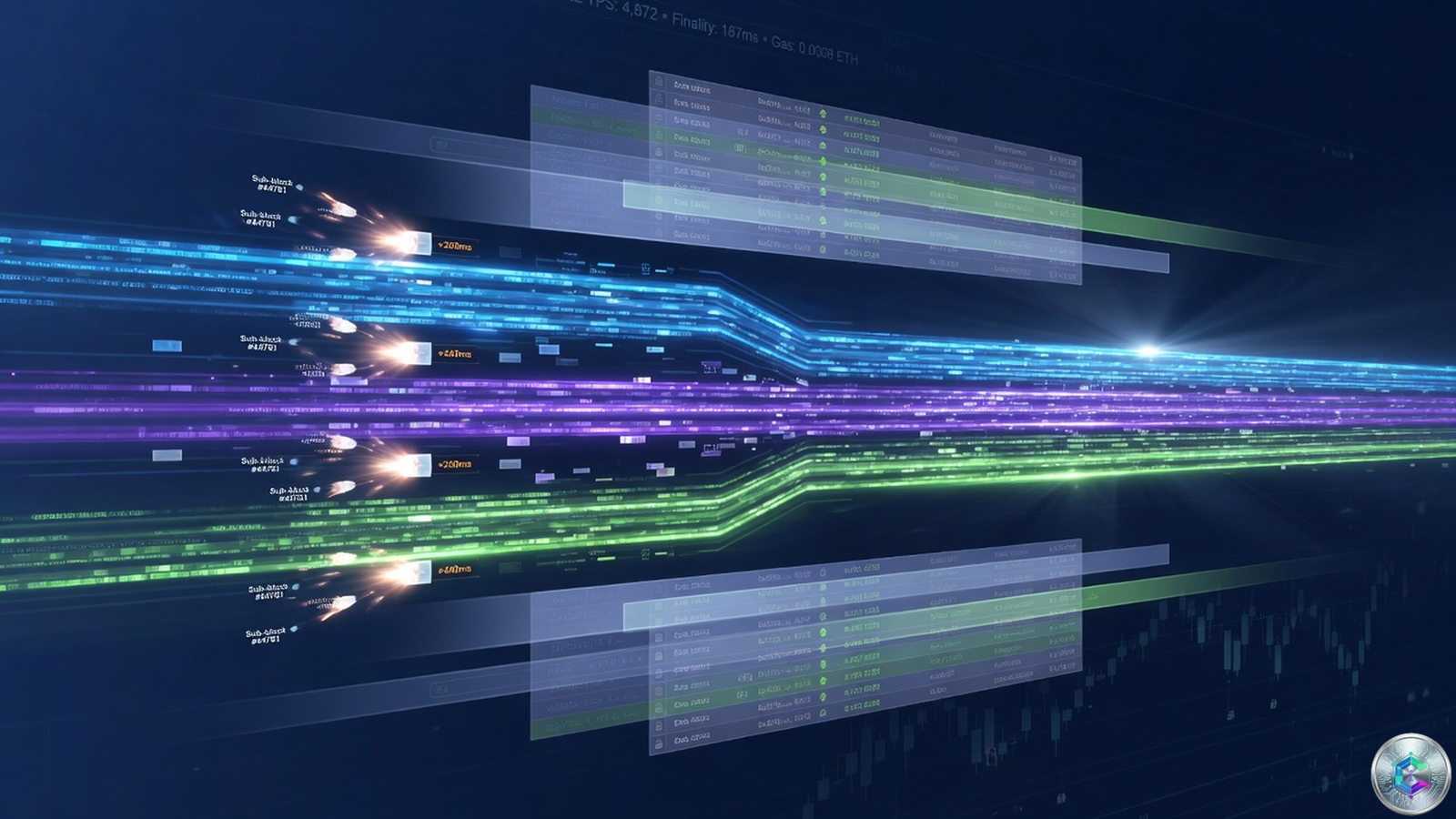
Flashblocks are ephemeral sub-blocks broadcast every 200 milliseconds within a standard two-second block window. Developed by Flashbots, the team behind MEV-Boost, in collaboration with Uniswap Labs and OP Labs, the fragments give users a preconfirmation of their transactions without waiting for full block finalization.
The sequencer emits lightweight partial blocks every 200 ms and streams them in real time to network nodes. At the end of the two-second window, all accumulated Flashblocks are committed into a single finalized block. The design borrows directly from Solana shreds and Celestia data squares, which similarly broadcast partial block data before finalization.
EIP-7928: Block Access Lists for parallel execution
EIP-7928 defines Block Access Lists (BAL), a structure that records every account and storage slot touched during block execution, alongside their post-execution values. Unlike the optional access lists introduced by EIP-2930, BAL are enforced at the protocol level for each block.
That constraint unlocks four major optimizations: parallel disk reads, parallel transaction validation, parallel state-root computation, and state updates without re-execution. The technical structure adds a new header field, block_access_list_hash, holding the Keccak-256 hash of the RLP-encoded access list.
| Element | Description |
|---|---|
| Modified accounts | Addresses whose state changed during the block |
| Targeted opcodes | BALANCE, EXTCODESIZE, EXTCODECOPY, EXTCODEHASH, CALL, CALLCODE, DELEGATECALL, STATICCALL |
| Deployments | Contract creation addresses |
| Zero-value transfers | Recipients of zero-value ETH transfers |
| Constraint | bal_items ≤ block_gas_limit / 2000 |
The deployment architecture
The pipeline relies on two main components. Rollup-Boost runs as a sequencer-side sidecar that builds and streams partial blocks every 200 ms over WebSocket. On the node side, the Flashblocks module on World Chain’s Reth fork consumes these streams and updates local state at each interval instead of waiting for a complete block.
The peer-to-peer coordination layer uses StartPublish and StopPublish control messages so nodes can dynamically negotiate which builder is responsible for producing blocks, with automatic failover if a builder drops out. Each message is cryptographically signed by both authorizer and builder, paired with a timestamp and payload identifier to guarantee authenticity, integrity, and freshness.
“By streaming Block Access Lists through Flashblocks, nodes receive detailed state-access information before the full block is sealed, paving the way for more efficient parallel execution and faster sync times.”
World Chain Engineering Team
Impact for users and DeFi
From a user-experience standpoint, confirmations drop from roughly 2000 ms on a standard endpoint to about 300-500 ms with Flashblocks, accounting for the 200 ms interval plus network travel time. The latency reduction is particularly valuable for DeFi applications, where faster blocks shrink the window during which stale prices can be arbitraged against liquidity providers.
The knock-on effect: adverse-selection costs fall, spreads tighten, and automated market makers (AMMs) quote tighter prices. Arbitrageurs also have less time to extract MEV at users’ expense, which should translate into better execution for retail flow.
The size debate
A discussion on the Ethereum Magicians forum raised concerns about the size and verbosity of Block Access Lists. At roughly 40 kibibytes (KiB), they would add non-trivial overhead, inflating average block size by a factor of two and 95th-percentile size by 1.55x.
Some developers have proposed exploring deterministic execution plans as an alternative to full differential traces baked into blocks. The trade-off between information richness for parallel execution and bandwidth overhead on the network will weigh heavily in any future decision to adopt EIP-7928 on Ethereum mainnet.
Conclusion
World Chain’s deployment marks a concrete step toward convergence between block streaming and parallelization, two workstreams widely seen as strategic for Ethereum’s scaling roadmap. While EIP-7928 remains under discussion for mainnet, its production rollout on a high-traffic L2 yields valuable empirical data on latency gains and bandwidth costs. The next milestone to watch: potential adoption of the same combination by OP Mainnet and other major rollups.
Sources
- The Block — World Chain becomes first production L2 to ship streaming Block Access Lists
- World.org — P2P Flashblock propagation
- Ethereum EIPs — EIP-7928 Block Access Lists
- Chainstack — What are Flashblocks
- Ethereum Magicians — EIP-7928 discussion
- CryptoPanic — World Chain news
This article is published for informational and educational purposes only. It does not constitute investment advice. Do your own research (DYOR) before making any decision.

