



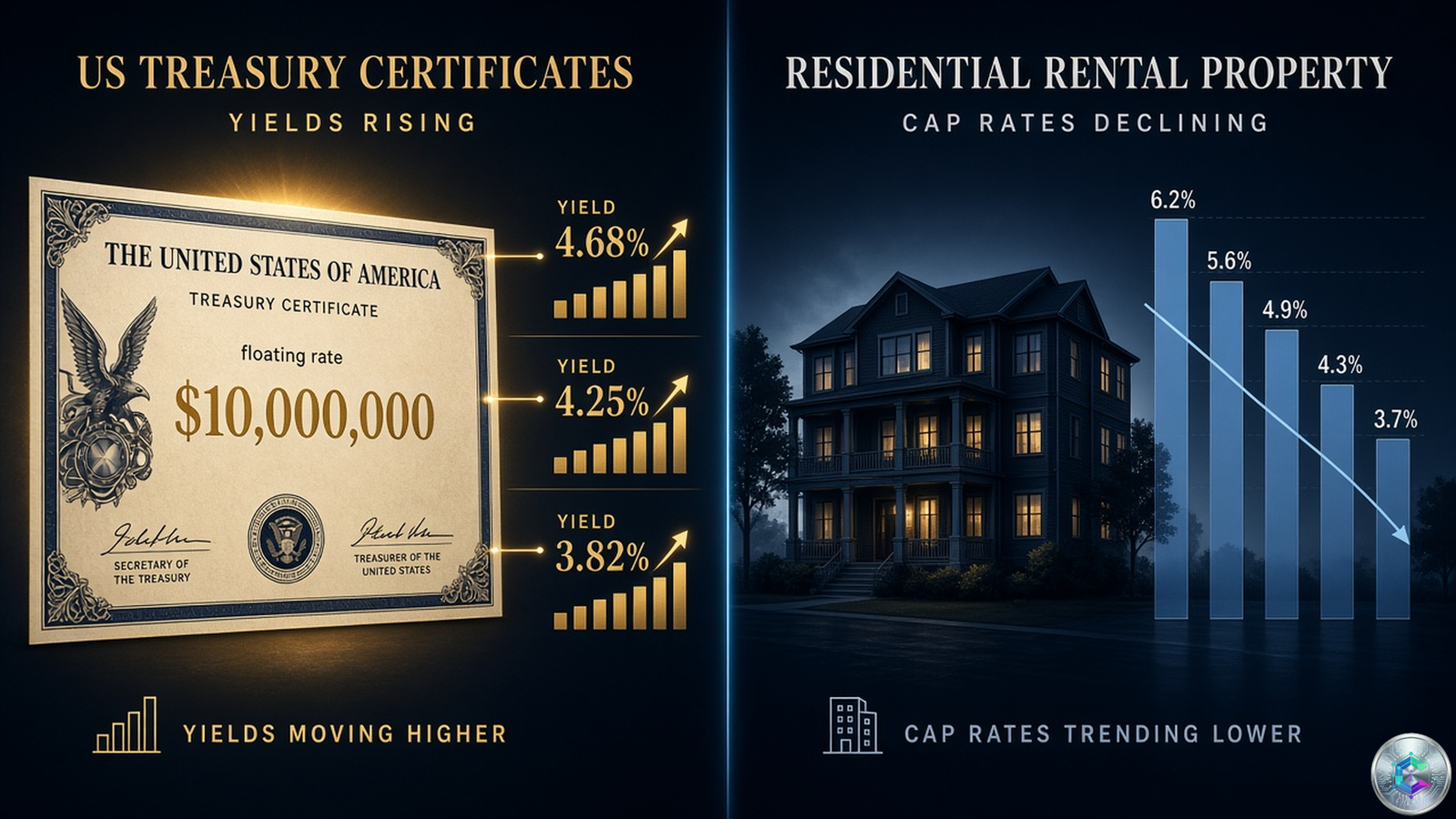
The 5.11% yield on the US 10-year Treasury now exceeds the 4.8% average cap rate on single-family rentals, an unprecedented spread since July 2007. This negative gap between sovereign bonds and rental real estate reshapes the portfolio allocation playbook for 2025 and beyond.
🔑 Key takeaways
- The US 10-year yield closed at 5.11% before climbing to 5.18%, according to Protos.
- The single-family rental cap rate stands at 4.8%, creating a record negative spread since 2007.
- The Case-Shiller index shows an annualized return of 3.7% between 1928 and 2013.
- NCREIF reports 9.4% annualized over 25 years for private commercial real estate.
- Bonds outperformed equities during the 2000, 2008, 2018, and 2020 crises.
A Spread Without Precedent Since the Housing Bubble
The US 10-year Treasury yield closed at 5.11% one Wednesday before climbing to 5.18% the following session, according to data relayed by Protos. Nick Gerli, CEO of a real estate analytics firm, posted a chart that drew more than 250,000 views, accompanied by a blunt warning on the relative profitability of the two asset classes.
« Rental property carries a negative opportunity cost relative to government bonds. »
Nick Gerli, CEO of a real estate data firm
His calculations show that 10-year Treasuries above 5.1% comfortably outpace the 4.8% cap rate on single-family rentals. That 4.8% figure is one of several net-after-cost benchmarks cited for rental properties. Historically, investors demanded a yield premium from real estate to compensate for its illiquidity and management burden; that premium has now flipped into a discount.
For context, the US bond market represents roughly 80% of the equity market in size according to the same source, providing unmatched liquidity depth for both institutional and retail allocators.
Yield Comparison Snapshot
| Asset | Annualized yield | Liquidity | Key risk |
|---|---|---|---|
| US 10-year Treasuries | 5.11% to 5.18% | Very high | Sovereign risk (low) |
| Single-family rental (cap rate) | 4.8% | Low | Vacancy, tenant default |
| NCREIF commercial real estate | 9.4% (25 years) | Low | Cyclical, geographic |
| Diversified REITs | 10.5% | High | Equity volatility |
| Case-Shiller index (housing) | 3.7% (1928-2013) | Variable | Real estate cycle |
Macroeconomic Drivers Behind the Rate Climb
Several forces have converged to push Treasury yields to these unusual levels. An oil shock combined with a borrowing spree during the US conflict with Iran initially pushed long-term rates higher. The Federal Reserve then orchestrated a recent hike in the federal funds rate, the first in three years according to chair Kevin Warsh, paired with projections for additional tightening.
The Fed’s 11 successive rate hikes between 2022 and 2023 already left a mark on bond history. 2022 remains the worst year ever recorded for the bond market: prices collapsed in response to the aggressive tightening cycle, and even defensive bond portfolios posted double-digit losses. Yet this sequence has lifted real yields to levels comparable with net rental yields, a configuration not seen for decades.
The Real Variability of Real Estate Returns
The 4.8% figure masks significant volatility that aggregated averages fail to capture. Nick Gerli points out that an individual landlord can earn double-digit returns in good years with minimal repairs, then lose money the following year due to unexpected costs, low occupancy, or casualty events. Aggregate benchmarks, however, provide useful long-term anchors.
The Case-Shiller index reports an annualized average return of 3.7% for housing between 1928 and 2013. The NCREIF (National Council of Real Estate Investment Fiduciaries) records 9.4% annualized over 25 years for privately held commercial investment properties. Residential and diversified portfolios performed slightly better, averaging 10.5%, while REITs also reached 10.5% annualized over the same horizon.
This dispersion underscores a critical point: gross rental yield hides operating costs, vacancy, maintenance, and property taxes that significantly erode net returns. Conversely, a Treasury held to maturity returns the full principal and coupons, setting aside the sovereign risk that the US itself represents the global benchmark for credit safety.
Specific Advantages and Risks of Each Asset Class
The Bond Pillar
The US bond market carries several structural strengths. Its size approaches 80% of the equity market, ensuring extremely high liquidity. Treasuries are backed by the full faith and credit of the US Treasury, making them one of the safest investments in the world. The historical aggregate return of the US bond market between 1926 and 2025 stands at roughly 5.4%, against a historical inflation rate of 2%, delivering an average real premium of 3.4 percentage points over nearly a century.
The Rental Real Estate Pillar
Rental real estate offers distinct advantages that bonds cannot replicate: leverage through mortgages (up to 70-80% of the purchase price financeable via debt), long-term capital appreciation, regular rental income indexable to inflation, and significant tax benefits. These include deductions for mortgage interest, property taxes, repairs, and depreciation. Commercial property depreciation is spread over 39 years under IRS rules. The capital gains exclusion of $250,000 for single filers and $500,000 for married couples represents an additional meaningful advantage.
However, real estate risks remain real: interest rate sensitivity (US mortgage rates stay elevated in 2025), unexpected vacancy, tenant defaults, surprise maintenance costs, localized geographic risks, and relative illiquidity — selling a property can take several months. The current market is characterized by strong rental demand in many US cities, but elevated mortgage rates compress net returns for new investors. Price-to-rent affordability remains best in parts of the Sun Belt and Midwest.
Allocation by Investor Profile
The trade-off between high-yield bonds and rental real estate varies sharply by investor profile, time horizon, and risk tolerance. Alliance Wealth Management recommends real estate to a 30-year-old investor seeking to build wealth with a high risk tolerance, and favors bond stability for a 70-year-old retiree with an already substantial portfolio.
« Bonds outperformed equities during the dot-com bubble burst in 2000, the 2008-2009 global financial crisis, the 2018 correction, and the March 2020 Covid crash. »
Financial Samurai analysis
Time horizon analysis is essential. Over 1 to 5 years, Treasuries deliver unmatched cash flow predictability with a yield guaranteed at maturity. Over 15 to 30 years, real estate leverage and capital appreciation can surpass bond returns, especially in inflationary environments where rents and prices are expected to adjust upward. The current spread between 5.1% bonds and 4.8% cap rates raises a key question: will real estate prices adjust downward to restore the traditional risk premium, or will bond yields normalize through Fed easing if the macroeconomy slows?
Conclusion: A Signal to Integrate in Allocation
The current negative spread between US Treasuries and rental cap rates is a historic signal without equivalent since July 2007. Two credible scenarios emerge for the coming quarters. The first would see Treasury yields normalize through Fed monetary easing if the macroeconomy slows, restoring the traditional real estate risk premium. The second would see a downward adjustment in real estate prices to push the cap rate above the bond yield, a scenario that could come with rising tensions in commercial mortgage credit markets.
For allocators, diversification between short-duration high-yield bonds and geographically diversified real estate exposure — including listed REITs — offers a pragmatic compromise between liquidity, current yield, and inflation protection. The question is no longer whether Treasuries dominate real estate, but how long this historic gap will persist and which asset class will reprice first.
Sources
- Protos – Are US Treasuries now a better investment than rental property?
- Alliance Wealth Management – Fixed income bonds vs real estate investment
- Kakande Alex Substack – Rentals investments vs Treasury bonds
- Brevitas – Commercial real estate vs Treasury bonds
- All Property Management – Is rental property a good investment?
- Financial Samurai – Real estate or bonds?
This article is published for informational and educational purposes only. It does not constitute investment advice. Do your own research (DYOR) before making any decision.
Crypto Info - Votre source d'information francophone sur les cryptomonnaies. Actualités, analyses de marché et tendances du monde crypto, pour rester informé sur Bitcoin, Ethereum et l'ensemble de l'écosystème blockchain.
Tendences
Catégories
© 2026 Cryptoinfo.ch