


Tether and Circle now hold nearly $200 billion in US Treasuries, placing them among the world’s top foreign holders of American debt. How millions of users simply seeking dollar stability are unknowingly financing the US government—and why regulators and central banks are watching closely.
🔑 Key Takeaways
- Tether and Circle combined hold approximately $200 billion in Treasuries, exceeding France or Taiwan
- Daily stablecoin transaction volumes have reached $4 trillion since the new regulatory framework
- The GENIUS Act mandates one-to-one backing in dollars or short-term Treasuries
- The Fed staff valued the stablecoin market at $317 billion as of April 6, 2026
- Forecasters project additional Treasury demand of $400 billion to $2.3 trillion by 2030
Dollar Dominance Extends to Private Tokens
The dollar remained the reference currency in global official reserves in Q1 2026, with a share of 57.13% according to IMF COFER data, slightly up from 56.42% in Q4 2025. The Bank for International Settlements estimated that 98% of stablecoin value was denominated in dollars, confirming the greenback’s dominance in private token markets. This supremacy is not merely fiducial—it directly impacts the structure of US debt financing.
Tether and Circle: Giants at the Treasury’s Doorstep
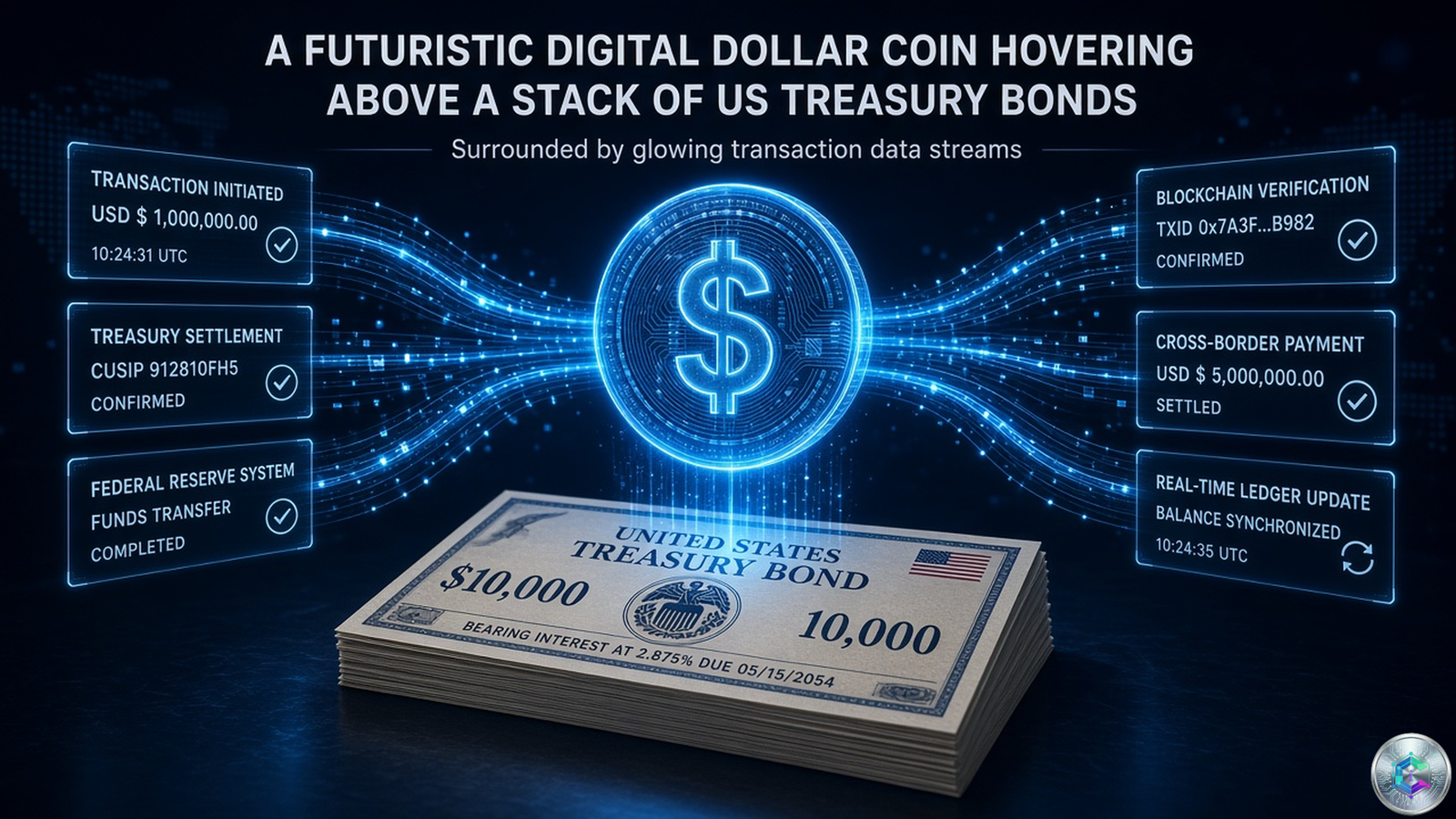
Tether, headquartered in El Salvador and led by Paolo Ardoino, forty, held approximately $141 billion in US debt according to its latest attestation. Circle, issuer of USDC, carried a comparable amount. Together, both companies held nearly $200 billion in US Treasury bills, ranking seventh or eighth among foreign holders of US public debt, surpassing countries like France, Switzerland, or Taiwan.
Tether counted approximately 186 billion USDT tokens in circulation by end-2025, versus 135 billion end-2024. Circle posted $1.68 billion in revenue for 2024 and went public in New York in June 2025, briefly reaching a $28 billion valuation. Its Q4 2025 quarterly revenue stood at $770 million.
| Company | Tokens in Circulation (end-2025) | Treasury Holdings (est.) | 2024 Revenue |
|---|---|---|---|
| Tether (USDT) | 186 billion USDT | ~$141 billion | Not disclosed |
| Circle (USDC) | ~50 billion USDC | ~$60 billion | $1.68 billion |
| Combined Total | ~236 billion | ~$200 billion | – |
« Volumes remain marginal at market scale, but growing in absolute value. »
Treasury Borrowing Advisory Committee Analysis, September 2025
The Leverage Mechanism: Users Lending Unknowingly
Daily stablecoin transaction volumes across all stablecoins surged from approximately $1 trillion before the new regulatory framework to roughly $4 trillion afterward—about one-third of Visa’s annual volume. Tether reported over 500 million users worldwide, with a significant portion residing in emerging markets with unstable currencies such as Argentina, Nigeria, Turkey, or Venezuela.
The mechanism driving this growth rests on structural leverage. USDT or USDC holders earn no interest on their holdings. Conversely, every dollar collected by the issuer is immediately reinvested in short-term US Treasury bills, yielding between four and five percent in early 2026. For Tether alone, this spread generated net profit of $13 billion in 2024 and over $10 billion in 2025—comparable to Goldman Sachs’ results for the same period. The company employed approximately one hundred people.
Banking Intermediation Without Traditional Overhead
The Treasury Borrowing Advisory Committee analysis, based on data from major issuers through September 2025, indicated that Treasury bills represented 53% of Tether and Circle assets, a $70 billion increase from 2022. Despite this growth, stablecoin issuers held less than 1% of total outstanding Treasury supply.
« Stablecoins create structural demand for short-term US debt, financed by millions of users who often don’t realize they are indirectly lending to the US government. »
Brookings Institution, Nellie Liang and Brent Neiman
US Regulatory Framework: GENIUS and CLARITY Accelerate the Trend
The regulatory framework has accelerated this dynamic. The GENIUS Act, enacted in July 2025, mandates that stablecoin issuers maintain one-to-one backing in dollars or short-term Treasuries, monthly audited reserve disclosures, a prohibition on paying interest to token holders, and priority for holders in bankruptcy proceedings. The general effective date was anticipated for January 18, 2027 according to the Treasury’s August rulemaking notice.
The CLARITY Act, which splits jurisdiction between the SEC and CFTC and regulates digital asset intermediaries, passed the House of Representatives with its provision advancing through the Senate Banking Committee by a 15-9 vote. Circle CEO Heath Tarbert testified before Congress on September 2, framing this framework as an instrument of dollar statecraft. He argued that US rules could strengthen private digital dollar payment rails, extend global adoption of dollar-backed tokens, and support short-term Treasury demand.
| Act | Adoption Date | Key Provisions | Effective Date |
|---|---|---|---|
| GENIUS Act | July 2025 | One-to-one backing, monthly audits, no interest to holders | January 18, 2027 (anticipated) |
| CLARITY Act | Pending | SEC/CFTC jurisdiction split, intermediary oversight | Varies by section |
Risks and Warnings from Authorities
Federal Reserve staff estimated stablecoin market capitalization at $317 billion as of April 6, 2026—a gain of over 50% versus early 2025. The Fed analysis indicated that USDC held high-quality reserves equal to its liabilities. USDT showed total reserves at approximately 1.04x liabilities, but high-quality reserves at only 0.74x.
Warnings from authorities were unanimous. Fed staff and BIS researchers highlighted that broader stablecoin adoption could increase opacity, contagion, and operational and liquidity risks; amplify private monetary substitutions; weaken monetary policy effectiveness in emerging markets; and transmit stress to local financial systems in the event of a run on a major issuer.
« Concentration of deposits with a small number of partner banks represented a systemic risk, particularly during correlated stress between issuers. »
Fed Staff Note, December 17, 2025
A Fed note also detailed implications for bank deposits: depending on scenarios, stablecoins could reduce, recycle, or restructure deposits. If issuers gained direct access to Fed accounts, they could bypass the banking system, increasing disintermediation.
Outlook: Up to $2.3 Trillion in Additional Demand?
A Brookings paper by Nellie Liang and Brent Neiman estimated the total stablecoin market at approximately $270 billion in June 2026. Under multiple growth scenarios from private forecasters, net additional Treasury demand from stablecoins could range between $400 billion and $2.3 trillion by 2030. The authors recommended that the Treasury incorporate this demand into its debt management.
Treasury Secretary Scott Bessent publicly endorsed stablecoins’ growing role in US debt financing. Department analysts had estimated that stablecoins could emerge as a $1 trillion to $2 trillion buyer of short-term Treasuries by 2028, ranking them second or third globally. This outlook emerged as traditional foreign buyers gradually withdrew: China had reduced its Treasury holdings by approximately $500 billion over ten years, Russia had exited the market, and Saudi Arabia was diversifying its holdings.
Conclusion: Debt Financed by the Digital Dollar’s Shadow
Across sources, a consensus emerges: stablecoins create structural demand for short-term US debt, financed by millions of users who often don’t realize they are indirectly lending to the US government. The net interest margin mechanism replicates banking intermediation without traditional overhead costs. Per CryptoSlate’s analytical framework, stablecoins fill the void as central banks liquidate their positions.
On the competitive front, several major banks are considering common-dollar stablecoins, with JPMorgan already developing an internal product called JPMD. Associated risks—primarily correlated runoff during periods of tension—remain limited but non-negligible. Tarbert acknowledged that payment technology alone cannot substitute for sound economic policy or independently preserve dollar primacy. The question remains open whether this private intermediation represents a stabilizing force or a new vector of systemic vulnerability.
Sources
This article is published for informational and educational purposes only. It does not constitute investment advice. Conduct your own research (DYOR) before making any decisions.

