


Outer Biosciences is revolutionizing ingredient discovery by training an artificial intelligence model on human skin samples kept alive for over a month. This approach could transform the beauty and pharmaceutical sectors by bridging the gap between rapid software development and the traditionally slow pace of biological research.
🔑 Key Takeaways
- Outer Biosciences keeps human skin alive for over a month, well beyond the industry standard measured in days
- An AI model predicts which untested chemical compounds are likely to positively influence specific skin functions
- The startup has raised approximately $23 million and has six active candidates
- Instead of creating its own consumer brand, the company licenses its ingredients to beauty companies or pharmaceutical groups
An Extended Tissue Window to Observe Slow Biological Processes
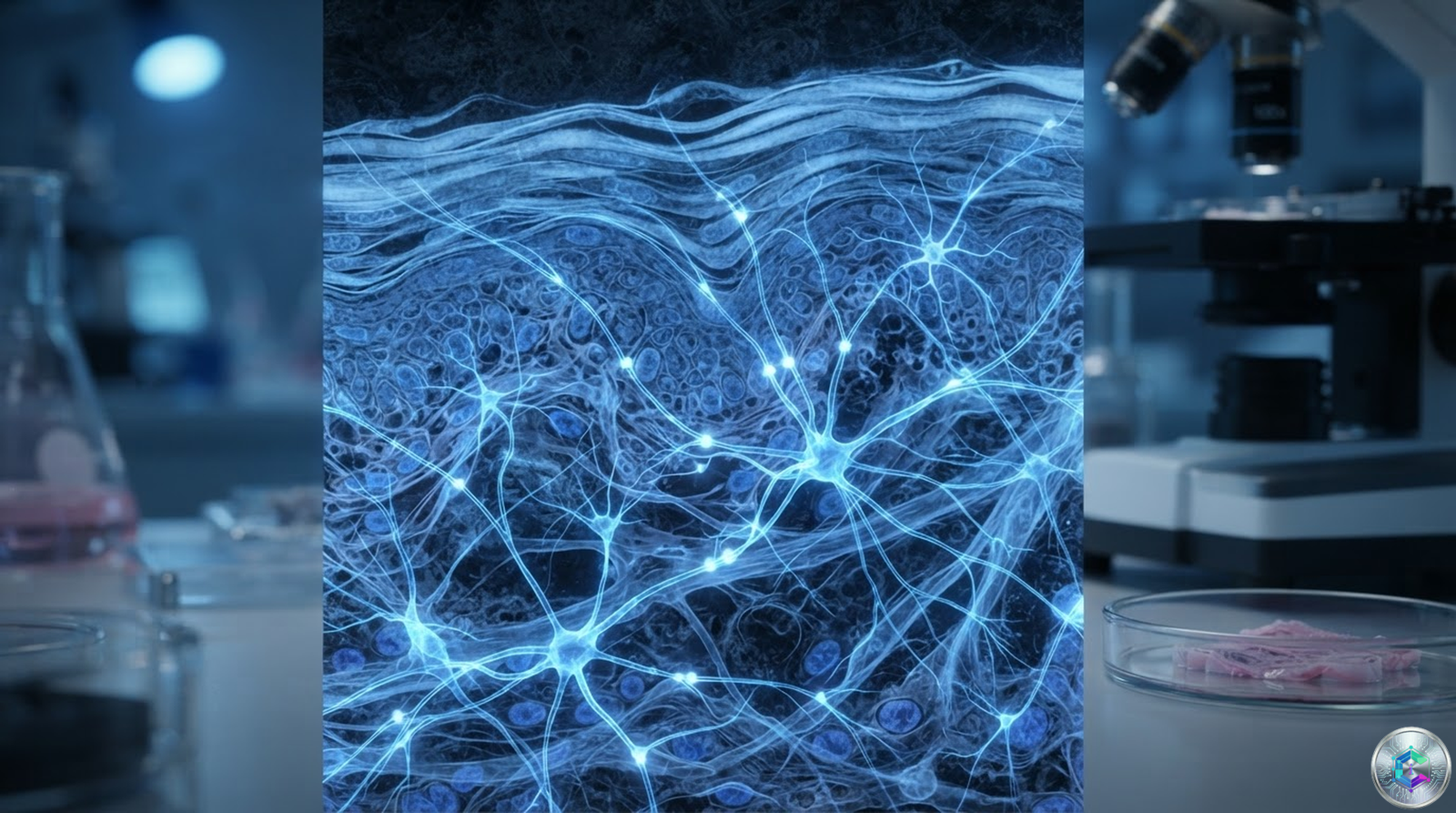
Founded in 2022 by Michael Polansky (CEO), Kyung-Jin Jang (Chief Scientific Officer), Chris Hinojosa (Chief Technology Officer), and Stanley King (Head of Business Development), Outer Biosciences has 19 employees based primarily near Cambridge, Massachusetts. The startup’s initial goal was to bridge the gap between rapid software development and the slow pace of innovation in biology and chemistry, hindered by the lack of ethical methods to experiment directly on human beings.
To solve this problem, the company sources human skin that would otherwise be discarded after surgical procedures, primarily plastic surgery. Samples are provided by biobanks and authorized intermediaries, including the National Disease Research Interchange and the Cooperative Human Tissue Network, both funded by the National Institutes of Health (NIH) and the National Cancer Institute. These organizations operate under institutional review board (IRB) oversight and obtain documented donor consent. Polansky clarified that each sample arrives already de-identified, with direct information removed upstream.
“The value of the startup is not an isolated piece but how the pieces fit together: human tissue kept alive for weeks, a diverse donor pool subjected to controlled experimental conditions, and repeated molecular measurements.”
Michael Polansky, CEO of Outer Biosciences
The Proprietary System Keeping Skin Alive
The startup developed a proprietary support system that supplies the tissue with nutrients and removes metabolic waste, extending its viability well beyond the industry standard. “The industry standard is a matter of days,” Polansky explained. Outer Biosciences claims it can keep skin alive for over a month, up to a month according to sources. This extended window allows observation of slower biological processes such as collagen remodeling, pigmentation changes, or barrier repair – phenomena that require several weeks to manifest.
The process is structured as a closed loop. An AI model predicts which untested chemical compounds are likely to positively influence a specific skin function. These compounds are then applied to living tissue, and the results – whether they confirm or contradict the prediction – are fed back into the model to refine subsequent iterations. Initially, the company used a “brute force” approach, exploring scientific literature and collaborating with the National Cancer Institute on natural compounds from extreme environments. This initial phase produced several leads in approximately 18 months.
Concrete Results and a Distinct Business Model
With AI integration, Outer Biosciences now generates a new candidate approximately every six weeks, according to Polansky. To date, the company has six active candidates and several dozen additional “hits.” According to internal assessments, four of these six candidates appear likely to lead to commercialization. The market context shows that the number of active ingredients approved for over-the-counter topical drugs is limited to approximately 120-130 according to the FDA, and around 200 if cosmetic ingredients backed by research are included.
| Indicator | Data |
|---|---|
| Skin lifespan (industry standard) | A few days |
| Skin lifespan (Outer Biosciences) | Over one month |
| Total funding raised | ~$23 million USD |
| Employees | 19 |
| Active candidates | 6 |
| New candidate frequency | Every ~6 weeks |
Rather than creating its own consumer brand, Outer Biosciences intends to sell or license its finished ingredients to beauty companies or pharmaceutical groups, which will handle formulation, large-scale production, and market launch. The company has already established collaborative research partnerships, including with a pharmaceutical player studying severe skin rashes caused by certain cancer drugs, as well as with consumer beauty brands seeking to verify whether Outer Biosciences’ data matches their own development and marketing processes.
“Trying to do this privately is difficult. We now want to start working in public.”
Michael Polansky, CEO of Outer Biosciences
The Competitive Landscape and Upcoming Challenges
Regarding competition, Vivodyne, a Philadelphia-based company developing lab-grown human tissues for preclinical testing, announced in August 2026 that it had raised nearly $80 million, including a $38 million seed round and a $40 million Series A, both led by Khosla Ventures. Outer Biosciences positions itself in a narrower niche, focused on discovering cosmetic ingredients from real surgical skin rather than organ-on-chip or microphysiological systems.
Each ingredient must still receive a standardized industry name, then undergo safety testing in accordance with OECD guidelines, before being transformed into a marketable product. The central question remains whether partners will successfully move candidates from this extended tissue window through safety stages and market entry. Nevertheless, Outer Biosciences’ ability to observe longer-term effects could lead to candidates previously invisible with standard acute toxicity tests.
Outlook and Scenarios for the Sector
Outer Biosciences represents an innovative approach that could redefine ingredient discovery standards in the cosmetic and pharmaceutical sectors. By combining artificial intelligence with an extended biological observation window, the startup fills a methodological void that was hindering innovation in these fields. Several scenarios are conceivable: commercial success could encourage other players to adopt similar approaches; conversely, regulatory challenges or scaling difficulties could slow adoption of these methods. Either way, the convergence between AI and synthetic biology observed at Outer Biosciences illustrates a broader trend at the intersection of these two disciplines.
Sources
- TechCrunch – Michael Polansky is training an AI model on skin that’s still alive
- Superpower Daily – Outer Biosciences ingredient AI
- Techspindle
This article is published for informational and educational purposes only. It does not constitute investment advice in any way. Conduct your own research (DYOR) before making any decisions.

