

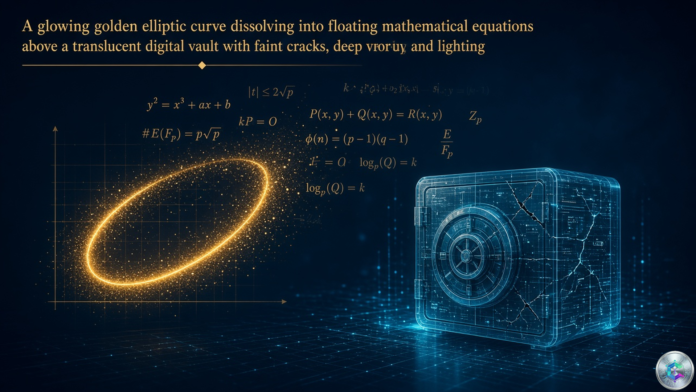
OpenAI’s release of 722 math manuscripts and Justin Drake’s “bunker mode” warning have reignited fears that AI-accelerated mathematics could break the cryptographic foundations of Bitcoin and Ethereum within months.
🔑 Key takeaways
- OpenAI published 722 math manuscripts on GitHub on October 6, 2026, with only 22 % formalized in Lean.
- In May 2026, an OpenAI model autonomously solved the 1946 Erdős unit distance conjecture in the plane.
- Justin Drake urges large holders to begin a controlled migration of ECDSA keys to addresses whose public keys have never been exposed.
- Vitalik Buterin calls for caution without panic, warning that botched migrations can cost more than hacks themselves.
- No practical ECDSA attack has been demonstrated, but cryptographic hardness assumptions could be revised “in months, not years.”
OpenAI dumps 722 math results in a single day
On October 6, 2026, OpenAI released a massive dump of 722 math manuscripts on GitHub, grouped into 372 problem families that were either solved or saw substantial progress. According to a company spokesperson, nearly every result was produced in response to a single prompt to a single AI agent, although some required multiple attempts. On average, each result consumed the equivalent of about three hours of ChatGPT Pro compute.
The covered domains range from the Kakeya conjecture in dimension four to improvements on some of the world’s most important algorithms, including progress on the Riemann hypothesis. Only 162 manuscripts (about 22 %) are accompanied by a Lean formalization, meaning most proofs have not yet been machine-verified. The company acknowledged that “some of the unformalized results could have issues.”
MIT mathematician Andrew Sutherland pushed back: “Until and unless they release the model and people can replicate their results, I think you should treat any claims about one-shotting problems with a single agent as unverified. We should ask for receipts.” Daniel Litt of the University of Toronto saw no reason to keep results secret, Terence Tao called the publication pace “insane,” and Princeton’s Institute for Advanced Study warned that “AI can output mathematical arguments in situations without the human who prompted it being able to understand the arguments, verify them, or take responsibility for them.”
The Erdős conjecture: a historic precedent
This publication builds on a landmark result from May 20, 2026: an OpenAI model autonomously solved the Erdős unit distance conjecture in the plane, posed in 1946. The proof, verified by an external group of mathematicians, leveraged unexpected tools from algebraic number theory, including infinite class field towers and Golod-Chafarevich theory.
“In my opinion this paper demonstrates that current AI models go beyond just helpers to human mathematicians – they are capable of having original ingenious ideas, and then carrying them out to fruition.”
Arul Shankar, Professor at Princeton
The result shows that, for infinitely many values of n, one can construct configurations of n points with at least n^{1+δ} unit-distance pairs, where δ > 0. A refinement by Will Sawin reached δ = 0.014. It is the first time a major open problem in a sub-field of mathematics has been solved autonomously by an AI. Fields medalist Tim Gowers called the advance a “milestone in AI mathematics.”
Justin Drake’s “bunker mode” warning
On October 7, 2026, Ethereum researcher Justin Drake published a post titled “bunker mode” in which he argues that AI could eventually discover a classical algorithm capable of breaking the elliptic curve cryptography (ECDSA) used to secure Bitcoin and Ethereum wallets. The threat differs from the usual quantum concern: Drake argues that unexpected math breakthroughs could allow recovery of private keys without large-scale quantum computers.
“In the worst case, an effective break of the Elliptic Curve Digital Signature Algorithm (ECDSA) could arrive ‘in months, not years’.”
Justin Drake, Ethereum researcher
He urged large holders to begin a controlled migration to addresses whose public keys have never been exposed, and to perform a second transfer to a new address after the first transaction. He cited custodians such as Binance, Bitbank, Robinhood, Bitfinex, and Tether as first candidates to strengthen their cold-storage practices. Haseeb Qureshi, managing partner at Dragonfly, called Drake’s call “very sober”: “The risk is not quantum, but just conventional mathematics overturning unproven cryptographic hardness assumptions.”
Vitalik Buterin: caution, not panic
Vitalik Buterin, Ethereum co-founder, supported Drake’s prudence while warning against overreaction. “I don’t recommend anyone scramble to move their funds to new wallets today. But we should take the risks to cryptography from AI-accelerated math seriously,” he wrote, adding: “I personally have lost more money in botched migrations than I have lost in all hacks combined.”
Buterin extended the warning to cryptosystems based on Euclidean lattices, often considered quantum-resistant. “So far most people have been in the mode of thinking ‘elliptic curves broken, hashes safe, lattices safe.’ But there is a good chance that the concrete security of lattices will take serious hits from the next two years of AI math,” he added, noting that Ethereum is already steering its roadmap toward “hash-only” cryptography.
| Measure | Timeframe | Actors concerned |
|---|---|---|
| Rotate ECDSA keys to hidden-public-key addresses | Immediate | Large holders, custodians |
| Add SPHINCS+ (hash-based signatures) | 6-12 months | Layer 2s, oracles |
| Migrate to “hash-only” cryptography | 2028-2029 | Ethereum core protocol |
| Research in hydrographic cryptography | Long term | R&D, academic researchers |
Concrete measures and outlook
Drake recommends rotating ECDSA keys for oracles and Layer 2 security councils, as well as adding hash-based systems like SPHINCS+. In the long term, he favors hydrographic cryptography, which exposes less exploitable algebraic structure to AI. Ethereum’s post-quantum roadmap currently targets around 2029 for core infrastructure, though the timeline remains subject to change. A second annual post-quantum research workshop is scheduled for October 9-12, and Drake plans to address institutional players in London next month.
Europol had previously warned that quantum computing could eventually compromise crypto-wallet cryptography, recommending that migration not be delayed because coordination and system upgrades take years. Market reactions have so far been limited to expert statements and calls for caution, with no documented price moves.
Conclusion
No practical attack on ECDSA or RSA has been demonstrated to date, but the hardness assumptions underlying the main cryptosystems could be revised faster than expected. OpenAI’s advances, from the autonomous Erdős result in May to the dump of 722 manuscripts in October, have turned a theoretical risk into an operational concern for custodians and large holders alike.
Drake’s “bunker mode” is closer to prevention than to panic: it is about initiating today the gentle migrations that would become impossible to coordinate the day a flaw is published. Ethereum’s roadmap toward hash-only cryptography and the gradual adoption of SPHINCS+ sketch a credible resilience scenario, provided that post-quantum research keeps pace through 2029.
Sources
- CryptoSlate — OpenAI’s math breakthrough raises fears of AI breaking Bitcoin and Ethereum
- OpenAI — Model disproves discrete geometry conjecture
- Scientific American — OpenAI unleashes hundreds more math results
- Decrypt — OpenAI secret AI model cracked hundreds of math problems
- Cointelegraph via TradingView — Justin Drake urges crypto bunker mode
- Hacker News discussion thread
This article is for informational and educational purposes only. It does not constitute investment advice. Do your own research (DYOR) before making any decision.

