


US stock futures rallied sharply on Monday after a week of losses driven by artificial intelligence (AI) stocks. The Nasdaq 100 had posted its worst week since March 2020, and Asian authorities are now rolling out support measures. Our read: the pause is real, but the question of whether AI spending will generate sufficient returns remains unanswered.
🔑 Key takeaways
- Nasdaq 100 futures up +3.5% and S&P 500 futures up +2.8% at 12:00 GMT.
- The Nasdaq had fallen 10% the previous week, its largest drop since March 2020.
- Taiwan +2.4%, South Korea’s KOSPI -3.3%: public support with mixed effects.
- Dollar index at 103.9, gold at $3,620 an ounce, Brent at $91.3 a barrel.
A Pause After the Worst Week for Stocks Since 2020
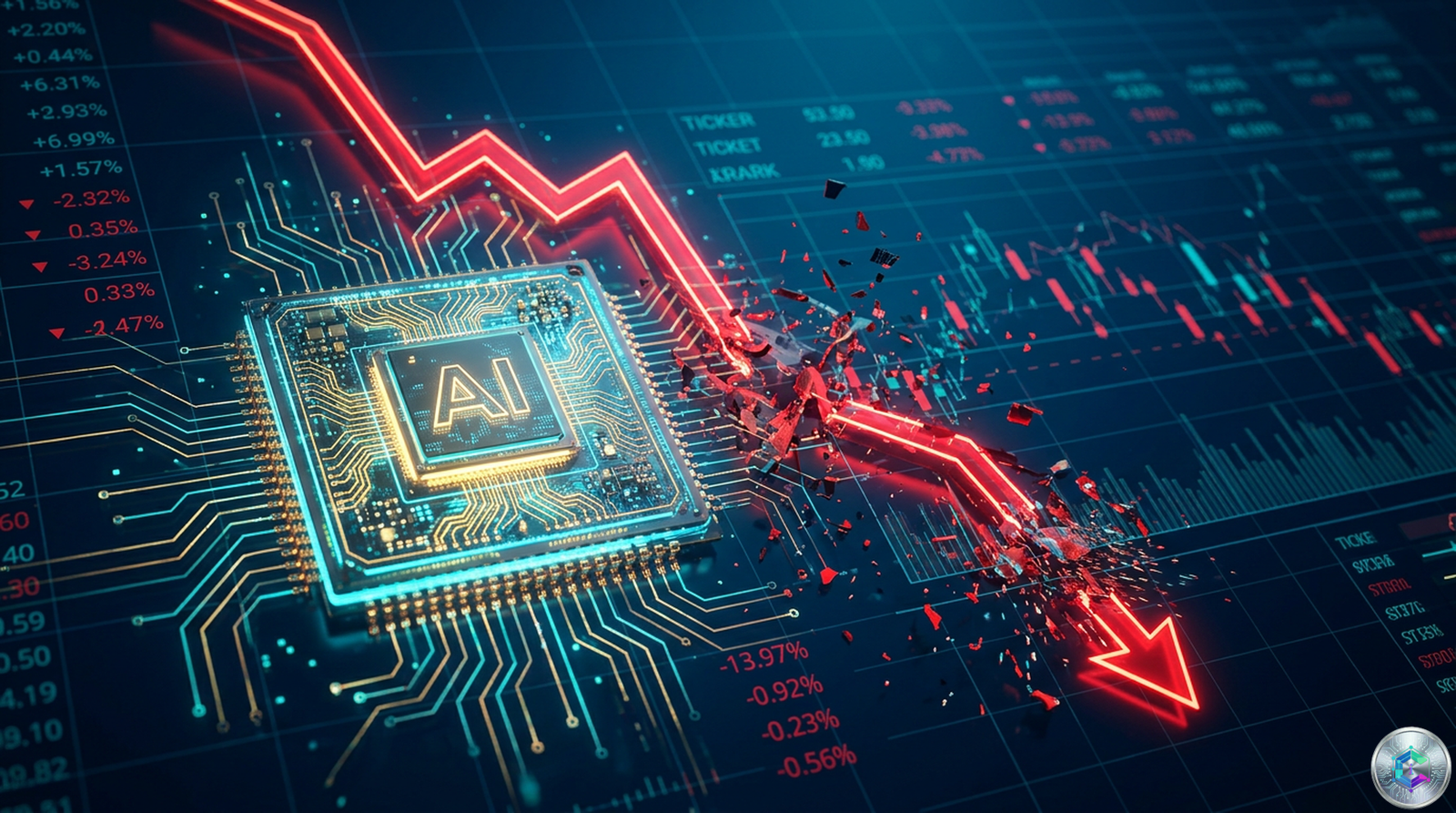
The rebound in US futures comes against a backdrop of a global correction in risk assets. The previous week, the Nasdaq had shed 10%, its steepest decline since the pandemic-driven selloff of March 2020. Wall Street’s fear gauge, the implied volatility index, rose above 40 for the first time since April 2025, a sign of heavy demand for protection.
In Europe, the STOXX 600 gained 0.8% on Monday, led by semiconductor and other technology names. European equities, which have less exposure to technology, had nonetheless posted their worst weekly performance in almost eight months. The US futures rally also reflected easing demand for safe-haven assets after their sharp gains on Friday.
For now, the move looks more like a technical respite than a confirmed reversal. Investors are asking whether positions built during the AI boom, which began roughly four years ago with the launch of ChatGPT, are still justified by corporate earnings.
Doubts Over Returns, the Fed and Nvidia’s Leadership
The correction was fed by several concerns. The first concerns the vast sums invested in AI data centres: investors doubt they will generate enough profit to justify the spending. Fears of tighter Federal Reserve policy, a leadership crisis at Nvidia and a possible slowdown in AI-related spending after the US midterm elections also weighed on the market.
Spending Still Looks Solid
Despite these doubts, analysts expect AI-related spending to remain robust. Morgan Stanley forecast that capital expenditure by hyperscale cloud operators would rise by more than 70% the following year, to more than $1.6 trillion. That projection contrasts with a market mood that had deteriorated markedly over the week.
| Indicator | Level | Reading |
|---|---|---|
| Nasdaq 100 futures (12:00 GMT) | +3.5% | Rebound after a 10% weekly drop |
| S&P 500 futures | +2.8% | Pause in the correction |
| Hyperscale cloud capex (following year) | > $1.6 trillion | Forecast increase of more than 70% |
The departure of Jensen Huang, Nvidia’s chief executive and a central figure in the sector, has called into question the chipmaker’s strategy of financing some of its customers. The rocky debut of Anthropic, which fell 8.5% on Friday in its first full session of trading, further unsettled investors.
“It was no longer simply a sell-off in technology stocks.”
Jim Reid, strategist, Deutsche Bank
Reid’s point is that fears about AI spread into a broader de-risking move, pushing international investors to raise cash. That transmission channel explains why assets far from the technology sector also came under pressure.
Asia Between Public Support and Selling Pressure
Asian markets were mixed on Monday. Taiwanese shares rose 2.4%, with government support helping to stabilise a market heavily exposed to chipmakers. In the previous week, the Taiwanese index had suffered its largest decline since 1990.
South Korea’s KOSPI continued to fall, by about 3.3%, after moving away from ten-month lows. The index had been the standout performer in global equities in the first half of the year, as bets on chip demand more than doubled its value in six months. After the correction, it has nonetheless lost half of its value from its peak. The South Korean finance minister reiterated his intention to stabilise the market if necessary.
Taiwan’s financial regulator ordered tighter rules on short selling. In China, exchanges announced a package of support measures, including easing margin financing conditions. Japanese markets were closed for a public holiday, but futures pointed to selling pressure.
| Market | Move | Measure or context |
|---|---|---|
| Taiwan | +2.4% | Government support; tighter short-selling rules |
| South Korea (KOSPI) | -3.3% | Half of value lost from peak |
| Mainland China | Multi-month low | Easing of margin financing conditions |
| Hong Kong | Multi-month low | Package of support measures announced |
Dollar, Bonds, Gold and Oil: A Signal of Caution
The US dollar index stayed below the nineteen-month highs reached on Friday against a basket of currencies, at 103.9. Its easing helped gold recover part of its losses, rising 2.5% to $3,620 an ounce. Bitcoin edged up 0.7%, a modest move that suggests crypto markets were not immune to the risk-reduction mood.
Ten-year US Treasury yields gained 4.6 basis points to 4.95%, while German Bund yields, the eurozone benchmark, were flat at 3.30%. Oil fell, with Brent down 1.3% at $91.3 a barrel, as higher Middle Eastern supply offset concern over persistent attacks on shipping and refineries in the region.
| Asset | Level | Change |
|---|---|---|
| US dollar index | 103.9 | Flat, below 19-month high |
| Gold (ounce) | $3,620 | +2.5% |
| Bitcoin | Not specified | +0.7% |
| US 10-year Treasury yield | 4.95% | +4.6 basis points |
| German 10-year Bund | 3.30% | Flat |
| Brent (barrel) | $91.3 | -1.3% |
Note on Quote Discrepancies
Versions of the Reuters report show slight differences. An earlier version showed the Nasdaq 100 up 3.3% and Taiwan up 2.1%, with the US 10-year yield at 4.96%. The figures used in this article come from the version updated at 12:00 GMT. The sources do not specify the time of each quote, so these levels cannot be reconciled precisely.
Outlook: A Pause, Not Yet a Reversal
The bullish scenario rests on confirmation that AI infrastructure spending remains elevated and that earnings follow. In that case, the correction would look like a valuation reset, and Asian public support would help stabilise regional markets.
The bearish scenario rests on monetary tightening. Investors had been pricing a possible Federal Reserve rate increase the following month, although the correction had led traders to scale back expectations of an aggressive hike. Dell’s results, expected on Tuesday, and upcoming US economic data will serve as tests for both scenarios.
Sources
- Global Banking and Finance, Reuters report of 23 November 2026
- Yahoo Finance, Reuters report of 23 November 2026
- Lufkin Daily News, Reuters report of 23 November 2026
- Devdiscourse, Reuters report of 23 November 2026
- TradingView, Reuters report of 23 November 2026
- Euronext Live, Reuters report of 23 November 2026
Cet article est publié à titre informatif et éducatif. Il ne constitue en aucun cas un conseil en investissement. Faites vos propres recherches (DYOR) avant toute décision.

