


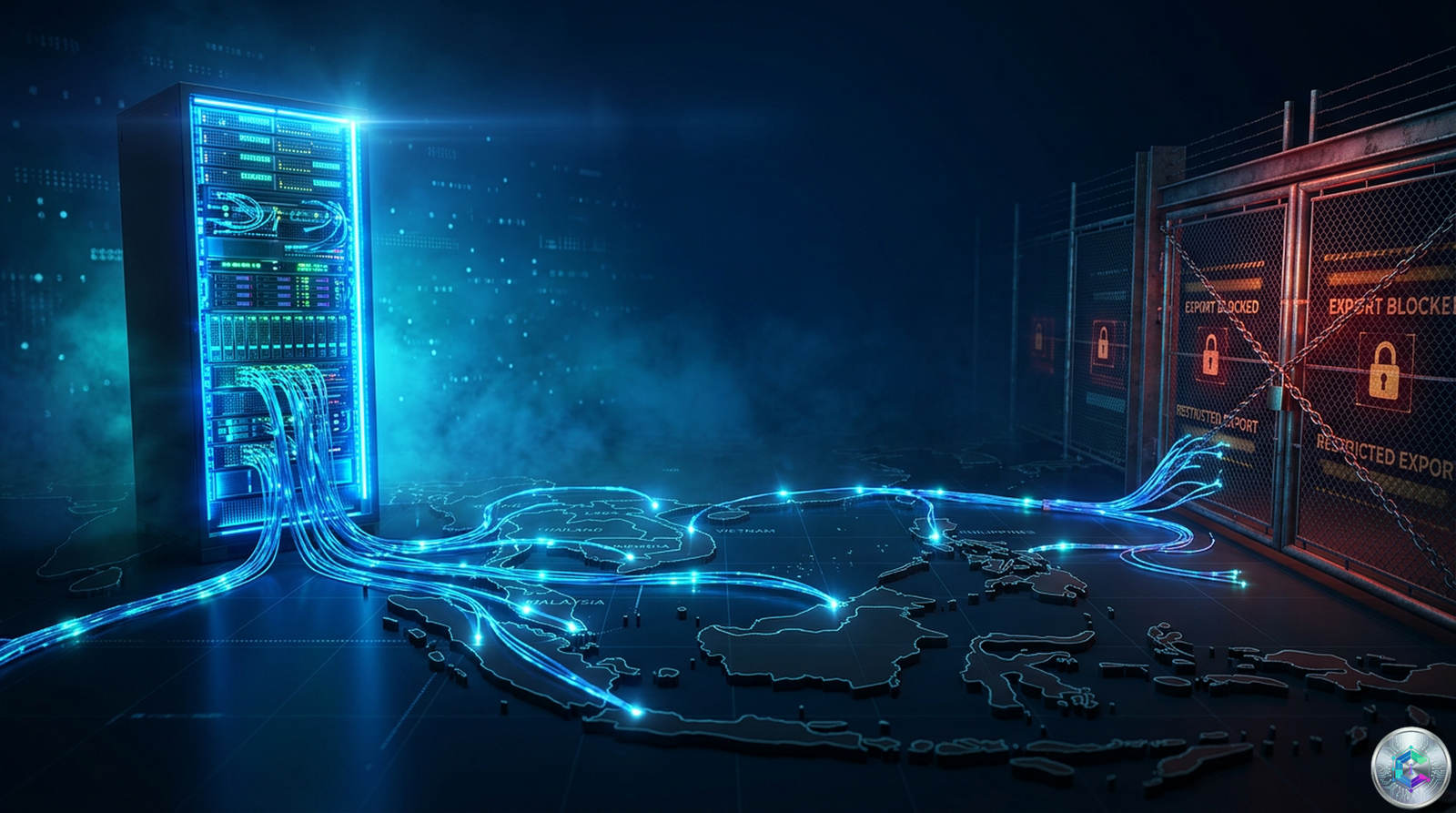
Nvidia has reportedly told manufacturing partners to halt shipments of its most advanced AI servers to Malaysia, Singapore, Thailand and Indonesia. The move follows a new US rule that puts remote access to computing power under license requirements. It signals how far Washington is willing to go to close the cloud loophole, and its effects are already rippling through regional data center financing and the secondhand GPU market.
🔑 Key Takeaways
- Nvidia has reportedly asked partners to suspend shipments of advanced AI servers to Malaysia, Singapore, Thailand and Indonesia.
- The Commerce Department rule, effective November 19, 2026, targets remote access to compute through data centers in third countries.
- Existing data centers have 90 days, until February 17, 2027, to apply for a license.
- Banks have suspended loans of roughly $480 million to $500 million tied to a Singapore-based cloud provider.
A shipment freeze across four Southeast Asian markets
On November 26, 2026, the Financial Times reported, citing three people familiar with the matter, that Nvidia had asked its manufacturing partners to stop shipping servers built around its most advanced processors to Malaysia, Singapore, Thailand and Indonesia. Dell and Supermicro reportedly told customers in those four countries that their orders could no longer be delivered. The duration of the suspension is unknown. Nvidia and its partners are still working out how to comply with the new US rules. At this stage, the reporting relies on anonymous sources, and the company has not issued an official confirmation in the material reviewed.
Closing the remote-access loophole
US restrictions already barred Chinese companies from buying Nvidia’s most advanced chips directly in the United States. Their workaround was to rent computing capacity remotely from data centers in third countries, particularly in Southeast Asia. These facilities sit roughly four to six hours’ flight from Hong Kong, Shenzhen and Shanghai, a relatively short direct link. Some firms reportedly also explored placing their workloads in Europe.
Key parameters of the rule
| Parameter | Detail |
|---|---|
| Announcement | November 16, 2026, interim final rule from the Bureau of Industry and Security |
| Effective date | November 19, 2026 |
| Transition period | 90 days for existing data centers, until February 17, 2027 |
| Threshold | More than 12 million TPP, roughly the capacity of 750 Nvidia H100 or H200 GPUs, according to TechCrunch |
| Group D:5 | China, Russia, Iran, North Korea and 18 other countries |
| Enhanced-scrutiny countries | Malaysia, Singapore, Indonesia, Thailand and Brazil |
According to Trending Topics, any exporter of chips or AI servers to a data center anywhere in the world must obtain a license if that facility may supply computing power to companies from the listed countries. Intermediaries and brokers must verify the ownership structure and activities of their customers. US companies are exempt for their own use, provided they report recipients, destinations and products. Recommendation systems, such as those used in e-commerce and social networks, are not affected.
Megaspeed sits at the center of the policy
Singapore-based data center operator Megaspeed, which also operates in Malaysia, has become the case that frames the policy. The company reportedly bought more than $4.8 billion (about 4.3 billion euros) of Nvidia chips over the past two years. US authorities suspect it used those chips to supply computing power to Chinese companies and to circumvent export controls. Megaspeed denies sending chips to China. The Commerce Department added the company to its Entity List, which requires suppliers, including Nvidia, to obtain a US license before delivering covered goods. The Justice Department is also investigating a possible violation of the controls.
“This new control is a logical extension of existing controls.”
US Department of Commerce, final rule, November 2026
The Wall Street Journal, cited by Trending Topics, reported that the Treasury Department had long sought to add Megaspeed to that list without action from Commerce. Treasury Secretary Scott Bessent reportedly then warned Nvidia about its activities in China. These accounts come from media reports and are not documented in a public decision.
A secondhand market heating up as financing tightens
The effects are already visible. According to CNBC, resellers have listed an unusually high number of GPUs since the announcement, a rise that Jack Duhamel, head of AI GPU infrastructure platform GPU Mart, and two other industry sources directly link to the new rules. The offers include thousands of B300 chips based on Nvidia’s Blackwell architecture, originally intended for data centers rented to Chinese customers. GPU Mart said a company seeking to sell these GPUs confirmed to it that the new rules made the chips affected. Reuters reported that Chinese companies had also moved to secure overseas computing capacity before the rules took effect. According to Trending Topics, a recent forensic analysis of large Chinese models suggests that Chinese labs kept obtaining the latest Nvidia chips despite the ban; that claim remains to be verified.
“There is this new rule, but no instructions on how to implement it. Nobody knows how to apply for this license while the 90-day clock runs. It is causing total chaos in the region.”
Executive at a regional cloud provider, quoted by the Financial Times
Project financing under pressure
The Financial Times reported that banks have suspended about $500 million in loans for Aolani, a Singapore-based cloud provider planning to supply AI computing to ByteDance, the parent company of TikTok. ByteDance could withdraw its agreement. Biz.Chosun, citing Bloomberg, gives a slightly different figure: a $480 million loan, or about 645 billion won, to buy Nvidia GPUs for a data center in Malaysia. The sources do not establish whether the gap reflects a difference in scope or in the financing stage. Lenders are reassessing their exposure to the risk of breaching the new US rules.
Nvidia’s considerable regional exposure
According to figures cited in the source material, Nvidia booked $104 billion in revenue in 2025 through its Singapore subsidiary, up 72% year over year. This figure should be checked against official company filings before it is relied upon. Singapore and Malaysia rank among Asia’s most dynamic data center hubs, having attracted multibillion-dollar investments from major cloud providers.
The political backdrop matters as well. The rule came just days before President Donald Trump’s planned trip to China for an economic summit with Xi Jinping. The Seoul Economic Daily described it as a hasty response to criticism that the Commerce Department had moved too slowly in the Megaspeed case. Nvidia had warned that restrictions on remote access could produce adverse consequences for the United States, according to Gizmodo via Trending Topics.
On governance, Engadget reported that Jensen Huang stepped down as chief executive on November 12 after reports of several extramarital relationships, including one with Alice Huang, a former Megaspeed executive whom some US officials suspect of being a Chinese intelligence agent. Trending Topics reports that Huang reportedly acknowledged the relationship, and that the suspension surfaced a few days after he resumed his role. These are personal matters and unverified suspicions. They are not confirmed here and do not by themselves explain the decision.
Outlook and scenarios
In the near term, the central question is whether operators can secure licenses within the 90-day window. Without clear procedures, the freeze could persist and weigh on deployment schedules across the region. The sources do not say whether shipments will resume once licenses are granted or once the deadline passes.
| Scenario | Assumption | Signal to watch |
|---|---|---|
| Normalization | Licenses granted quickly, shipments resume | Commerce publishes application procedures |
| Extension | Freeze runs beyond 90 days | Further delays at Dell and Supermicro |
| Tightening | More entities or countries added to the framework | New listings on the Entity List |
For the market, the stakes reach well beyond Southeast Asia. The issue is where legitimate cloud use ends and circumvention begins. Regional operators, lenders and Nvidia will need to document the ownership structure and end users of their customers. The most reliable signals will come from Bureau of Industry and Security publications and from manufacturers’ order books.
Sources
Cet article est publié à titre informatif et éducatif. Il ne constitue en aucun cas un conseil en investissement. Faites vos propres recherches (DYOR) avant toute décision.

