

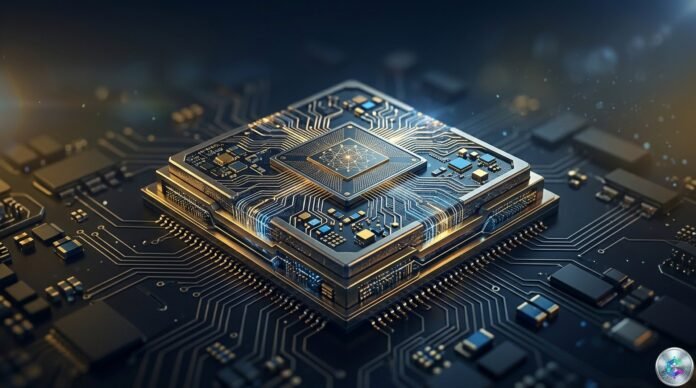
Microsoft officially unveiled its Azure Maia 300 inference accelerator on October 12, 2026, at the OCP Global Summit 2026 in San Jose. This third-generation custom chip marks a new milestone in the tech giant’s in-house silicon strategy, with the explicit goal of reducing dependence on Nvidia while optimizing the operational costs of AI inference.
🔑 Key takeaways
- The Maia 300 integrates 4 TSMC N2P 2nm chiplets and 288 GB of HBM4 memory
- A full 96-chip rack delivers 18 TB/s of peak memory bandwidth
- Microsoft claims 40% better energy efficiency in tokens per megawatt vs leading GPUs
- Production starts in 2027 with multi-gigawatt deployments planned
- Evercore ISI estimates Maia will account for ~10% of Microsoft’s AI chip spend in Q1 2027
Multichiplet architecture and technical specifications
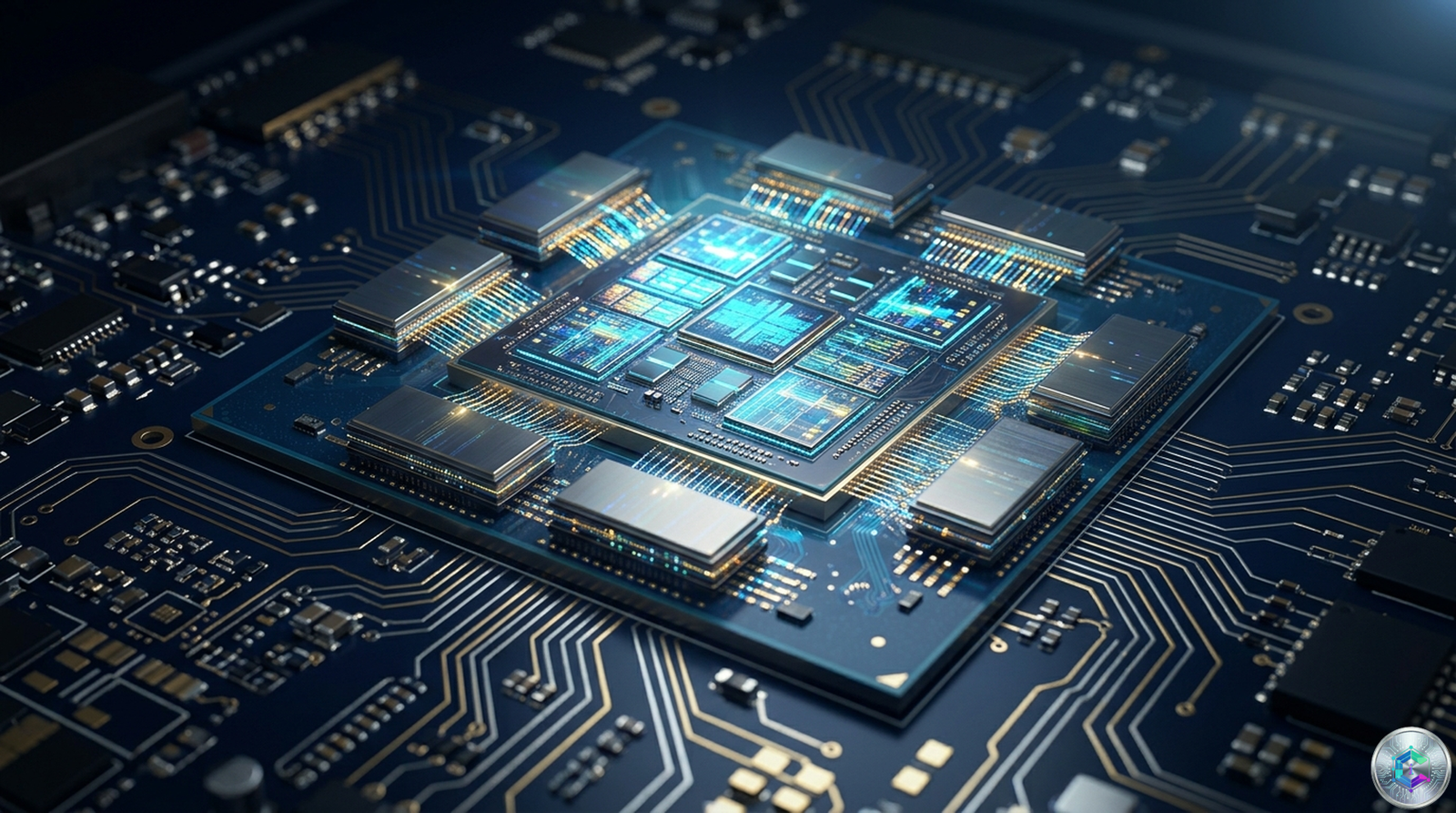
The Maia 300 is built on a multichiplet architecture that combines four compute dies manufactured on TSMC’s N2P node (2 nanometer Plus). The package carries eight HBM4 modules totaling 288 GB of memory — the same capacity as Nvidia’s Rubin accelerator, but with roughly 20% lower memory bandwidth.
Each rack houses 96 accelerators arranged in trays of four chips, wrapped in a 950-watt design thermal envelope. A fully populated rack delivers the following specifications:
| Specification | Maia 300 (full rack) |
|---|---|
| Number of accelerators | 96 |
| HBM4 capacity | 27.6 TB |
| Peak memory bandwidth | 18 TB/s |
| Aggregate HBM bandwidth | 1.7 PB/s |
| Power envelope | 167 kW |
The core innovation lies in the software-defined dataflow architecture. According to executives Rani Borkar and Saurabh Dighe, this design minimizes data movement by keeping information in an on-chip SRAM cache (fast static memory) rather than shuttling it back to HBM stacks. Low-precision compression formats, notably MXFP4, further reduce memory footprint and accelerate internal transfers.
Performance and energy efficiency gains
Microsoft claims 40% better energy efficiency in tokens per megawatt (a measure of text throughput per unit of energy) compared with leading GPU systems, implicitly targeting Nvidia products. At full rack scale, the Maia 300 delivers up to seven times the token throughput of the Maia 200.
The Maia 200, introduced in January 2026 and now in production, already validates this approach. Scott Guthrie, corporate vice president of Cloud + AI, said the previous generation delivers 1.7x more tokens per watt for AI features embedded in Teams, Copilot, and Cowork. Satya Nadella stated in July 2026 that the Maia 200 offers 30% better performance per dollar than the latest generation of hardware in Microsoft’s fleet.
“Nobody outside Microsoft has tested them yet. Unlike Google’s TPUs or Amazon’s Trainium, these accelerators are not available for hourly rental to external customers.”
Patrick Moorhead, CEO of Moor Insights and Strategy
Superpods, networking, and deployment roadmap
Microsoft groups its Maia 300 racks into superpods of 12,288 accelerators. The interconnect relies on a custom Ethernet fabric that dynamically adjusts bandwidth between intra-rack and inter-rack traffic. Unlike traditional architectures that require distinct CPUs or networking chips to switch between these two modes, the Maia 300 uses the same communication semantics in both cases — eliminating extra hardware and improving accelerator utilization.
Maia 300 production begins in 2027. Microsoft is planning multi-gigawatt deployments for the Maia family starting that year, making these chips the primary inference system for its products and services. The Maia 200 already powers Microsoft Copilot, OpenAI models, in-house MAI models, and several open-source families, with deployments across the United States, Europe, and Australia.
Financial implications and competitive context
Evercore ISI analysts estimate that Maia will account for roughly 10% of Microsoft’s AI chip spend in Q1 2027. Their rating on the stock remains Buy, suggesting the transition is viewed as value-accretive for shareholders. CFO Amy Hood said at a Goldman Sachs conference last month that in-house silicon has contributed to “a decade of margin improvement.”
Nvidia, however, remains a central player. Jensen Huang spoke at an event where Microsoft announced a Surface laptop powered by an Nvidia processor. For model training, Microsoft is keeping its partnerships with both Nvidia and AMD, according to Alistair Speirs, a general manager at Microsoft. The objective is not to replace Nvidia, but to reclaim control over inference — the most expensive phase to operate at scale.
Conclusion
The Maia 300 marks a decisive step in Microsoft’s silicon sovereignty strategy. By targeting inference specifically — the most energy-hungry phase once models are deployed — the company aims to optimize margins while securing its supply chain. The coming quarters will reveal whether this technology bet translates into a measurable competitive edge against the Nvidia ecosystem, which remains dominant for training foundation models.
Sources
This article is published for informational and educational purposes only. It does not constitute investment advice. Do your own research (DYOR) before making any decision.

