


Singapore-based stablecoin payments firm dtcpay has closed a $25 million Series A round on September 18, 2026, with Japan’s SBI Group entering as a strategic investor. The round, led by Vertex Ventures Southeast Asia & India, positions the fintech as a key infrastructure layer for stablecoin-based cross-border payments across Asia.
🔑 Key takeaways
- dtcpay raises $25M in Series A funding with SBI Group as a strategic investor.
- The round is led by Vertex Ventures Southeast Asia & India, with a first closing in March-April 2026.
- The firm holds a Major Payment Institution license from MAS and operates in Luxembourg, Hong Kong, Australia, the US and Canada.
- dtcpay offers a stablecoin POS terminal, a Visa partnership and WalletConnect integration covering 700+ wallets.
- SBI Group is consolidating a regional playbook: Coinhako acquisition, RLUSD distribution, and Circle’s Arc validator role.
Vertex-led round, with SBI Group joining as strategic investor
The Series A round was opened in early 2026 by Vertex Ventures Southeast Asia & India, with a first closing in March-April 2026. Japan’s SBI Group subsequently joined the round through two vehicles: SBI Ventures Asset Pte Ltd and the SBI-NTU-Kyobo Digital Innovation Fund. Existing backers Genedant Capital and Singaporean businessman Kwee Liong Tek maintained their positions, according to sources cited by The Block.
dtcpay did not disclose SBI’s individual ticket size nor the post-money valuation (company value after the investment), nor the precise split of the $25M between participants. The company also did not share revenue figures. Founder and CEO Alice Liu and group chairman Band Zhao co-founded dtcpay in 2019; the company had previously raised $16.5M in a pre-Series A in June 2023.
According to Dealroom, this $25M round ranks in the top 10% of all Series A rounds raised by Singapore-based companies, signalling institutional appetite for stablecoin infrastructure that bridges digital assets and TradFi (traditional finance).
Alice Liu framed the round’s ambition: « We did not raise this round to maintain what we have built. We raised it to fundamentally change how money moves across borders. »
« We did not raise this round to maintain what we have built. We raised it to fundamentally change how money moves across borders. »
Alice Liu, Founder and CEO of dtcpay
A regulated, multi-jurisdiction stack
dtcpay delivers a tech stack that enables businesses and individuals to accept, store and transact in stablecoins (tokens pegged to fiat currencies, most commonly the US dollar). The platform combines digital-asset conversion, custody (secure storage of digital assets) and a real-time swap engine (instant exchange between stablecoins and fiat currencies) for transaction settlement.
On the regulatory side, dtcpay holds the Major Payment Institution (MPI) license from the Monetary Authority of Singapore (MAS), a stricter regime than the standard payment-institution license once certain transaction thresholds are crossed. The firm also holds an e-money institution license in Luxembourg, and has regulatory footprints (registrations or licenses) in Europe, Hong Kong, Australia, North America, the US and Canada.
| Jurisdiction | Regulatory status |
|---|---|
| Singapore | Major Payment Institution (MAS) |
| Luxembourg | E-money institution |
| Europe, Hong Kong, Australia | Active regulatory footprints |
| United States, Canada | Local licenses or registrations |
Multi-jurisdiction coverage lets dtcpay serve corporate clients on fully regulated cross-border corridors, a meaningful differentiator versus competitors operating purely on-chain (directly on a blockchain) without fiat integration.
Strategic partnerships: Visa, WalletConnect, BNB Chain and Metro
dtcpay has assembled a partnership stack designed to accelerate merchant adoption. The firm partnered with Visa to launch a stablecoin-to-fiat card (instant conversion of stablecoins into fiat currency at the point of sale) usable across the Visa merchant network, alongside a stablecoin POS terminal (point-of-sale device) for in-store acceptance.
Through WalletConnect, users access stablecoin payments via 700+ supported wallets. dtcpay also partnered with BNB Chain to broaden its settlement rails. On the ground, the firm enabled department store Metro to become the first Singapore department store to accept stablecoin payments.
Band Zhao stressed the current phase: « the next chapter for dtcpay is scale », pointing to infrastructure investments, partnerships with global financial institutions and expansion into new regulated markets. The proceeds will fund a corporate portal for professional clients, mobile app upgrades and merchant network expansion.
SBI Group’s regional playbook around Japan-Asia corridors
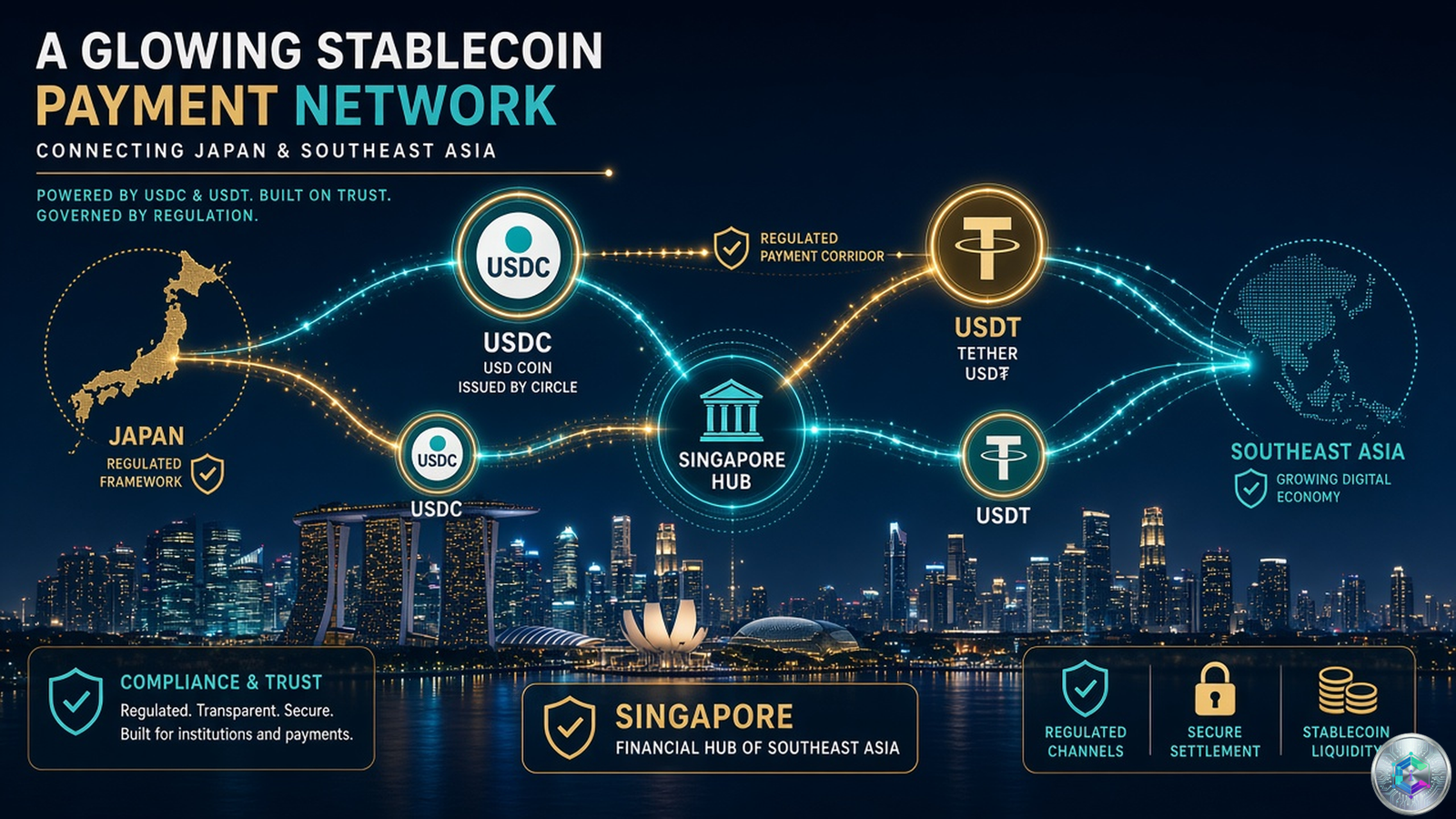
SBI Group’s investment in dtcpay fits a broader strategy of building fully regulated payment corridors linking Japanese capital with Southeast Asian commerce. Recent moves chart this roadmap:
- Acquisition of Singapore-based platform Coinhako.
- Multi-billion-dollar participation in Ripple to distribute the RLUSD stablecoin.
- Founding validator role on Circle’s Arc network (a blockchain built for stablecoin payments).
dtcpay therefore becomes a complementary infrastructure layer: Coinhako serves retail, RLUSD and Arc address interbank liquidity, and dtcpay covers merchant acceptance and B2B (business-to-business) settlement.
The stablecoin payments market: a booming segment
Stablecoin payments have become one of the most active segments of the crypto industry over the past two years. These firms build infrastructure enabling businesses to accept, settle or move value using fiat-pegged tokens. The pitch: faster settlement and materially lower transaction costs than traditional cross-border rails.
« Where traditional cross-border transfers via SWIFT and correspondent banking networks are often slowed by multi-day settlement cycles, dtcpay settles transactions at a fraction of the cost. »
dtcpay, official statement
dtcpay sits in the same wave as players such as StraitsX, BVNK or Triple-A, but pairs its MPI regulatory profile in Singapore with an integrated Visa card — two elements that ease onboarding (integration) for corporates traditionally cautious about digital assets.
Conclusion: consolidation of stablecoin infrastructure in Asia
This $25M round validates several structural trends: the entry of Japanese financial groups (SBI) into crypto payment infrastructure, Singapore’s attractiveness as a post-MAS regulatory hub, and the convergence of stablecoins with card networks (Visa) and decentralized wallets (WalletConnect). In the short term, execution will hinge on the corporate portal rollout and merchant adoption velocity in Singapore and the region. In the medium term, the key variable will be the activation of JPY ↔ SGD and SGD ↔ USD corridors via SBI’s existing partners.
Sources
- The Block — dtcpay Series A funding (September 18, 2026)
- Cryptonomist — dtcpay Series A coverage
- Dealroom — dtcpay $25M Series A analysis
- KuCoin News — dtcpay SBI Group round
- Biggo Finance — dtcpay Series A
- Newscord — SBI Group backs dtcpay
This article is published for informational and educational purposes only. It does not constitute investment advice. Do your own research (DYOR) before making any decision.

