

Core Scientific, a historic Bitcoin miner, confirms it will fully exit mining by the end of 2026 to concentrate on artificial intelligence and high-performance computing (HPC). The move reflects a broader split in the sector: mega-campuses are converting to AI, while miners with cheap power stay on the network.
🔑 Key Takeaways
- Core Scientific will stop mining by late 2026: its self-mining revenue fell from $57.4 million to $12.3 million in one year.
- Estimates of Bitcoin’s production cost diverge sharply: $137,800 per BTC for CoinShares, $93,700 in Vitalik Buterin’s breakdown.
- Converting to AI costs $8 to $15 million per MW, versus $700,000 to $1 million for a classic mining site.
- Financing, rather than demand, is the main constraint, with listed miners needing roughly $50 billion in the short term.
An Exit From Mining Already Visible in the Accounts
On the third-quarter 2026 earnings call, CFO Jim Nygaard recalled that the pivot had first been announced in July. CEO Adam Sullivan argued that the strategy should simplify the business and allow the company to concentrate its resources on more attractive long-term growth opportunities. The figures show that self-mining has become a residual part of the business.
- $12.3 million in self-mining revenue in Q3 2026, versus $57.4 million a year earlier, a decline of roughly 79%.
- $5.2 million in hosting revenue from other miners, down from $8.7 million in Q3 2025.
- Together, these two activities now account for just 7.5% of quarterly revenue of $232.9 million.
- Colocation revenue rose by almost 60% sequentially to $215.4 million, driven by the continued delivery of billable megawatts.
The growth engine is therefore contractual. Core Scientific hosts CoreWeave’s infrastructure under an agreement covering about 500 MW of AI-oriented HPC capacity. In July, the company announced a second high-density colocation contract with AMD and a ‘Neocloud’ client, covering roughly 530 MW across five sites that are still under construction.
The transition also involves selling a significant share of the company’s Bitcoin holdings. In May 2026, Morgan Stanley committed up to $1 billion of financing to support this step. Execution remains exposed to politics, however: the midterm elections brought to power some Democrats who oppose data center development.
Production Costs: Estimates Diverge
CoinShares’ Q4 2025 mining report described a “breaking point”. In Q2 2025, the average cash cost for public miners to produce one Bitcoin reached about $74,600, while the total cost stood at $137,800. The average hashprice hovered around $50 per PH/s per day before falling further after the halving. CoinShares expects a range of $37 to $55 through 2028, unless a Bitcoin rally outpaces hashrate growth.
Even so, network hashrate crossed 1 zettahash/s for the first time in August 2025. Public miners contributed only about 80 EH/s to that annual growth, with most of the expansion coming from private operators, sovereign miners and energy players enjoying lower power costs. Transaction fees fell below 1% of block rewards in May and June 2025 and no longer offset the shrinking subsidy.
On October 17, 2026, Vitalik Buterin, Ethereum co-founder, published on X a cost table valuing Bitcoin mining at about $93,700 per coin. The breakdown is shown below.
| Cost item | Estimated amount per BTC | Share of total cost |
|---|---|---|
| Electricity fed directly into machines | $40,600 | about 43% |
| Other electricity spending | $2,400 | about 3% |
| Compute capex (hardware, cooling, electrical equipment, financing) | $37,600 | about 40% |
| Other items (labor, leasing, maintenance, insurance, taxes, bandwidth) | balance | about 14% |
| Total | $93,700 | 100% |
On this basis, electricity accounts for about 46% of cost and compute capex for 40%. The total is closer to JPMorgan’s $85,000 estimate, cited by BeInCrypto, than to CoinShares’ $137,800. The sources do not say whether differences in periods, scope or accounting conventions explain the gap. The table also exceeded Bitcoin’s market price at the time of publication, meaning an average miner would not have covered its full costs.
“Fun fact of the day: Bitcoin mining cost is split about 50/50 between compute capex and electricity. Meanwhile, AI inference is almost completely dominated by compute capex.”
Vitalik Buterin, Ethereum co-founder, on X, October 17, 2026
The contrast is clear: mining depends as much on power as on hardware, while AI inference relies mostly on chips.
AI Versus Mining: Two Different Economics
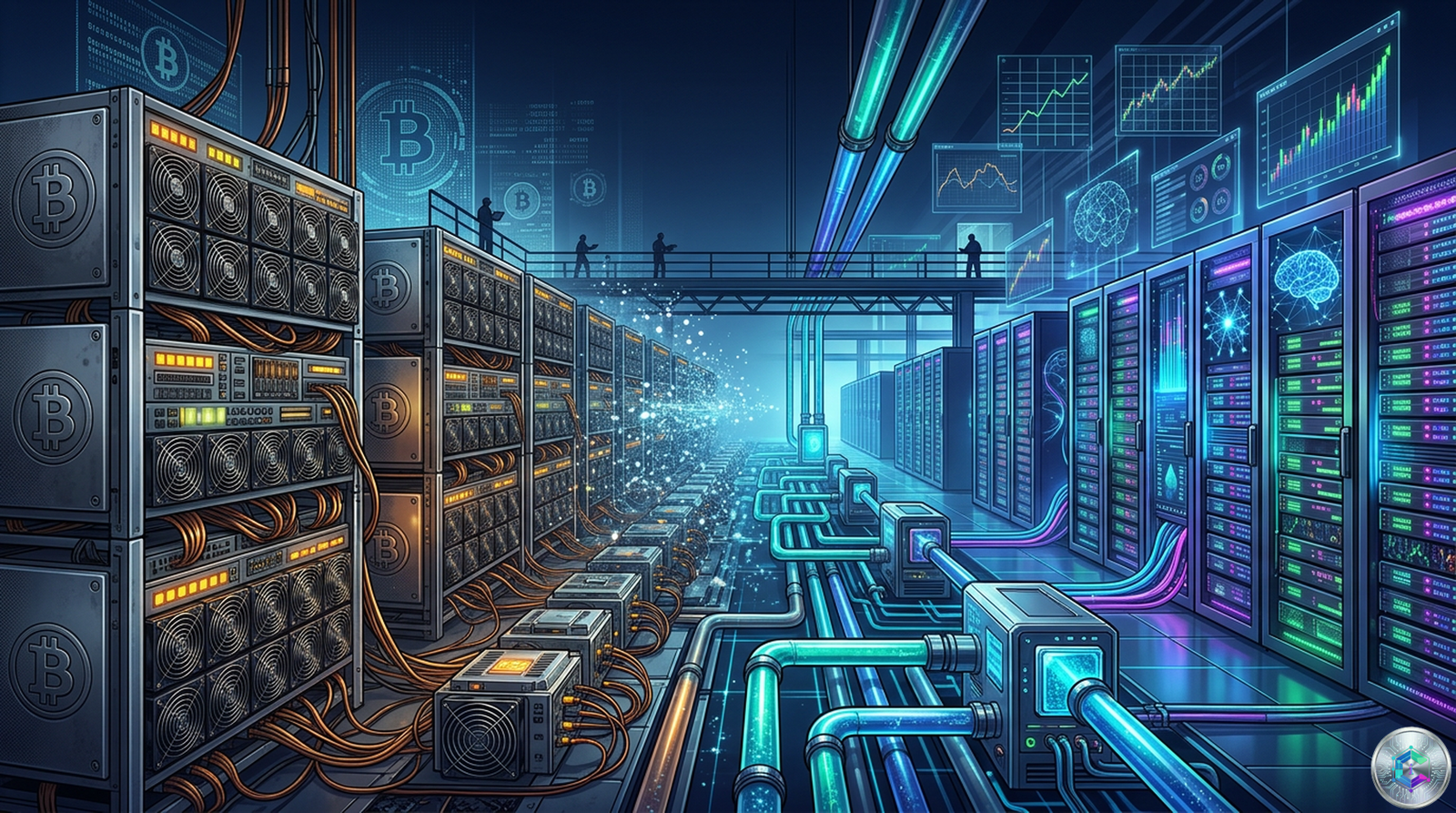
Industrial mining campuses of 100 MW to 1 GW share with modern data centers similar requirements for power, cooling and density. They have therefore become targets for hyperscalers, notably through the Google-TeraWulf, Google-Cipher and Fluidstack deals. Mining generates roughly $1 million per MW, compared with $10 to $20 million per MW for AI compute.
Two paths are emerging. Mega-campuses are converting fully or partially to AI/HPC, signing multi-decade contracts and swapping volatile block rewards for capacity revenue. Low-cost mobile miners, by contrast, are moving to stranded energy sources such as flared gas, remote hydropower or surplus renewables.
BeInCrypto notes that miners retain one edge: many already hold authorized grid capacity that data center developers cannot build fast enough, just as local restrictions on data centers multiply. Arthur Hayes, BitMEX co-founder, is meanwhile working on a Bitcoin-inspired AI mining network that would reward GPU owners. Buterin’s analysis implies that cheap energy remains the miner’s advantage, while cheap capital favors AI.
Financing, the Main Bottleneck
The conversion is not cheap. A classic mining site costs between $700,000 and $1 million per MW, versus $8 to $15 million per MW for AI infrastructure with liquid cooling. AI data centers require sturdier buildings, advanced cooling, fast connectivity, redundant power and permanent availability.
“Major lenders have become more selective about lending to data centers.”
BlocksBridge Consulting
Lending decisions now depend on the client, the signed contract and the company’s ability to complete the project. A multibillion-dollar commercial commitment therefore does not guarantee access to the capital required.
IREN shows how volatile these conditions can be. In June 2026, the group secured $3.65 billion to finance graphics processors at an average rate of 6%. Two months later, it signed a $2.4 billion facility at a fixed rate of 9%. The two deals cover different projects and are not directly comparable, but the gap in the cost of capital is significant.
| Company | Unfunded needs (June 2026 estimate) |
|---|---|
| IREN | $21.1 billion |
| Riot Platforms | $7.2 billion |
| HIVE Digital | $4.6 billion |
| All listed companies | about $50 billion short term, up to $221 billion longer term |
At the peak of the October 2025 market, sector debt had risen by roughly 500% compared with Q2 2024.
Financing can also dilute shareholders. In a transaction involving Cipher Digital, Google guaranteed up to $1.4 billion of lease obligations and received warrants that could represent 5.4% of Cipher’s capital, subject to adjustments. Convertible bonds can also be converted into shares. Finally, delivery delays force companies to keep paying interest before collecting the revenue expected from AI customers.
Announced Contracts, Modest Revenue
The companies studied have announced more than $100 billion of AI and HPC contracts, yet generate only about $1.1 billion in annualized revenue. Roughly 4 GW of capacity has been contracted, of which 550 MW is currently billing, or about 14%. The text also indicates that about 25% of capacity already leased has been delivered. The sources do not explain the scope difference between billing, delivery and contracted capacity.
In the first half of 2026, nine miners invested $5.11 billion in AI and HPC projects, against $341.2 million of revenue directly attributed to those activities, a ratio of roughly fifteen to one. The halving of the block reward, from 6.25 to 3.125 BTC, pushed several operators to diversify.
Lancium, a Houston-based technology company, and Denver-based Crusoe Energy Systems have announced a multibillion-dollar agreement to build a 200 MW data center outside Abilene, Texas. That first phase is only a small part of a 1.2 GW expansion plan. Both companies had raised hundreds of millions of dollars to build Bitcoin mining infrastructure. Lancium chairman Ali Fenn said that, once fully operational, the site will become “one of the largest artificial intelligence data center campuses in the world”.
Chase Lochmiller, co-founder and CEO of Crusoe, explained that these facilities require:
“new levels of high-density rack space, liquid cooling directly on the chip, and unprecedented overall energy demand”
Chase Lochmiller, Co-founder and CEO, Crusoe
Core Scientific and Hut 8 have also invested millions of dollars in expanding their AI activities and data center portfolios.
A Split That Is Taking Hold
The sources do not quantify any immediate reaction in Core Scientific’s share price or in Bitcoin’s price following the announcement. They mainly document a split: Core Scientific plans a complete exit from mining, mega-campuses are converting to AI, and miners with access to cheap energy remain on the network, whose hashrate keeps rising.
Outlook and Scenarios
Core Scientific’s exit does not signal the end of mining, but the end of a model in which a generalist miner funds its expansion through Bitcoin production alone. The sector is now divided between players able to sign long-term AI contracts and low-cost miners that remain exposed to Bitcoin’s price and network difficulty.
Three scenarios stand out. In the central case, conversion advances gradually, contracts turn into revenue as capacity is delivered, and funding needs are met at higher rates. In a bullish case, a Bitcoin rally faster than hashrate growth would restore margins for remaining miners. In a bearish case, tighter credit or further delivery delays would prolong cash pressure on the most indebted companies.
For investors, the gap between more than $100 billion of announced contracts and $1.1 billion of annualized revenue remains the main point of vigilance. Converting these commitments into delivered capacity, more than their announcement, will determine the value actually created.
Sources
- Cryptoast, Bitcoin: a historic miner abandons mining for AI
- Benzinga FR, August 12, 2026
- BeInCrypto FR, Bitcoin mining cost according to Vitalik Buterin
- CoinTribune via TradingView
- Quartz FR, Bitcoin miners abandon crypto for AI
- Yahoo Finance FR, Bitcoin mining reaches a breaking point (CoinShares report)
Cet article est publié à titre informatif et éducatif. Il ne constitue en aucun cas un conseil en investissement. Faites vos propres recherches (DYOR) avant toute décision.

