

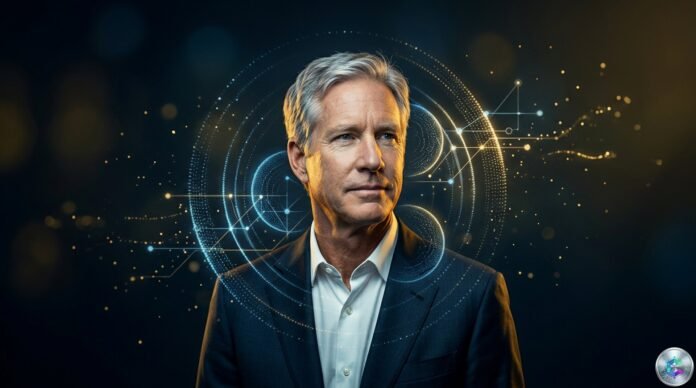
A central figure in the XRP ecosystem, Chris Larsen built E-Loan, ran Prosper and co-founded Ripple. His path, from traditional finance to blockchain, shows how a company moved from cross-border payments toward a full crypto infrastructure stack. Here are the key milestones, the published figures and the gaps in the available sources.
🔑 Key takeaways
- Larsen co-founded OpenCoin in September 2012, the origin of the Ripple protocol and Ripple Labs.
- As E-Loan’s leader, he negotiated a sale to Intuit for $130 million in 1998.
- He backed California’s financial privacy law, adopted in August 2003.
- A theft of about $150 million in XRP from his personal accounts was reported in January 2024.
- Forbes lists his net worth at $8.4 billion in the profile reviewed.
From Mortgages to E-Loan
Born in San Francisco in 1960, Larsen started his career at Chevron, where he carried out financial audits in Brazil, Ecuador and Indonesia. He earned an MBA from the Stanford Graduate School of Business in 1991. In the early 1990s he worked at a Palo Alto lending firm alongside Janina Pawlowski. The two resigned in 1992 to start their own lending business, then turned to a website in 1996 to bypass agent commissions and other industry fees. The project was initially funded with $450,000 from friends and family.
E-Loan went public in 1997 and became one of the first online mortgage lenders in the United States. The model let borrowers compare loans directly, without the fees charged by brokers and loan officers, before the company expanded into home equity and auto loans. Pawlowski served as CEO for the first two years, then swapped roles with Larsen in 1998, when he became president.
In the fall of 1998, the founders negotiated a sale of E-Loan to Intuit for $130 million. Days before the deal closed, Timothy Koogle, then CEO of Yahoo, offered $25 million for 23% of the company. The payout was smaller, but Larsen and Pawlowski would keep control of the company and the E-Loan brand, so they chose that offer while also raising money from SoftBank and Sequoia Capital. Growth was rapid: $6.8 million in revenue in 1998, then $470 million in mortgage loans processed in the first quarter of 1999.
The IPO came in June 1999, after a filing in late March. In the third quarter, E-Loan lost $13 million despite a 200% year-over-year revenue increase. For the full year 1999, it processed 5,000 loans, or 25% of the online mortgage market, the largest share among online companies. By February 2000 its market capitalization was estimated at $1 billion. During Larsen’s tenure as CEO and chairman, E-Loan became the first company to give consumers their FICO credit scores for free.
Sources disagree on several biographical details: his age (65 or 66, depending on the reference), the name of his university degree (B.S. or B.A.) and the founding date of Prosper, discussed below. These gaps do not change the overall career picture, but they call for checking figures before reuse.

Financial Privacy and Prosper
In the early 2000s, Larsen described himself as “radically pro-consumer”. In 2001, a bill sponsored by lawmaker Jackie Speier required consumers’ prior consent before financial services firms could share or sell personal data such as bank balances, phone numbers and Social Security numbers. Initially blocked by legislators friendly to business, the bill was backed by Larsen, who co-founded the coalition Californians for Privacy Now and put $1 million of his own money into it.
The campaign gathered 600,000 signatures, nearly double the number needed to put the measure before voters. Combined with Consumer Watchdog’s lobbying in 2002, the signatures led major financial institutions to drop their opposition. The law was adopted in August 2003.
“Without Chris Larsen, California’s financial privacy law, which sets the standard for the rest of the nation, would never have become a reality.”
Jackie Speier, California lawmaker
By May 2004, E-Loan had extended more than $18.9 billion in consumer loans since its founding and had been profitable for eight consecutive quarters. Larsen stepped down as CEO in early 2005 to launch Prosper, and remained chairman until E-Loan was sold to Banco Popular.
Sources differ on Prosper’s founding date, which is given as either 2005 or 2006. Larsen co-founded the company with John Witchel and became its CEO. From 2006 to 2009, the platform operated as a peer-to-peer lending marketplace comparable to eBay, with lenders and borrowers setting rates through a mechanism resembling a Dutch auction. Prosper verified identities, handled repayments and interest distributions to investors, and published borrowers’ “credit grades”. In 2008, Larsen personally funded 450 loans. That year the company facilitated more than $120 million in loans, with an average size of $7,000, and made Fast Company’s Fast 50 List.
The Securities and Exchange Commission quickly challenged the model, since existing rules had been written for traditional banks. In 2008, Prosper filed its first prospectus and moved to predefined rates, calculated with a formula that assesses each borrower’s credit risk. In 2011, Larsen publicly backed the Occupy Wall Street movement and raised funds for protesters at the San Francisco camp. By the end of that year, Prosper had facilitated $271 million in loans and raised $74.5 million from investors including Jim Breyer, Tim Draper, Omidyar Network, Nigel Morris and Court Coursey.
On March 15, 2012, Larsen announced he was stepping down as CEO while staying on as chairman. San Francisco State reports that Prosper was then valued at more than $1 billion.
Ripple: From Payment Protocol to Crypto Infrastructure
In September 2012, Larsen co-founded OpenCoin, which developed the Ripple payment protocol based on a concept from Ryan Fugger. The system enables instant, direct transfers between two parties, bypassing the fees and delays of the correspondent banking system. It can handle assets as different as gold, airline miles and rupees. To secure the network, OpenCoin relies on independent validating servers, which can be run by banks, market makers or any other party, and which constantly compare their transaction records. The company also created its own digital currency, described as similar to bitcoin, to let financial institutions move funds at negligible cost and speed.
On May 14, 2013, OpenCoin announced a second round of angel funding led by Andreessen Horowitz, Google Ventures and IDG Capital Partners. In September 2013, the company was renamed Ripple Labs, Inc., with Larsen remaining CEO. Ripple Labs open-sourced the peer-to-peer node code and remained the main contributor to the consensus verification system, which it presents as capable of integrating with banks’ IT systems. By 2014, Ripple ranked as the second-largest cryptocurrency by market capitalization, behind bitcoin.
“The Internet of value is more than just laying out a new way of doing finance. Fundamentally, this represents the final step in globalization.”
Chris Larsen, Ripple Co-founder and Executive Chairman
Recognition followed: MIT Technology Review named Ripple Labs one of its 50 “Smartest Companies” in 2014, and Fast Company ranked it fourth on its 2015 list of the world’s most innovative companies in the finance category. According to Forbes, Ripple has also spent roughly $3 billion on strategic acquisitions in recent years, shifting from a cross-border payments provider toward a full crypto infrastructure business. That shift is central to the analysis: the company is no longer just a protocol, but a set of services and assets whose trajectory remains closely tied to XRP and to the regulatory framework.
Philanthropy, Theft and Net Worth
RippleWorks, a non-profit foundation launched in 2015 by Larsen and Doug Galen, the third employee at E-Loan, is described by Forbes as one of the first foundations funded by cryptocurrencies. It reports $2.5 billion in assets in 2025. In 2019, Larsen, his wife Lyna Lam and RippleWorks made what is described as the largest digital donation ever given to a U.S. university, at San Francisco State University, funding chairs in financial technology and entrepreneurship. The business school was later renamed the Lam Family College of Business. In 2020, Larsen and Ripple each gave $1 million to five food banks in San Francisco for COVID-19 relief. Forbes estimates his cumulative giving at $409 million, or 5% of his net worth.
In January 2024, unauthorized access to his personal accounts led to the loss of about $150 million in XRP. The sources provided do not specify the XRP price at the time, the change in its market capitalization or any other quantified market reaction, so the event’s actual impact on the ecosystem cannot be measured from this document alone.
According to the Forbes profile, updated September 15, 2026, Larsen’s real-time net worth stands at $8.4 billion as of November 26, 2026, with the fortune classified as coming from cryptocurrency. The same profile describes him as self-made and lists him in 18 Forbes rankings. In 2018, Forbes estimated his fortune at $59 billion, briefly placing him ahead of Mark Zuckerberg in fifth place worldwide. That gap shows how volatile wealth estimates tied to crypto assets can be.
Outlook and Scenarios
Larsen’s career shows a consistent theme: the search for cheaper intermediation, whether in mortgage broker commissions, peer-to-peer lending fees or the delays of correspondent banking. The same logic underpins the Ripple thesis, which positions XRP as a bridge asset for real-time settlement between fiat currencies, according to The Block.
Three scenarios deserve attention. In a favorable case, institutional adoption of RippleNet and its acquisitions translate into sustained growth in payment volumes and clearer regulatory visibility. In a middle case, the company remains a niche player whose valuation depends more on XRP’s price than on operating revenue. In a downside case, tougher regulation or weaker volumes would erode the credibility of the model. These are analytical frameworks, not forecasts, and they offer a way to read the company’s future disclosures.
Sources
- The Block, Chris Larsen profile
- Forbes, Chris Larsen profile
- Bloomberg Billionaires, Christian A. Larsen profile
- Wikipedia, Chris Larsen
- California State University, San Francisco alumni profile
- Council for Inclusive Capitalism, Chris Larsen member profile
Cet article est publié à titre informatif et éducatif. Il ne constitue en aucun cas un conseil en investissement. Faites vos propres recherches (DYOR) avant toute décision.

