


Researchers at China’s People’s Public Security University claim an AI model flags 89.4% of illicit crypto transactions. The system, detailed in the Journal of Chinese Intelligence, pairs blockchain graph analysis with a large language model. Yet the 10.6% error rate raises questions about how the tool scales to real Bitcoin and Ethereum volumes.
🔑 Key takeaways
- An AI trained at China’s People’s Public Security University hits 89.4% precision on illicit crypto transactions.
- The architecture combines graph analytics on blockchain data with a memory module attached to a large language model.
- A 10.6% error rate mechanically produces a high volume of false positives when applied to real Bitcoin and Ethereum flows.
- China has banned all crypto-related activity since September 2021 and prosecuted 3,259 people for laundering in 2025.
- Chainalysis, Elliptic and TRM Labs already dominate this market, but the Chinese tool is trained inside the police apparatus.
A model built inside the Chinese police
The study, led by Dr. Sun Jingchao, a cybersecurity and criminal investigation expert, describes a system that goes beyond simple on-chain tracing. The model pairs a memory module with a large language model to interpret the context of each transaction and flag cross-border, pseudonymous practices typical of crypto financial crime.
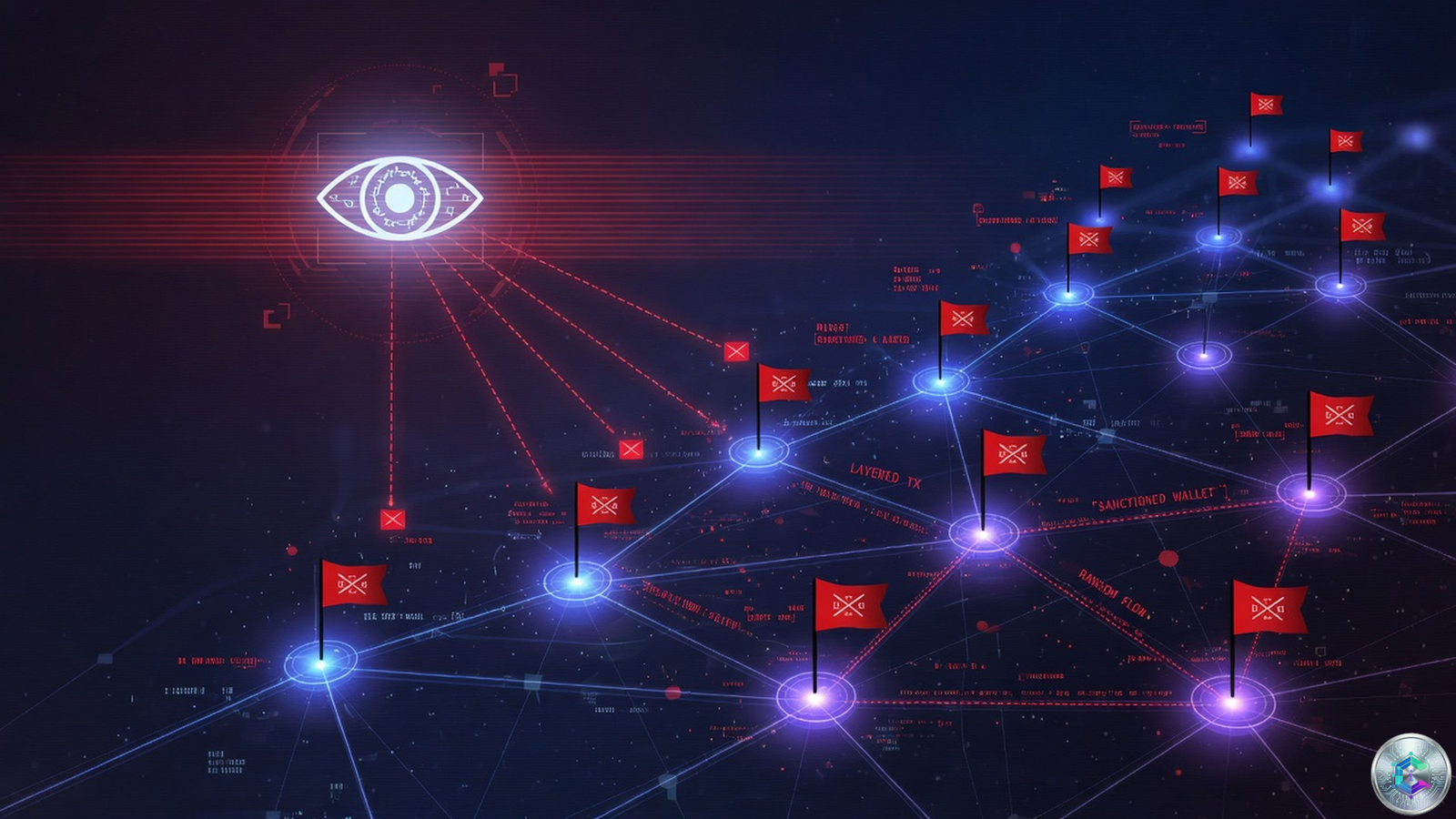
The analytical core remains graph analysis. Each blockchain can be visualized as a network of addresses linked by transfers. The system builds behavioral profiles by cross-referencing send frequency, amounts, transaction depth and proximity to labeled clusters: darknet markets, ransomware wallets, documented scams.
“These results offer a precise, generalizable and explainable solution for detecting illicit crypto transactions and provide a novel technological roadmap for regulators.”
Dr. Sun Jingchao, People’s Public Security University
The approach is not new. Chainalysis, Elliptic and TRM Labs have commercialized similar tools for years. The difference lies in the sponsor: a laboratory that trains future Chinese police officers, aligning academic research with the operational priorities of the Ministry of Public Security.
Lab precision that frays at scale
The 89.4% score was achieved on a labeled dataset under controlled conditions. Applied to real flows, the math looks less flattering. A 10.6% error rate across the roughly 1.4 million daily transactions processed cumulatively by Bitcoin (about 400,000) and Ethereum (over 1 million) creates an avalanche of alerts requiring manual review.
| Metric | Value |
|---|---|
| Reported precision | 89.4% |
| Error rate | 10.6% |
| Bitcoin tx/day | ~400,000 |
| Ethereum tx/day | >1,000,000 |
| Estimated false positives (ETH) | ~106,000/day |
Such a system does not convict anyone. It ranks leads and shortens investigations. The added value is the number of investigator hours saved when chasing illicit money on a public ledger, not the raw ability to spot it.
China’s crackdown is already well underway
The rollout of this tool fits a long-standing repressive policy. In September 2021, the People’s Bank of China classified all crypto-related activity as illegal, after driving miners off Chinese soil. In May 2021, state institutions had already warned buyers they would receive no protection. In June 2021, banks and payment platforms were ordered to stop facilitating transactions.
The numbers tell the story of the reversal. In September 2019, China still accounted for 75% of the energy used by Bitcoin mining worldwide. By April 2021, that figure had fallen to 46%. Bitcoin lost more than $2,000 on the September 2021 announcement alone.
The market did not disappear, it migrated. USDT remains the unit of account for underground exchanges (dīxià qiánzhuāng) that help bypass the $50,000 annual conversion cap per resident. According to the Supreme People’s Procuratorate, 3,259 people were prosecuted for laundering tied to crypto and the parallel banking system in 2025.
A strengthened legal arsenal
A joint interpretation from the Supreme People’s Court and the Supreme People’s Procuratorate, effective August 2024, explicitly lists virtual asset transactions as sanctioned money-laundering channels. Recent precedents put the stakes in context.
| Case | Seizure | Year |
|---|---|---|
| PlusToken pyramid | 194,775 BTC + 833,083 ETH | 2020-2021 |
| Chen Zhi (Prince Group) | 127,271 BTC (US DOJ) | 2025 |
| Illicit crypto volume 2024 | $40.9B to $50B+ | 2024 |
The record seizure of 127,271 BTC from Chen Zhi, founder of Cambodia’s Prince Group accused of industrializing romance scams, marks the largest confiscation ever conducted by the US Department of Justice. It illustrates the porosity between jurisdictions and the transnational reach of these investigations.
Traceability strikes back, but so do the criminals
Blockchain delivers what no banking system can: a public, timestamped, exhaustive ledger replayable from the genesis block. Chainalysis estimates $40.9 billion flowed to identified illicit addresses in 2024, later revised above $50 billion after new attribution. Against that, the UN Office on Drugs and Crime puts global money laundering at 2% to 5% of GDP, or $800 billion to $2 trillion per year, the vast majority circulating through channels that leave no algorithmically exploitable trace.
Launderers do not stand still. Cross-chain bridges, mixers, privacy coins and over-the-counter brokers are built precisely to break the graphs these models learn to read. In a country where holding crypto is tolerated but any related activity is illegal, the line between financial policing and mass surveillance comes down to a threshold setting. The 89.4% classifier has no opinion on the nature of the offense it flags: it predicts a probability, not a crime.
Conclusion: precision alone is not enough
The People’s Public Security University AI proves that a model trained inside Chinese law enforcement can compete with Western commercial solutions. The 89.4% figure is already circulating as an authority argument in crypto surveillance debates. Three scenarios emerge. If the model is deployed at scale, pressure on Chinese users rises while the offshore market thickens. If provincial police integrate it with existing tools (SlowMist, Beosin), the marginal productivity gain will be real but limited. If international cooperation advances, classifiers like this could be shared. The race between algorithmic graphs and evasion engineering is only beginning.
Sources
- Journal du Coin — China unveils police AI hitting 89.4% on illicit crypto
- South China Morning Post — Chinese police AI algorithm tracks Bitcoin money laundering
- Vietnam.vn — China’s new AI tool for tracing Bitcoin laundering
- Le Monde — China declares all crypto transactions illegal
- BBC Afrique — China declares crypto-related activities illegal
This article is for informational and educational purposes only. It does not constitute investment advice. Do your own research (DYOR) before making any decision.

