


The Commodity Futures Trading Commission published on October 5, 2026 an Advanced Notice of Proposed Rulemaking (ANPRM) designed to build a uniform federal framework for crypto-asset platforms operating in the United States. Spearheaded by Chairman Michael S. Selig, the initiative introduces a new registration category dubbed CAM and mandates retail intermediation through licensed Futures Commission Merchants (FCMs).
🔑 Key takeaways
- CFTC publishes ANPRM (RIN 3038-AF80) on October 5, 2026
- 60-day public comment window opens on Regulations.gov
- New registration tier created: Crypto Asset Market (CAM)
- Mandatory FCM intermediation for retail crypto transactions
- 28-day delivery window codified for the actual-delivery carve-out
An ANPRM to fill the federal void
Filed under the full title Regulation Crypto Asset Transactions and Regulation Crypto Asset Markets, the notice covers parts 1, 38 and 39 of the Code of Federal Regulations. It invokes section 2(c)(2)(D) of the Commodity Exchange Act to regulate retail transactions involving crypto assets, branded CTX (Crypto Asset Transactions). The stated goal from Michael S. Selig, the 16th CFTC chairman since December 22, 2025, is to keep the United States as “the global capital of cryptocurrency” while folding platforms into a single national framework.
“Today’s action is a critical step in the CFTC’s ongoing efforts to ensure that America remains the global capital of cryptocurrency.”
Michael S. Selig, CFTC Chairman
The release underscores that US retail investors have long relied on a patchwork of state-level protections: money-transmitter regimes, New York’s BitLicense, California’s Digital Financial Asset license, and FinCEN registration. According to the CFTC, those frameworks “do not protect retail customers in the same way as the federal regulatory framework,” because they do not guarantee orderly and transparent trading or the prevention of conflicts of interest and market manipulation. The ANPRM cites the $8 billion FTX fraud revealed on November 11, 2022, and former chairman Rostin Behnam’s testimony that customer property at FTX’s CFTC-registered entities stayed segregated, unlike 130 affiliated entities that went bankrupt.
Three pillars of the public consultation
The ANPRM structures the consultation around three distinct questions directed at the public, market participants and industry associations:
- How can the CFTC prevent abusive practices in crypto-asset markets and CTX under a uniform national regime?
- What crypto-specific contextual information should be provided to market participants, based on the agency’s surveillance experience since 2014?
- Should the Commission codify a sub-category of designated contract market registration — the Crypto Asset Market (CAM) — specifically designed for CTX?
The comment window runs for 60 days from publication in the Federal Register. Submissions must be filed on Regulations.gov and will be made public.
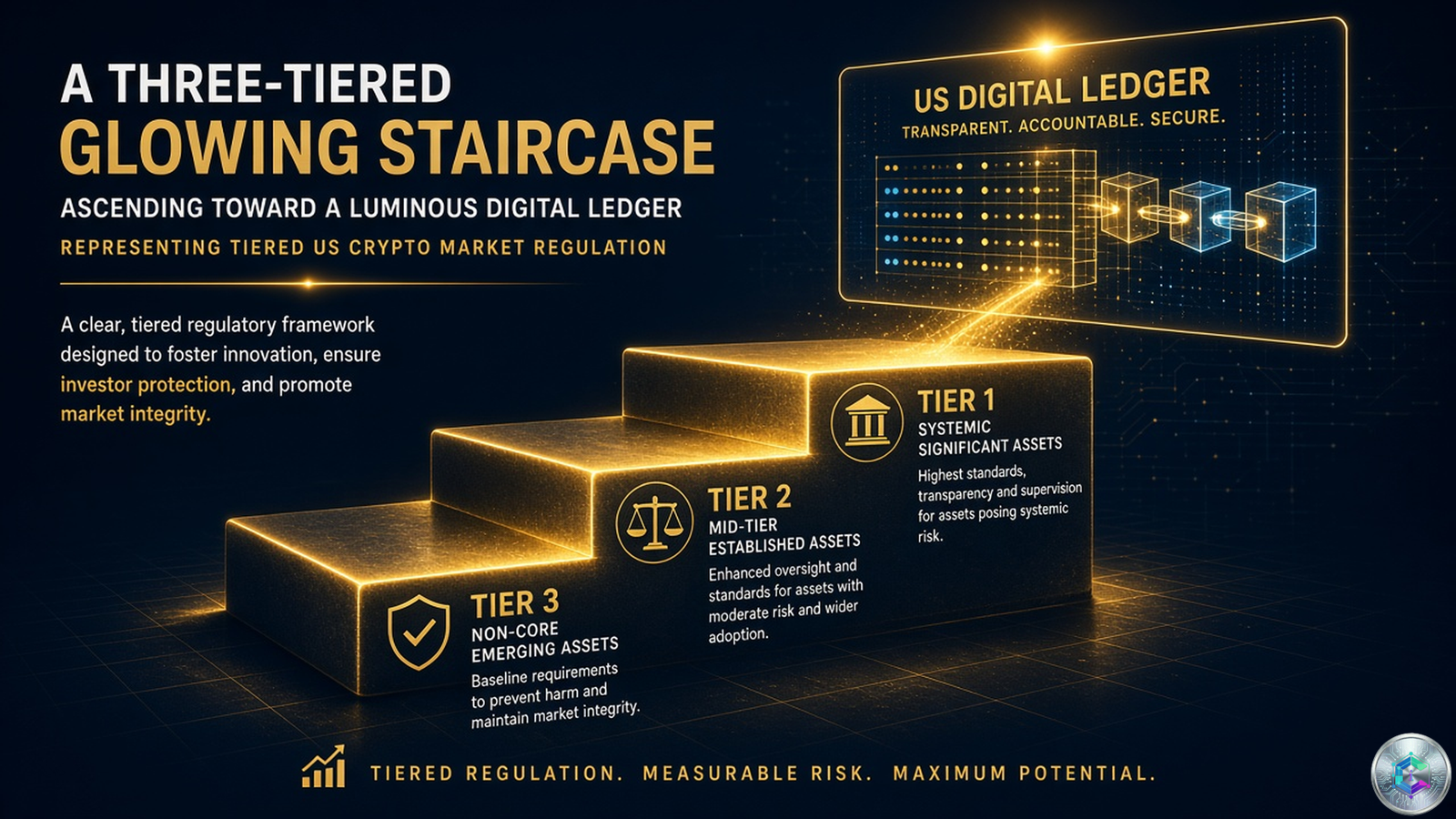
Selig’s ladder: three tiers of registration
On October 5, at the Fordham Law Blockchain Regulatory Symposium in New York, Selig described the registration landscape as a three-rung ladder, each tier reflecting a deeper level of federal integration.
| Tier | Type of activity | Applicable regime |
|---|---|---|
| 1 | Spot crypto exchanges (no leverage) | State money-transmitter laws, CFTC anti-fraud oversight |
| 2 | Exchanges offering margin, leveraged or financed retail trading | CFTC registration required (DCM or new CAM) |
| 3 | Exchanges offering perpetual contracts and other derivatives | Existing DCM/FCM framework |
The initial proposals specifically target tier 2. DCMs already registered with the CFTC will be able to offer CTX under tailored rules, while new entrants can choose between the classic DCM status and the new CAM status. The CAM designation will respect the core statutory principles of DCMs but with a rule set adapted to the specificities of crypto assets.
Proof of reserves, FCMs and the 28-day delivery window
The draft CAM rules introduce several new structural obligations. Exchanges holding customer property in omnibus accounts will need to publish a proof of reserves for the benefit of clients. CTX will also have to be intermediated by Futures Commission Merchants (FCMs), which will manage accounts under the law’s capital, segregation and disclosure requirements.
“Under my leadership, the Commission will take whatever steps are necessary to establish rules designed to prevent — rather than merely prosecute after the fact — fraudulent schemes like FTX.”
Michael S. Selig, CFTC Chairman
Selig noted that FCM intermediation will also ensure compliance with the Bank Secrecy Act on anti-money-laundering (AML), customer identification (KYC) and suspicious activity reporting (SAR). The ANPRM also proposes codifying an interpretation of actual delivery: the transfer of a crypto asset to a user-controlled external non-custodial wallet within 28 days will generally satisfy the statutory carve-out.
Project Crypto and the CFTC-SEC alignment
The ANPRM fits into a policy sequence that started with the presidential working group report on digital asset markets on July 30, 2025, followed by a Crypto Sprint in August 2025. On December 4, 2025, the CFTC announced that CTX would be traded for the first time on a US-regulated exchange. On January 29, 2026, Selig and SEC Chairman Paul Atkins launched Project Crypto, formalized through a memorandum of understanding signed on March 11, 2026.
On March 17, 2026, the two agencies published a Joint Crypto Asset Taxonomy that sorts assets into five categories, explicitly citing Bitcoin, Ether, Solana, Stellar, Tezos and XRP as examples of digital commodities. This shared taxonomy provides the technical foundation for the upcoming regulation. The CFTC nonetheless acknowledges one limit: it cannot compel crypto assets to be traded only on registered platforms without congressional action.
Treasury backs away from self-custody wallet rules
In parallel, crypto think tank Coin Center announced that the US Department of the Treasury had officially dropped two proposed rules targeting self-hosted wallets and crypto mixing. Those proposals, which would have required the collection and storage of large amounts of sensitive personal financial data, had drawn fierce industry opposition. Their withdrawal marks a notable de-escalation in the US regulatory approach, contrasting with the more prescriptive route taken by Europe under MiCA.
Conclusion: a US crypto federalism in the making
The CFTC’s ANPRM marks a turning point in US crypto regulation: for the first time, a federal agency is proposing a complete framework for retail platforms, built around the new CAM category and FCM intermediation. While the notice alone cannot mandate trading exclusively on registered platforms, it offers a credible federal option against today’s state-level mosaic (BitLicense, California DFAL, FinCEN). The 60-day comment window will be decisive: it will determine whether the industry favors a classic DCM registration or the new CAM route, and whether Congress will eventually legislate to make trading on registered platforms mandatory. In the meantime, the CFTC-SEC alignment around a shared taxonomy and the Treasury’s retreat on wallet rules sketch the contours of a more coherent US framework, even if the debate on the boundary between securities and commodities is far from closed.
Sources
- CFTC Press Release 9307-26
- CryptoAst — CFTC proposes new regulatory framework
- Brookings Institution — Best way to regulate digital assets
- SEC — Statement on regulation of crypto assets
- Latham & Watkins — US Crypto Policy Tracker
- Securities.io — CFTC seeks comment on retail crypto rules
This article is for informational and educational purposes only. It does not constitute investment advice. Do your own research (DYOR) before making any decision.

