

With nearly one in four adults holding digital assets in 2026, choosing the right crypto wallet has become a central challenge for every investor. Between hot, cold, and custodial solutions, the offer has exploded. This guide reviews 20 reference wallets, their fees, security features, and ideal use cases.
🔑 Key Takeaways
- About 23% of adults hold digital assets in 2026
- Crypto fraud caused $5.6B in losses in 2023, per the FBI IC3 report
- Three wallet families coexist: hot, cold, and custodial wallets
- MetaMask remains the DeFi/NFT standard with 100M+ users
- Tangem and ZenGo offer seedless recovery via MPC and NFC
A market reshaped by mass adoption
In 2026, cryptocurrency is no longer a niche market reserved for early adopters. According to a study cited by Coincub, roughly 23% of adults worldwide hold some form of digital asset, whether Bitcoin, stablecoins, or DeFi tokens. This record adoption has forced the industry to rethink the user experience from the ground up.
Wallets are no longer static key containers: they have evolved into true super-apps integrating swaps, staking (delegating tokens to secure a network and earn rewards), NFT management, and cross-chain navigation. Three trends define the 2026 market. First, seedless recovery, powered by MPC (Multi-Party Computation, a cryptographic scheme that splits a key across multiple parties) and adopted by ZenGo and the latest generation of Tangem cards. Second, native integration of biometrics and NFC (near-field communication), bringing the wallet closer to a traditional banking experience. Third, radical interface simplification to onboard first-time users.
The three wallet families
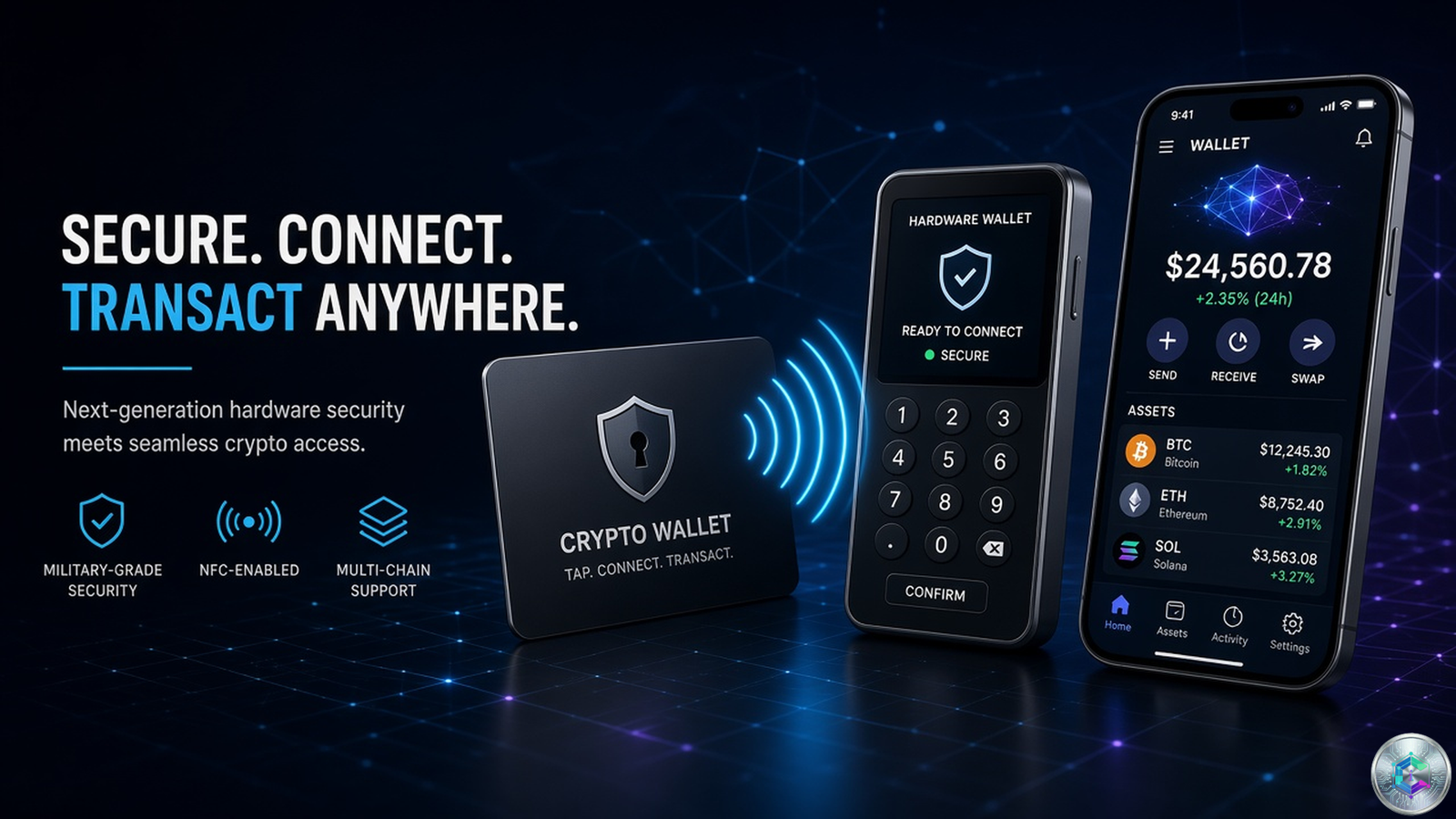
Before choosing a wallet, it is essential to understand the underlying architecture. The market splits into three main families, each with its own trade-off between security and convenience.
Hot wallets are software connected to the internet: browser extensions like MetaMask or Rabby, and mobile apps like Trust Wallet or Phantom. Convenient for daily use, they remain exposed to online attacks. Cold wallets are offline hardware devices: Ledger, Trezor, Tangem, NGRAVE, or Blockstream Jade. More cumbersome, they offer unmatched security for significant amounts. Custodial wallets finally entrust your private keys to a third party, usually an exchange: Coinbase Wallet, Nexo, or CoinRabbit.
The core principle remains non-custody (self-sovereignty). A non-custodial wallet keeps private keys with the user, in line with the maxim « not your keys, not your coins. » Custodial solutions offer ease of use and integrated services (fiat, cards, credit) in return, but expose the user to counterparty risk, a critical angle in a post-FTX context.
Hot wallets: 2026 benchmarks
Software wallets dominate daily usage thanks to their free access and smooth ergonomics. Here is a comparison of the main options available on the market.
| Wallet | Type | Supported assets | Swap fees |
|---|---|---|---|
| MetaMask | Non-custodial | EVM, BTC, SOL | 0.875% + gas |
| Trust Wallet | Non-custodial | 100+ chains, 10M+ assets | Variable |
| Exodus | Non-custodial | 300+ assets | 0.5% to 12% |
| Coinbase Wallet | Non-custodial | 100+ coins | Free (L2) |
| Phantom | Non-custodial | SOL, ETH, BTC, Polygon | Free + gas |
| ZenGo | Non-custodial | 1,000+ assets | $20/month plan |
| SafePal | Non-custodial | 30,000+ tokens, 100+ chains | 0.2% + gas |
MetaMask remains the undisputed reference for DeFi and NFTs, with over 100 million active users according to Baltex.io. Trust Wallet stands out for its exceptional multi-chain support (10 million assets per Tangem, 10,000+ per the Bitcoin Foundation). Phantom has won over the Solana ecosystem with real-time scam detection and an AI filter.
Critical warning: Atomic Wallet suffered a hack worth over $100 million in 2023, as Tangem reminds us. This incident highlights the importance of choosing open-source solutions audited by the community. Bitcoin-only users will find what they need with Sparrow (desktop, multisig) or BlueWallet (mobile, Lightning Network).
Cold wallets: security first
For anyone holding a significant amount of crypto, the hardware wallet remains the standard in 2026. Here are the leading references in the segment.
| Wallet | Price | Security | Key strength |
|---|---|---|---|
| Ledger Stax | €399 | Secure Element | 3.7″ E Ink touchscreen |
| Trezor Safe 7 | $249 | Open-source firmware | Shamir backup |
| Tangem (2 cards) | $54.90 | EAL6+ | NFC, seedless recovery |
| NGRAVE ZERO | €398 | EAL7 air-gapped | Maximum security |
| Trezor Safe 3 | ~$49 | Secure Element | FIDO2, entry-level |
| Ledger Nano S Plus | ~€79 | Secure Element | Value for money |
| Ellipal Titan 2.0 | ~$169 | Air-gapped QR | 10,000+ assets |
Tangem democratizes hardware wallets with an NFC card (tap-to-sign, no battery required) at $54.90 for two units, certified EAL6+ (one of the highest security certifications for secure chips). Ledger targets the premium segment with the Stax and its E Ink (electronic ink) touchscreen, Qi wireless charging, and magnetic shell. NGRAVE ZERO pushes security to its peak with EAL7 certification and 100% air-gapped operation (fully isolated from any network, no wired or wireless connection).
« A hardware wallet remains indispensable for anyone holding the equivalent of more than three months of salary in crypto. It is the only reliable shield against remote theft. »
Satoshi Labs, manufacturer of Trezor
Selection criteria and best practices
Choosing a wallet is not just about the brand: it must reflect your usage profile, your risk tolerance, and your budget. Several elements should guide the decision.
Security first: auditable open-source code, recovery phrase encryption, biometric authentication, secure element (a dedicated chip resistant to physical attacks). Features next: multi-chain support, DeFi (decentralized finance) and NFT options, staking integration, hardware compatibility. Fees finally: they range from 0% (Coinbase Wallet on Layer 2, MoonPay zero-fee swaps) to over 12% on Exodus, a gap that weighs heavily on frequent transactions.
On the operational security side, a few reflexes are non-negotiable in 2026.
- Never share your recovery phrase, and never store it digitally
- Enable 2FA (two-factor authentication) systematically
- Verify every URL before signing a transaction
- Avoid public Wi-Fi for any sensitive operation
- Update firmware and software as soon as a release is available
- Consider multisig (multiple signatures required) for very large holdings
Multisig remains the industry standard for corporate treasuries and DAOs (decentralized autonomous organizations), as the Bitcoin Foundation reminds us. Solutions like Sparrow or Nunchuk let you set up 2-of-3 or 3-of-5 configurations in a few clicks.
Conclusion: the ideal wallet depends on your profile
In 2026, there is no universally superior wallet: everything depends on your profile. For DeFi and NFTs, MetaMask remains the go-to entry point, despite its technical complexity. For mobile multi-chain use, Trust Wallet and Exodus offer a smooth experience. For maximum security, Ledger Stax and Trezor Safe 7 lead the high-end segment.
Beginners will appreciate ZenGo and Tangem, which remove the stressful burden of the seed phrase. Bitcoin maximalists will turn to Sparrow or Blockstream Jade Plus, designed exclusively for BTC security. Finally, diversification remains the best protection: a hot wallet for daily use, a hardware wallet for long-term savings. In a context where crypto fraud exceeds $5.6 billion per year, this separation of roles is more necessary than ever.
Sources
- CryptoSlate – Crypto Wallets
- Tangem Blog – Best Crypto Wallet Apps
- NerdWallet – How to Get a Crypto Wallet
- Baltex – Best Cryptocurrency Wallet
- Bitcoin Foundation – Best Crypto Wallets
- Coincub – Best Crypto Wallets Guide
This article is published for informational and educational purposes only. It does not constitute investment advice. Do your own research (DYOR) before making any decision.

