


US inflation came in hotter than expected in September, with Core CPI rising 0.3% month-on-month and 2.6% year-on-year, above consensus. The dollar soared, short-end Treasury yields jumped, and Wall Street closed lower as traders priced in a higher probability of another Fed rate hike as soon as this month.
🔑 Key Takeaways
- US Core inflation reached 2.6% YoY in September, above the 2.5% expected.
- The dollar index jumped 0.68%, its highest level since April 2025.
- The 2-year Treasury yield rose 7.2 basis points to 4.87%.
- Markets now price a ~41% probability of a Fed rate hike this month (up from ~20%).
- The Dow fell 0.17%, the S&P 500 dropped 0.94%, and the Nasdaq lost 1.3%.
A hotter-than-expected Core CPI print
Data released Wednesday by the Bureau of Labor Statistics (BLS) dashed hopes of a durable inflation cooldown in the United States. The Core CPI index — which excludes volatile food and energy components — rose 0.3% from August to September, while the Reuters consensus had forecast 0.2%.
On a year-on-year basis, Core inflation stands at 2.6%, above the 2.5% expected. The headline CPI advanced 3.7% YoY (vs. 3.6% expected). The breakdown shows the increase is no longer driven by energy alone: it is spreading to other categories, which is precisely what concerns the Federal Reserve.
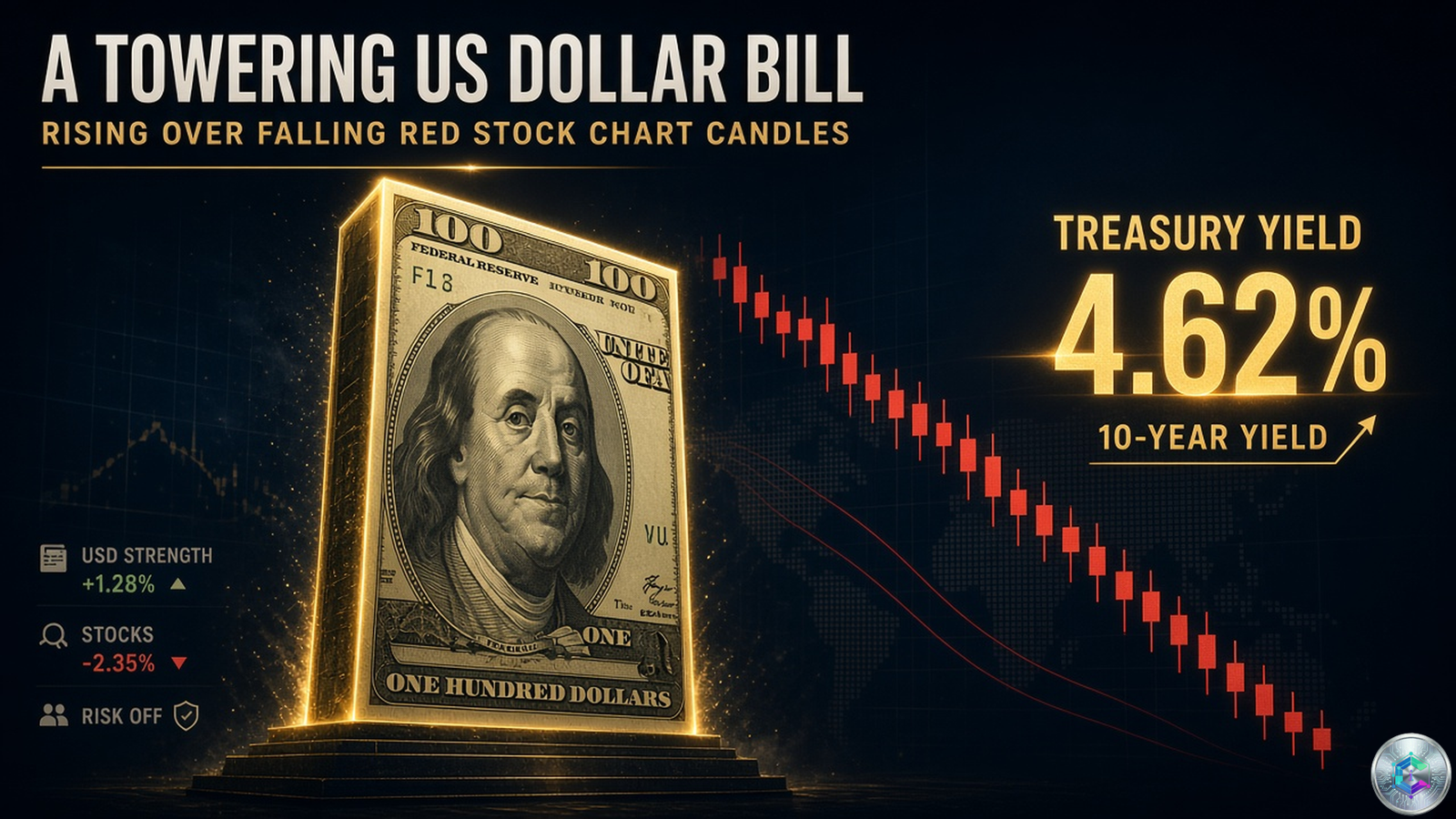
According to the BLS, energy and food contributed to the rise in the headline basket, while services — particularly shelter and medical care — remained firm. This configuration is fueling fears that tariff hikes and geopolitical disruptions are spilling over into the real economy.
“The print was higher than expected, not just for energy but across the board, suggesting that tariff increases and conflict-related disruptions are spilling into other categories.”
Mark Hackett, Chief Strategist at Nationwide
Dollar surges, crosses under pressure
The DXY index — which measures the dollar against a basket of six major currencies — climbed 0.68% on Wednesday, reaching its highest level since April 2025. The move mirrors the widening policy gap between a Fed that appears set to tighten further and European and British central banks that, by contrast, are easing.
| Currency | Change | Rate |
|---|---|---|
| Euro (EUR/USD) | -0.73% | 1.1117 |
| Sterling (GBP/USD) | -0.81% | 1.3145 |
| Japanese yen (USD/JPY) | +0.35% | 158.87 |
The euro slipped to 1.1117, sterling fell 0.81% to 1.3145, while the Japanese yen — traditionally sensitive to US rate moves — weakened to 158.87 per dollar.
Bonds: short-end reprices the Fed
In the bond market, the 2-year Treasury yield — the most sensitive to monetary policy expectations — jumped 7.2 basis points to 4.87%. The 10-year yield also rose, but by a smaller magnitude, leaving the curve roughly unchanged.
This limited steepening reflects investors’ acceptance of more persistent inflation. Fed Funds futures deeply revised their scenario: the implied probability of a rate hike as soon as this month jumped from roughly 20% before the release to ~41% afterwards, according to LSEG data.
“Markets are right to assume policy will need to become much more restrictive to bring inflation back to target. The question is whether the Fed is willing to tighten as much as the inflation situation demands.”
George Brown, Senior Economist at Schroders
Wall Street in the red, mixed bank earnings
The reaction across US equities was sharp. The Dow Jones lost 0.17%, the S&P 500 fell 0.94%, and the Nasdaq Composite — more exposed to rate-sensitive growth names — dropped 1.3%. Technology and industrials were the hardest hit, while healthcare, consumer staples, and energy held up better.
| Index | Session change | Lead sector |
|---|---|---|
| Dow Jones | -0.17% | Industrials, tech |
| S&P 500 | -0.94% | Tech, cyclicals |
| Nasdaq Composite | -1.30% | Growth, AI |
| Stoxx 600 (Europe) | +0.47% | Diversified |
| MSCI All-World | -0.77% | Global |
In Europe, the Stoxx 600 closed +0.47%, erasing part of its intraday losses after the CPI release. The MSCI All-World index lost 0.77%. Futures on the S&P 500 and the Nasdaq pointed to declines of 0.25% and 0.5% respectively.
On the earnings side, Bank of America saw its third-quarter profits drop, while Morgan Stanley beat expectations on the back of solid equity trading and wealth management revenues — a contrast that highlights the premium for houses most exposed to capital markets.
Gold and oil: two opposite reads
Spot gold fell 1.63% to $4,088.96 per ounce, hurt by the prospect of higher policy rates that makes the precious metal less attractive (gold pays no coupon). On the other hand, oil prices remained close to their two-week highs, with Brent crude hovering around $106 a barrel.
The support for oil comes from the geopolitical backdrop: two ships were attacked in the Strait of Hormuz, and Iranian officials announced new tactics targeting merchant vessels, raising fears of disruptions to energy supply chains.
Conclusion: the Fed pushed into a corner
The September CPI release has reshuffled the monetary-policy deck. Markets now price a real risk of another rate hike in the near term, supporting the dollar and weighing on bond duration as well as growth stocks. For the Fed, the equation is uncomfortable: keeping policy accommodative fuels inflation, while tightening further threatens growth.
In the coming weeks, attention will turn to the next inflation prints, retail sales, and FOMC member speeches to gauge whether the rate move observed on Wednesday is durable or merely technical. This month’s meeting looks set to be one of the most closely watched of the year.
Sources
This article is published for informational and educational purposes. It does not constitute investment advice. Do your own research (DYOR) before making any decision.

