

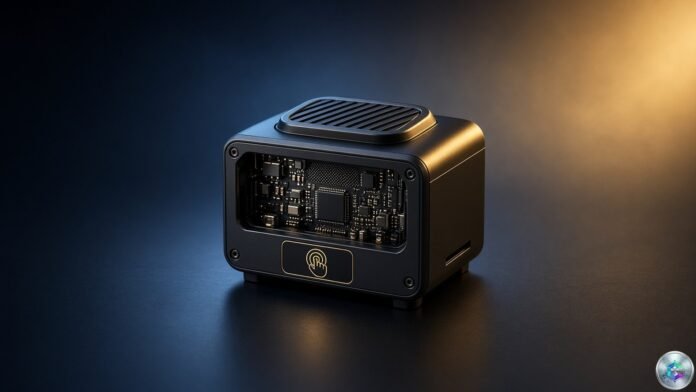
Solo Satoshi has launched the Bitaxe Turbo Touch, a fully open-source touchscreen Bitcoin miner rated at 2.15 TH/s out of the box and over 3 TH/s when overclocked. Marketed as the most powerful solo mining device (mining independently without joining a pool) currently available to retail users, the unit bets on software transparency to stand out from industrial-grade ASICs (application-specific integrated circuits, chips designed solely for hashing).
🔑 Key Takeaways
- Standard hashrate (computational power) of 2.15 TH/s, up to 3.06 TH/s overclocked, at roughly 18 J/TH (joules per terahash) efficiency.
- Two BM1370 ASIC chips, identical to those in Bitmain’s Antminer S21 Pro.
- 4.3-inch capacitive touchscreen pulling live network data from mempool.space.
- Estimated operating cost of $3.70 per month, 43 W power draw, 35 dB noise level.
- AxeOS and BAP-GT-TOUCH firmware published in open source, ESP32-S3 microcontroller.
An Open-Source Architecture Built on the Bitaxe GT 801
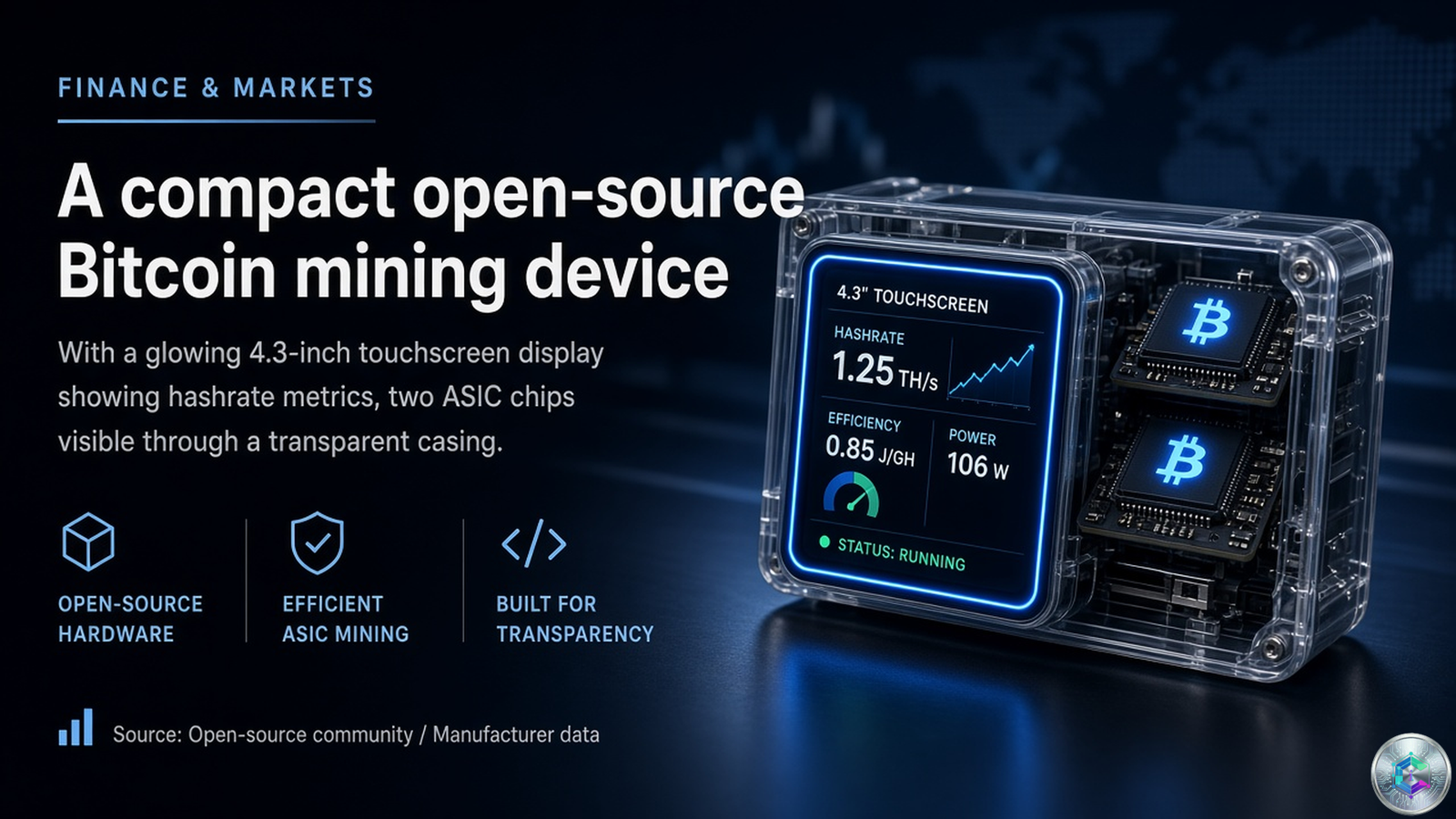
The Bitaxe Turbo Touch is built on the Bitaxe GT 801 open-source platform, designed by the Open Source Miners United community and distributed by Houston, Texas-based Solo Satoshi. The unit packs two BM1370 ASIC chips — the same silicon used in Bitmain’s Antminer S21 Pro, a model typically reserved for professional mining farms. This shared technology allows the Turbo Touch to deliver a standard 2.15 TH/s hashrate at roughly 18 J/TH efficiency.
According to HackerNoon, overclocked test units have pushed beyond 3 TH/s, peaking at 3.06 TH/s. Under normal operating conditions, chip temperatures stay between 60 and 70 °C, a range compatible with continuous home use. Power draw settles at approximately 43 W — comparable to a high-efficiency LED (light-emitting diode) bulb — while noise output measures 35 dB, roughly the level of a quiet whisper.
A Touchscreen Interface and 100% Auditable Firmware
The Turbo Touch’s defining feature is its 4.3-inch capacitive display, which cycles through eight real-time screens: instant hashrate, bitcoin price, block height (the index of the latest block appended to the chain), recently mined blocks, and performance metrics. Network data is pulled from mempool.space, a reference block explorer in the Bitcoin ecosystem.
Two open-source firmware layers run the device: AxeOS, which drives mining operations, and BAP-GT-TOUCH, which powers the user interface. The hardware schematic, board layout, and software repositories are all published under an open hardware license, allowing anyone to audit the code running between the ASIC chips and the display pixels. Connectivity relies on a 2.4 GHz Wi-Fi module driven by an ESP32-S3 microcontroller, with configuration handled through a browser-accessible dashboard.
“We built this because we believe the tools people use to interact with Bitcoin must be fully verifiable. Every line of code between the ASIC chips and the touchscreen pixels is open source.”
Matt Howard, Founder and CEO of Solo Satoshi
Three Performance Modes and a Competitive Cost per TH
The official setup guide (firmware v2.13.0, updated March 2, 2026) details three selectable operating profiles:
| Mode | Hashrate | Power Draw |
|---|---|---|
| Low | 2.34 TH/s | ~41 W |
| Medium (default) | 2.44 TH/s | ~45 W |
| High | 2.67 TH/s | ~48 W |
Advanced tuning through AxeOS unlocks over 3 TH/s, at the expense of higher power consumption. Solo Satoshi prices the device at approximately $151 per TH, compared to $299 per TH for the Braiins BMM 101, the other main touchscreen competitor on the market. The BMM 101 draws 40 W for 1.0 TH/s, while the Turbo Touch delivers 2.15 TH/s at 43 W — a markedly better efficiency-to-price ratio.
Documented Solo Mining Wins on the Bitcoin Blockchain
Beyond the spec sheet, the Bitaxe Turbo Touch fits into a broader trend: open-source solo miners accumulating verifiable victories on the Bitcoin blockchain. According to data relayed by HackerNoon, three significant block wins were recorded in less than a year, and the interval between each success is shrinking:
| Block | Date | Setup | Reward |
|---|---|---|---|
| #887,212 | March 2025 | Bitaxe cluster ~3.3 TH/s | 3.125 BTC (~$200,000) |
| #920,440 | October 2025 | NerdQaxe++ on Public Pool | 3.141 BTC (~$347,000) |
| #924,569 | November 2025 | 6 × Bitaxe Gamma 602 (6.6 TH/s) on CKPool | 3.08 BTC (~$310,000) at 221.39 T difficulty |
Block #924,569 was mined at a record network difficulty of 221.39 T, showing that home setups can still find a full block despite the competitive pressure of large industrial farms. Solo Satoshi claims more than 40,000 miners shipped to over 70 countries in under two years, and open-source Bitcoin miners have collectively produced over one million dollars in verifiable block rewards.
“In Bitcoin, you verify. You don’t trust. If I can’t read the code running on the screen our customers tap every day, we can’t ship it under our name.”
Matt Howard, Founder and CEO of Solo Satoshi
Conclusion
The Bitaxe Turbo Touch crystallizes a deeper trend: the democratization of solo mining through auditable, cost-controlled hardware. Priced at roughly half the dollar-per-terahash cost of its direct competitor, and shipping with fully open-source firmware, the device could accelerate solo mining adoption among an audience previously confined to pools (platforms that aggregate hashing power from multiple miners).
The probabilistic equation remains, however. A 2.15 TH/s miner facing a network hashrate north of 800 EH/s (exahashes per second, or quintillions of calculations per second) holds an infinitesimal chance of finding a block on each attempt. Yet recent successes prove the event — however rare — remains possible, and that the 3.125 BTC subsidy (plus transaction fees) can turn a modest home investment into an exceptional payoff for those willing to absorb the variance.
Sources
- Bitcoin Magazine – Solo Satoshi Launches Bitaxe Bitcoin Miner
- Solo Satoshi – Bitaxe Turbo Touch Setup Guide
- HackerNoon – Most Powerful Open-Source Touchscreen Bitcoin Miner
- Open Source For U – Bitaxe Open-Source Touchscreen Bitcoin Miner
This article is published for informational and educational purposes only. It does not constitute investment advice. Do your own research (DYOR) before making any decision.

