


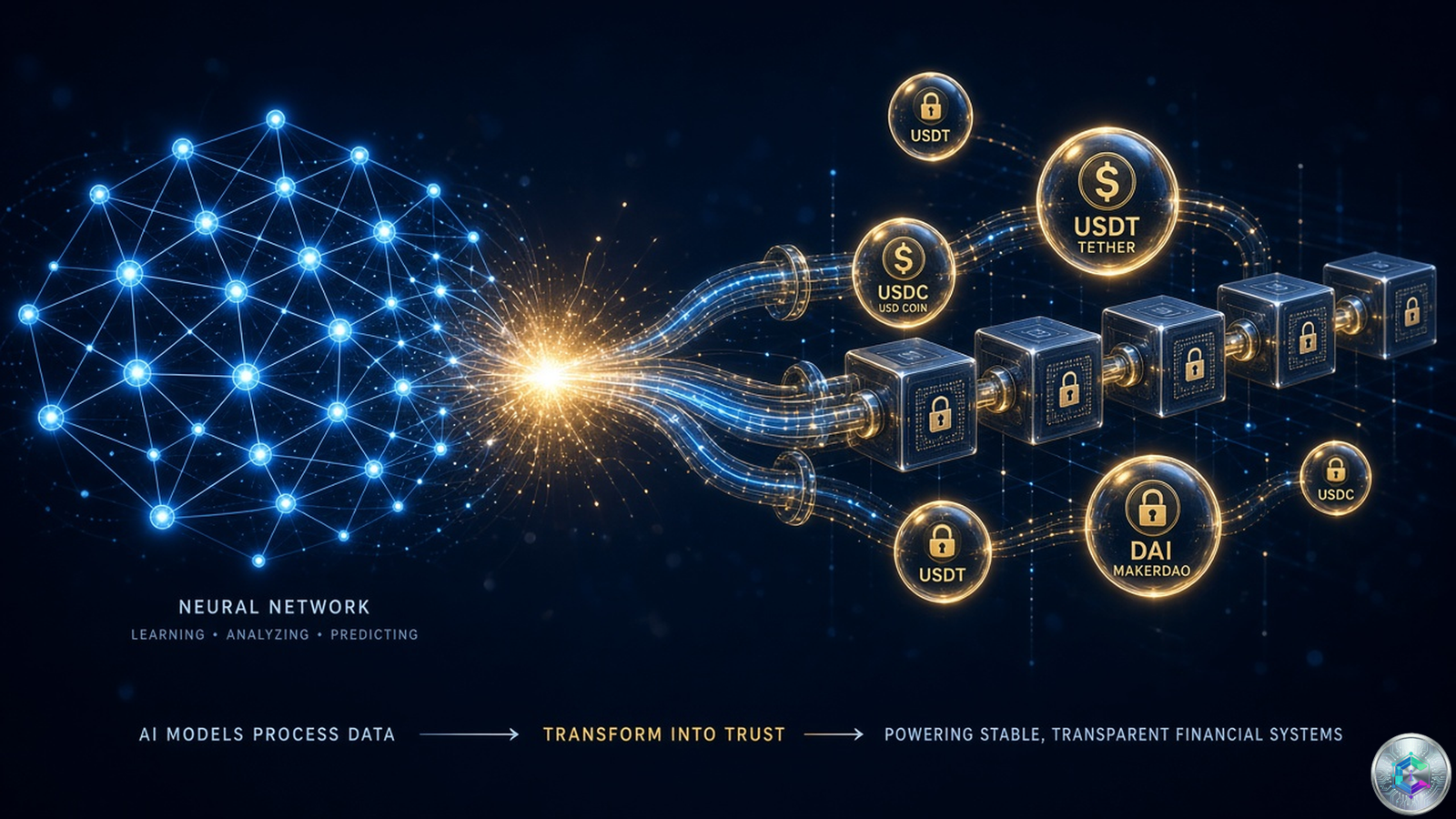
The economy of autonomous AI agents demands programmable financial infrastructure capable of executing millions of low-value transactions without human intervention. BlackRock, Moon Pursuit Capital and several institutional players are mapping the contours of this new layer where stablecoins, smart contracts and on-chain identity will become the native rails for machines.
🔑 Key takeaways
- Legacy banking systems are unfit for the millions of micro-transactions initiated by autonomous agents.
- BlackRock argues AI could become one of the largest drivers of crypto demand, alongside regulation and institutional adoption.
- Stablecoins processed more than $11 trillion in 2025, on par with Visa and Mastercard.
- AI trading agents combine reinforcement learning with direct API access to execution engines.
- Identity, traceability and standardized compute assertions are becoming structural on-chain use cases.
Why blockchain is becoming the native infrastructure for AI agents
Utkarsh Ahuja, founder and managing partner at Moon Pursuit Capital, sets the baseline: legacy payment systems were designed for humans and institutions, not for millions of autonomous software programs conducting low-value operations continuously across borders.
In an analysis published by CoinDesk, he argues that blockchain infrastructure (distributed and programmable ledgers) is particularly well-suited to this environment because money can become programmable. An AI agent can interact with a digital wallet, execute a smart contract or transfer a stablecoin without the layers of manual intervention required by traditional financial rails.
“Stablecoins serve as a bridge between blockchain programmability and a familiar unit of account, making them especially suited to machine-to-machine payments.”
Utkarsh Ahuja, founder of Moon Pursuit Capital
Identity is another pillar of this new economy. As autonomous agents become more capable, markets must determine who or what is behind a transaction, and what an agent is authorized to do. The same applies to traceability: when AI systems consume data, create intellectual property or execute transactions, establishing the origin of information and the ownership of assets becomes critical.
BlackRock’s paper on the machine-native economy
BlackRock, the world’s largest asset manager, has published a research paper titled The Machine-Native Economy, produced by its digital assets research team led by Will Su and Robert Mitchnick, together with the firm’s ETF and iShares product leads.
The central thesis draws a direct parallel between two technological domains: AI is the native intelligence for machines, while digital assets are the native money for machines. According to BlackRock, the two were destined to converge.
The paper stresses that traditional payment rails are unsuitable for autonomous agents. Opening a bank account or credit card requires a human ID, and card network fees are calibrated for forty-dollar purchases, not for API calls costing a fraction of a cent.
“AI represents the native intelligence for machines, while digital assets represent the native money for machines.”
BlackRock, The Machine-Native Economy
BlackRock anticipates that standardized compute assertions (proof-of-compute) will become a significant use case for digital assets, enabling programmable financing and settlement. Agentic AI and machine-to-machine payments will likely increase demand for programmable payment infrastructure: stablecoins, native crypto assets and other on-chain instruments serving as native money for machines.
Stablecoin volumes and institutional adoption
The figures published by BlackRock illustrate the scale of adoption. The table below compares annual payment volumes in 2025 across the main networks:
| Network | 2025 Volume ($T) | Annual growth |
|---|---|---|
| Stablecoins (adjusted) | 11.0 | ~80% |
| Visa | ~13.0 | n/a |
| Mastercard | ~10.0 | n/a |
| ACH (US bank transfer) | 93.0 | ~8.5% |
Adjusted stablecoin transaction volume thus exceeded $11 trillion in 2025, in the same range as Visa and Mastercard, but still well below the $93 trillion transiting via the ACH system. Stablecoin growth of roughly 80% per year since 2020, versus 8.5% for ACH, suggests sustained adoption for machine-to-machine transactions, where settlement speed and low fees matter more than absolute flow size.
Technical architecture of AI trading agents
An AI-driven trading agent combines machine-learning algorithms with direct API access to a platform’s execution engine. Unlike traditional algorithmic bots following preprogrammed rules, these agents learn and adapt continuously.
The process starts with massive data ingestion. Agents monitor standard market metrics (price, volume, order-book depth) across multiple venues, process alternative sources (social media, regulatory announcements) via natural language processing, and analyze on-chain data to detect large transfers.
To decide, many agents rely on reinforcement learning: placed in simulated market environments built on historical data, they are rewarded for maximizing portfolio value and penalized for excessive risk. After millions of iterations, they develop strategies capable of identifying non-linear patterns.
Execution then happens in milliseconds. High-frequency agents exploit price gaps between platforms via arbitrage, capturing profits on tiny spreads with very low latency.
The layers of a crypto agent
- Input: user prompts, API calls, real-time feeds.
- Processing: large language models (LLMs) interpreting context.
- Memory: short term (immediate context) and long term (vector databases).
- Action: API calls, smart contract triggers, stablecoin transfers.
Developers typically rely on Python or Node.js, with frameworks like LangChain or AutoGen to orchestrate components. Memory is handled by vector databases storing embeddings, and deployment runs on AWS or GCP, often containerized with Docker.
Market moves and integration signals
Several recent developments illustrate the intersection of traditional finance and crypto infrastructure. Goldman Sachs has routed its FTIXN Treasury fund, worth roughly $100 billion, to digital-asset trading firms through Lynq, a settlement network used by crypto companies, without tokenizing the assets.
Meanwhile, Cboe Global Markets and S&P Dow Jones Indices have extended their licensing agreement, leaving the door open to exploring tokenized options products, another signal that blockchain-based instruments are moving closer to established derivatives markets.
On the spot market, bitcoin recovered above $84,000 after dropping to $82,500, as Treasury yields stabilized following a brief rise in the ten-year yield to 5.2%. Spot bitcoin ETFs received $30 million on Tuesday, a modest but positive figure after the $2.84 billion collected over six sessions the previous week.
Conclusion: targeting the infrastructure layer
AI is profoundly changing who makes economic decisions: humans, institutions, and now autonomous agents. Investors should not assume all the value will sit at the application layer. Some of the largest opportunities may emerge from the financial infrastructure required to run an increasingly autonomous economy — programmable payment rails, agent identity protocols and verifiable on-chain compute markets.
The internet transformed the flow of information, blockchain changed the flow of value, and AI is now redefining economic decision-makers. The convergence of AI and blockchain is attracting growing interest, and autonomous agents in decentralized finance as well as in algorithmic trading will play an increasingly structural role in tomorrow’s financial ecosystems.
Sources
- CoinDesk — Crypto Long & Short: What will the AI agents run on?
- Quora — How do AI agents work in cryptocurrency trading
- Yahoo Finance — BlackRock: AI agents could drive crypto demand
- Medium / Coinmonks — Building crypto AI agents: architecture and tech stack
This article is for informational and educational purposes only. It does not constitute investment advice. Do your own research (DYOR) before making any decision.

