


Daily flows into US spot Bitcoin ETFs saw significant swings in September 2026, alternating between massive outflows and record-breaking inflow days, peaking at $999 million on September 21 according to Farside Investors. This volatility illustrates the growing sensitivity of the market to institutional capital movements and confirms the central role of ETFs in Bitcoin’s market structure.
🔑 Key Takeaways
- September 21, 2026: $999M in net inflows per Farside, led by BlackRock ($381.4M), Bitwise ($289.1M), and Fidelity ($238.8M)
- September 10, 15, and 16 posted combined outflows exceeding $1 billion, signaling notable investor nervousness
- Since launch, IBIT (BlackRock) holds $64.5B in cumulative flows, while GBTC shows -$27.3B in cumulative outflows
- 13 spot Bitcoin ETFs are approved by the US SEC, with management fees ranging from 0.14% to 1.50%
- Two leading data sources (Farside and Bitbo) show significant methodological discrepancies on daily flow figures
September 21, 2026: An Exceptional Inflow Day
September 21, 2026 marked a major inflection point in spot Bitcoin ETF flow dynamics. According to data compiled by Farside Investors, total net inflows reached $999 million on that day—a level that nevertheless remains below the all-time record set by these vehicles since their January 2024 launch.
The distribution across issuers reveals the structural concentration of the market. BlackRock (IBIT) captured the largest share with $381.4 million, closely followed by Bitwise (BITB) with $289.1 million and Fidelity (FBTC) with $238.8 million. The Grayscale Bitcoin Trust (GBTC) contributed $61.7 million, marking a positive day for a fund historically under redemption pressure. VanEck (HODL) and the Grayscale Bitcoin Mini Trust (BTC) each added approximately $3 million, while WisdomTree (BTCW) recorded $43 million. Franklin (EZBC) generated no notable flow that day.
Data from Bitbo.io, which provides independent flow tracking, shows materially different figures for the same date: total inflows of $1,404 million, with IBIT at $708.8 million, ARKB at $280.8 million, MSBT at $155.7 million, and FBTC at $231.1 million. These methodological gaps between sources—common in this market—stem from distinct calculation scopes, different update schedules, and possibly the inclusion or exclusion of newer vehicles such as Morgan Stanley’s MSBT.
“A single day of $500 million in inflows means authorized participants bought real Bitcoin to create shares, effectively removing supply from the market.”
ETF Flow Tracker, app description
This share creation/redemption mechanism is the central channel through which ETF flows exert direct pressure on Bitcoin supply. When flows are positive, authorized participants buy spot Bitcoin to back the newly created ETF shares, absorbing supply from the cash market. Conversely, outflows imply sales of Bitcoin to honor redemptions.
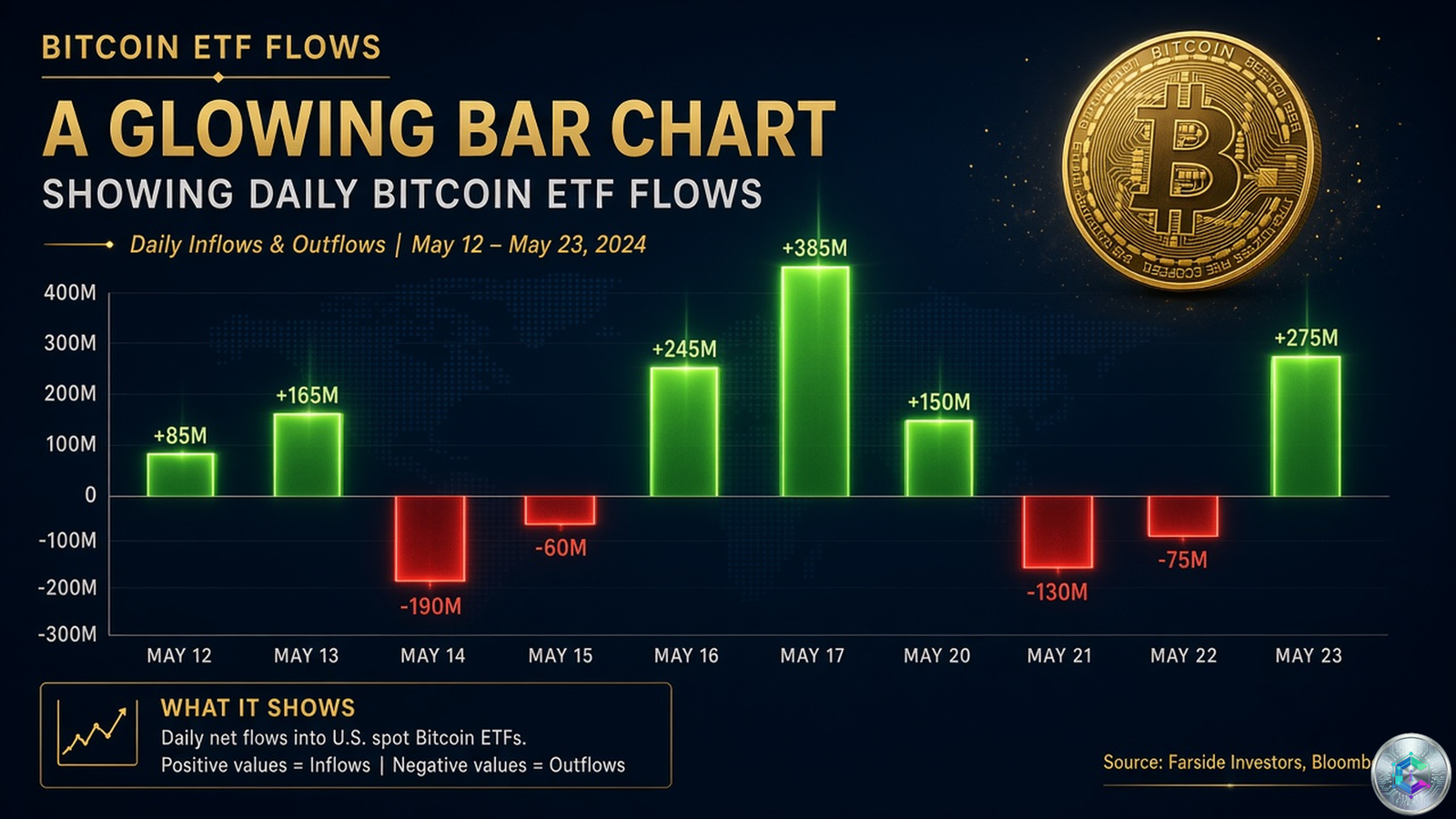
A September Defined by Alternating Inflows and Outflows
Before the record day on September 21, the spot Bitcoin ETF market had endured a sequence of several days of significant net outflows, reflecting a climate of persistent risk aversion at the start of the month.
On September 15, 2026, total outflows reached $450.4 million according to Farside, with FBTC accounting for $214.8 million and IBIT $161.7 million. September 16 extended the bearish trend with $295.9 million in redemptions, GBTC representing $144.1 million and BITB $84.4 million. September 10 had already seen massive outflows of $282.7 million, with BITB alone absorbing $164.3 million of these redemptions.
The days preceding the September 21 peak, however, showed signs of stabilization. September 18 recorded $433 million in inflows, FBTC dominating at $310.7 million and IBIT at $108.4 million. September 17 saw more modest inflows of $159.5 million, September 14 $159.9 million, while September 11 posted limited outflows of $13.2 million.
| Date | Net Flows ($M) | Leading Issuer | Amount ($M) |
|---|---|---|---|
| September 10, 2026 | -282.7 | BITB | -164.3 |
| September 11, 2026 | -13.2 | — | — |
| September 14, 2026 | +159.9 | — | — |
| September 15, 2026 | -450.4 | FBTC | -214.8 |
| September 16, 2026 | -295.9 | GBTC | -144.1 |
| September 17, 2026 | +159.5 | — | — |
| September 18, 2026 | +433.0 | FBTC | +310.7 |
| September 21, 2026 | +999.0 | IBIT | +381.4 |
Cumulative Flows Since Launch: IBIT’s Overwhelming Dominance
Cumulatively since their January 2024 launch, disparities between vehicles are substantial. According to Farside data, IBIT holds $64,506 million in cumulative net flows—more than all other spot Bitcoin ETFs combined. FBTC (Fidelity) ranks second with $10,610 million, followed far behind by DEFI (Hashdex) at $2,927 million, BITB (Bitwise) at $1,375 million, ARKB (Ark/21Shares) at $1,011 million, and HODL (VanEck) at $634 million.
The Grayscale Bitcoin Trust (GBTC) shows a cumulative balance of -$27,841 million, a consequence of the massive outflows that occurred mainly during the first weeks following its conversion from a closed-end trust into a spot ETF. This negative figure reflects redemptions by investors who sought to arbitrage between GBTC’s high fees and the more competitive products launched by competitors. Other ETFs show more modest cumulative figures: BTCW (WisdomTree) at $329 million, BTCO (Invesco/Galaxy) at $319 million, the Grayscale Bitcoin Mini Trust (BTC) at $144 million, and EZBC (Franklin) at $82 million.
Bitbo.io data, covering a more recent period and a different scope, confirm the overall hierarchy: IBIT with $1,340 million cumulative over the tracked period, FBTC at $917.2 million, MSBT at $197.9 million, and ARKB at $194.5 million, while GBTC posts net outflows of $71.2 million over this window.
| Issuer | Ticker | Cumulative Flows ($M) |
|---|---|---|
| BlackRock | IBIT | +64,506 |
| Fidelity | FBTC | +10,610 |
| Hashdex | DEFI | +2,927 |
| Bitwise | BITB | +1,375 |
| Ark Invest / 21Shares | ARKB | +1,011 |
| VanEck | HODL | +634 |
| WisdomTree | BTCW | +329 |
| Invesco / Galaxy | BTCO | +319 |
| Grayscale Mini Trust | BTC | +144 |
| Franklin Templeton | EZBC | +82 |
| Grayscale | GBTC | -27,841 |
An Ecosystem of 13 ETFs and Highly Variable Fees
The US SEC-approved spot Bitcoin ETF ecosystem now comprises 13 distinct funds, offering institutional and retail investors regulated vehicles to gain exposure to Bitcoin’s price. Major issuers include BlackRock with IBIT, Fidelity with FBTC, Grayscale with GBTC and its BTC derivative (Mini Trust), Bitwise with BITB, Ark Invest and 21Shares with ARKB, Franklin Templeton with EZBC, Invesco and Galaxy with BTCO, VanEck with HODL, Valkyrie with BRRR, WisdomTree with BTCW, and Hashdex with DEFI. Morgan Stanley is also present via MSBT, which arrived more recently.
Management fees vary considerably across issuers, creating a significant competitive factor. GBTC posts the lowest rate at 0.14%, while the Grayscale Bitcoin Mini Trust (BTC) charges the highest at 1.50%. The most competitive products sit in a 0.20% to 0.25% range, gradually aligning with traditional equity and bond ETF standards.
Tracking Tools and Real-Time Read
The ETF Flow Tracker app, available on Google Play, provides daily flow tracking for thirteen crypto assets including Bitcoin, fifty-one funds, and forty-seven tickers. The tool integrates a sentiment index calculated every fifteen minutes from ETF flows, offering a real-time read on institutional appetite. This granularity allows traders and analysts to quickly detect trend reversals in flows.
Beyond the raw data, daily flows represent a fundamental indicator closely monitored by market participants because they reflect actual movements of institutional capital. Unlike exchange trading volumes—which may include high-frequency trading or wash trading (fictitious transactions without real ownership change)—ETF flows translate into irreversible capital movements between traditional markets and spot Bitcoin.
Conclusion: Between Flow Volatility and Ecosystem Maturity
September 2026 perfectly illustrates the dual nature of spot Bitcoin ETFs: a vector for massive institutional capital inflows, capable of absorbing nearly one billion dollars in a single day, but also a rapid exit channel during stress phases. IBIT’s dominance, which concentrates the bulk of cumulative flows since launch, raises the question of market concentration and ecosystem resilience in the event of a sudden sentiment reversal on BlackRock’s flagship product.
In the short term, the market’s ability to sustain positive net inflows after the September 21 record day will be decisive. The coming weeks will determine whether this peak represents a temporary high or the beginning of a new sequence of institutional accumulation. Investors will pay particular attention to the reaction of smaller issuers—BTCO, BRRR, BTCW—whose structurally lower volumes make them more vulnerable to flow shocks.
Sources
- The Block — Spot Bitcoin ETF Flows
- Farside Investors — Bitcoin ETF Flow Data
- SoSoValue — US BTC Spot ETF
- Bitbo.io — ETF Flows Tracker
- Bitcoin Strategy Platform — ETF Dashboard
- ETF Flow Tracker — Google Play
This article is for informational and educational purposes only. It does not constitute investment advice. Do your own research (DYOR) before making any decisions.

