

Nvidia, Google, and Emerald AI officially launched the AI Energy Management Alliance (AEMA) on Wednesday, September 16, 2026 — a coalition bringing together 21 companies and organizations around a shared goal: turning AI-dedicated data centers into flexible electrical loads capable of modulating their power draw when the grid is under stress. The initiative lands at a sensitive moment, as 84% of Americans say they worry about the impact of these facilities on local electricity prices.
🔑 Key Takeaways
- AEMA launches with 21 members: 3 founders (Nvidia, Google, Emerald AI) and 18 partners including Anthropic, Analog Devices, National Grid, AES, Constellation, NRG, and RWE.
- Goal: turn data centers into « good grid citizens » able to shed load on utility signals.
- Google commits to modulating 1 GW through utility agreements across the United States.
- Emerald AI closed a $150 million funding round in August 2026 and is deploying the Emerald Conductor platform.
- An AP-NORC poll published the same day shows 84% of Americans fear data center impacts on their electricity bills.
AEMA: a 21-member coalition to rethink the data center’s role
The AI Energy Management Alliance is not built from scratch. As Varun Sivaram, CEO of Emerald AI, explained during a press call on Monday, September 15, the group builds on the legacy of the Advanced Energy Management Alliance, founded in 2014 to advocate for demand-response players, but largely dormant since. The new alliance is « technology-neutral » and performance-driven, Sivaram said.
Alongside the three founders — Nvidia Corp., Google LLC, and Emerald AI Inc. — sit 18 high-profile partners: the AI lab Anthropic, chipmaker Analog Devices, several utilities and power producers (National Grid, AES, Constellation, NRG, RWE), plus regional grid operators. Tyler Norris, Google’s head of advanced energy markets innovation, said the company had committed to modulating 1 GW through utility agreements across the United States — a threshold the firm had already disclosed internally in March.
« The power grid looks like a large-scale highway that only sees traffic jams twice a month. That tells you how under-utilized our grid actually is. »
Varun Sivaram, CEO of Emerald AI
The technical levers of energy flexibility
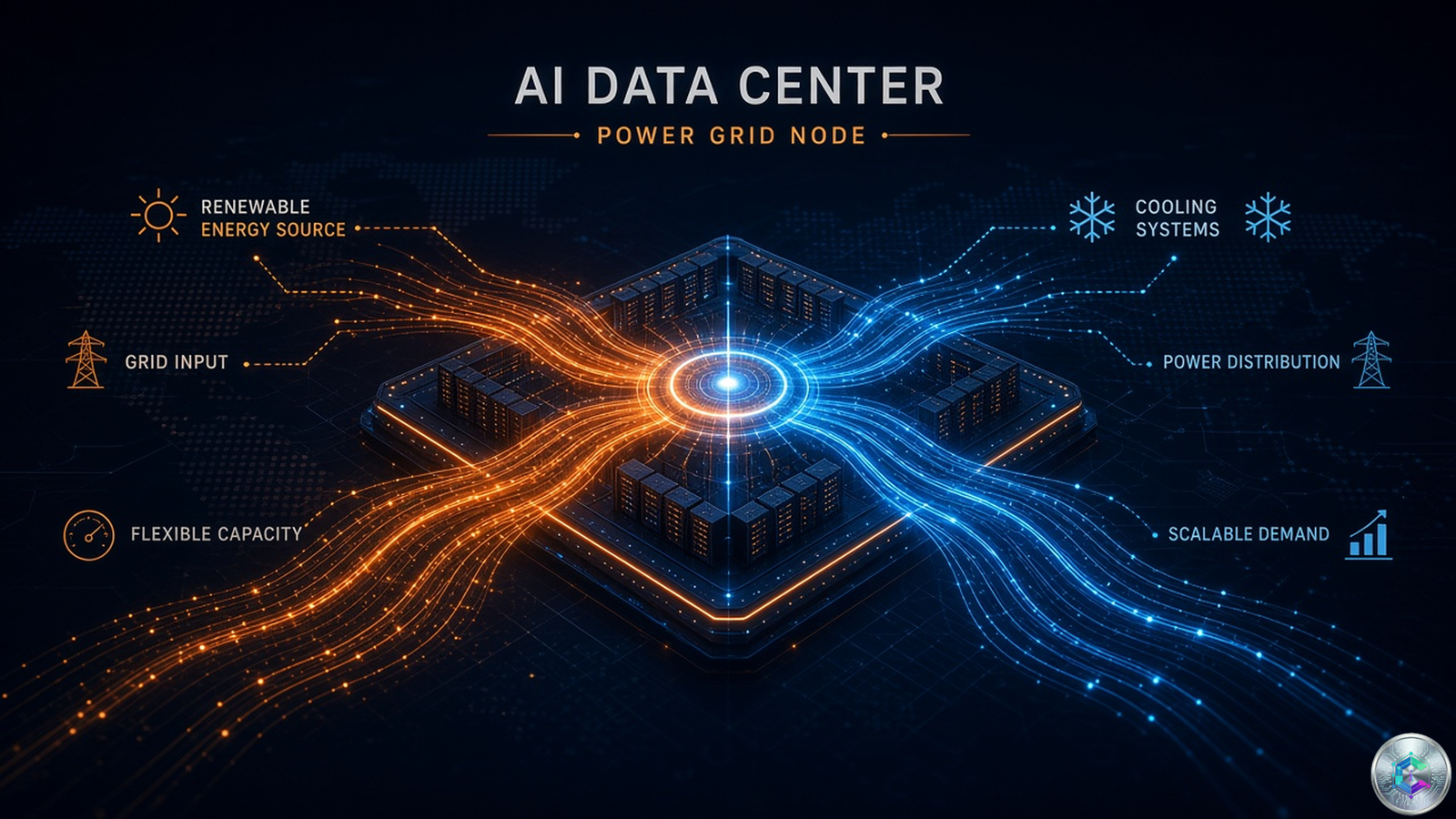
A « flexible » data center is a facility able to cut its electricity consumption when the grid is stressed. Three main levers enable this modulation: rescheduling AI training jobs to avoid peaks, drawing on on-site batteries instead of the grid, and injecting stored electricity back into the network to support end customers.
Two platforms stand out on the tooling side:
| Platform | Vendor | Main function | Deployment |
|---|---|---|---|
| DSX Flex | Nvidia | Grid + on-site battery optimization for Rubin GPUs | Available to Rubin operators |
| Emerald Conductor | Emerald AI | AI workload modulation based on utility signals | Manassas (Virginia), Phoenix, London, Chicago, Portland |
For Josh Parker, Nvidia’s head of sustainability, the equation is simple: « This is really a triple-win solution. » The alliance wants to make data centers « model grid citizens », perceived by local communities as assets rather than burdens.
Conclusive field demonstrations
The technology is no longer a prototype. Emerald AI and its partners have run repeated trials under real-world conditions. The most striking one took place on May 3, 2025 in Phoenix, under EPRI’s DCFlex initiative. On a particularly hot Arizona day, the data center cluster instantly cut its power consumption by 25% and held that level for 3 consecutive hours, with AI workloads staying within their service-level agreements.
Further trials followed in Chicago, Virginia, Portland, and most recently London, at Nebius’s new AI factory equipped with 96 Nvidia Blackwell Ultra GPUs. By simulating real events — coffee breaks during football matches, lightning strikes — the Emerald Conductor platform proved it can react within seconds. The flagship project remains the Manassas, Virginia site: 100 MW of capacity, built with Digital Realty, EPRI, and PJM Interconnection, billed as the « world’s first energy-flexible AI factory. »
| Site | Partners | Capacity / config | Reduction | Duration |
|---|---|---|---|---|
| Phoenix (Arizona) | Nvidia, OCI, SRP, APS | EPRI DCFlex initiative | 25% | 3 h |
| Manassas (Virginia) | Nvidia, Emerald AI, Digital Realty, EPRI, PJM | 100 MW | Variable | Continuous |
| London (Nebius) | Nvidia, Nebius | 96 Blackwell Ultra GPUs | Variable | Seconds |
| Chicago / Portland | Emerald AI, local utilities | Real-environment testing | n/a | n/a |
Regulation, public opinion, and AEMA’s roadmap
The US regulatory landscape is shifting fast. In June, the FERC (Federal Energy Regulatory Commission) ordered the six regional grid operators it supervises to explore new options for connecting large flexible loads. The Texas operator is finalizing rules that let « controllable » data centers connect faster, and Silicon Valley Power has launched the first US flexible-load interconnection program.
On the coalition side, AEMA has set three priorities: drafting best practices (including outage response) before facilities come online, standardizing the metrics used to evaluate energy optimization, and encouraging technical data sharing across the industry. The alliance’s principles stipulate that uptime, curtailment, and contingency-response obligations must be defined before a site is interconnected.
The political stakes are real. An AP-NORC / University of Chicago Energy Policy Institute poll published on September 16 shows that 84% of Americans worry about data center impacts on local electricity prices. More than half say they are extremely or very concerned about AI’s environmental impacts, up from 41% a year earlier. Roughly 99% of Democrats and 78% of Republicans support requiring data center developers to fund the grid upgrades needed to power their facilities.
Consultancy Brattle Group estimates that every 10% improvement in grid utilization cuts tariffs by about 3.4% — figures cited by Varun Sivaram in a Fortune op-ed.
« Data centers should only get faster or larger grid connections if their demand-reduction capability is verifiable and enforceable. »
Varun Sivaram, CEO of Emerald AI
Conclusion: toward a new social contract between AI and the grid
For Varun Sivaram, energy flexibility could unlock 100 GW of capacity on existing US power networks, letting new AI factories come online without spurring demand peaks. If these numbers hold at scale, AEMA could become one of the most concrete levers to reconcile the AI economy with grid sustainability. The coalition now needs to convince federal and state regulators to enforce common standards, and prove that flexibility is verifiable and enforceable — not just a marketing pitch. The next real-world test will likely come from the announced pilots with Silicon Valley Power in Santa Clara and the ramp-up of the Manassas site.
Sources
- SiliconANGLE, September 17, 2026
- Nvidia Blog
- Axios, September 16, 2026
- HPCwire
- Nvidia Case Study
- Fortune, September 16, 2026
This article is for informational and educational purposes only. It does not constitute investment advice. Do your own research (DYOR) before making any decision.

