


A governance proposal filed on September 15, 2026 aims to open Aave V4 to regulated institutions by leveraging Anchorage Digital and Chainlink — without ever moving the underlying collateral on-chain.
🔑 Key takeaways
- « Custodied Collateral Lending » proposal filed on Aave V4 on September 15, 2026
- Anchorage Digital would act as the federally chartered US custodian
- Chainlink would provide the CustodySync infrastructure to sync on-chain/off-chain balances
- Collateral would remain at Anchorage; non-transferable accounting tokens (CoCT) would be minted on Aave
- Liquidations would be conducted over-the-counter (OTC) via Anchorage, with partial liquidations supported
Technical architecture: off-chain collateral backing on-chain liquidity
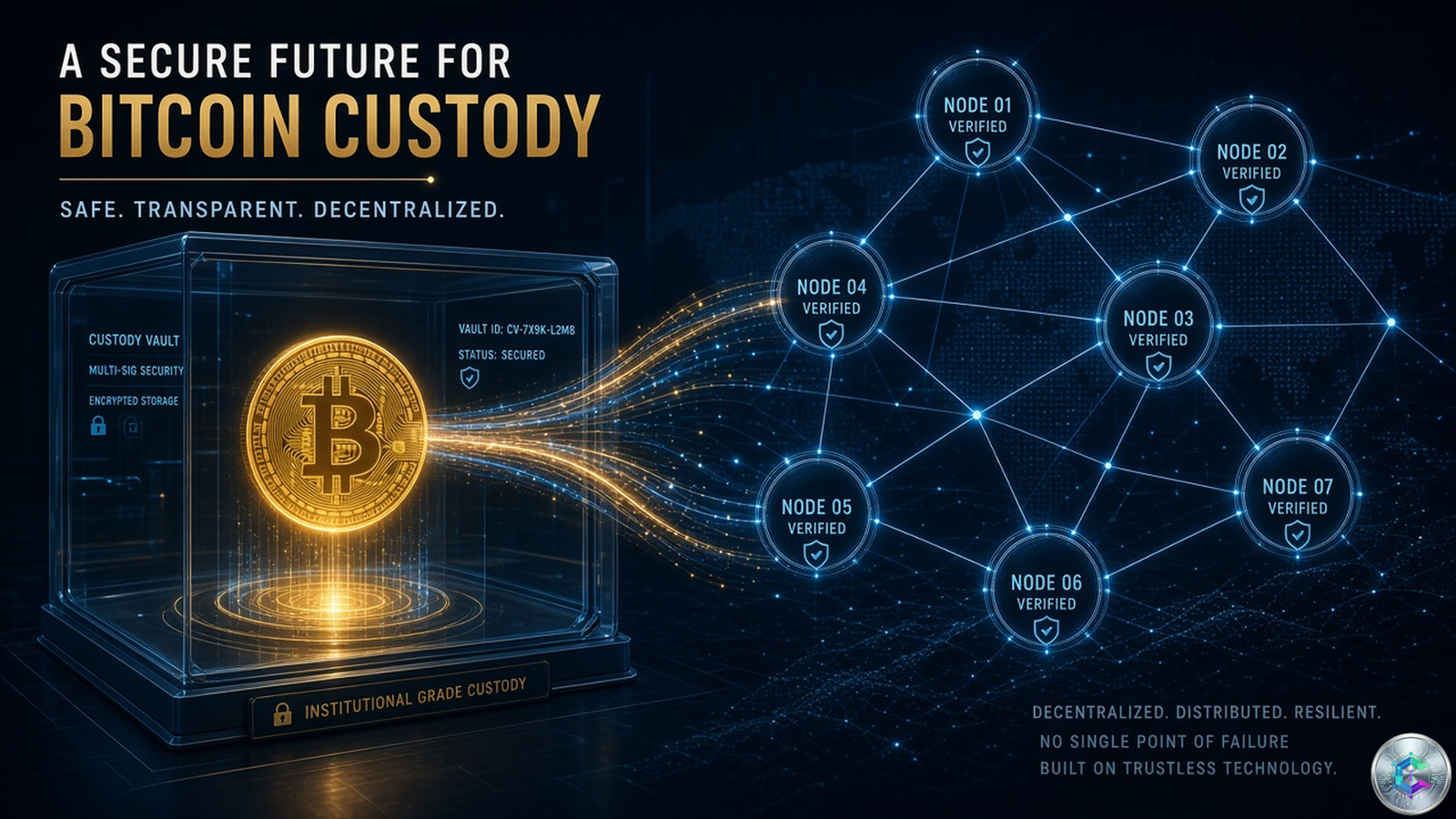
The proposal, titled « Custodied Collateral Lending: Aave V4 Isolated Hub & Spoke, » introduces a mechanism designed to connect a traditional custodian to an on-chain lending market without transferring the underlying assets to the blockchain. The core idea is to separate the custody of the collateral, which remains on Anchorage’s books, from its on-chain representation, which takes the form of a non-transferable accounting token.
That token, called a Custodied Collateral Token (CoCT), functions neither as a tradable asset nor as a direct claim on the underlying collateral: it acts as a unit of account whose quantity reflects, at all times, the balance actually held by the institution at Anchorage. Multiple sources indicate that the first CoCT issued would represent Bitcoin held by Anchorage, although the proposal anticipates expanding the list of eligible assets over time.
The architecture leverages the Hub-and-Spoke model introduced in Aave V4. A dedicated Hub concentrates the stablecoin liquidity made available to borrowers; a dedicated Spoke accepts CoCTs as collateral and draws its liquidity from the Hub. This separation isolates the new flow of activity from the rest of the existing retail markets on Aave.
Anchorage Digital and Chainlink, two complementary pillars
The setup rests on two technical partners with clearly distinct but tightly coordinated roles. Anchorage Digital, founded in San Francisco in 2017 and valued at approximately $4.2 billion, is the first federally chartered digital asset bank in the United States (Anchorage Digital Bank N.A.). It acts as the regulated custodian and physically holds the assets pledged as collateral. The firm’s backers include Andreessen Horowitz, GIC, Goldman Sachs, KKR, and Visa; it also operates from New York, Porto (Portugal), Singapore, and Sioux Falls (South Dakota).
Chainlink provides the infrastructure layer that makes the bridge between Anchorage and Aave both reliable and auditable. Its core component, called CustodySync, controls the minting and burning of CoCTs: every change in the collateral balance reported by Anchorage is automatically mirrored by a corresponding update to the CoCT supply. Chainlink also contributes its Proof of Reserve feeds and price feeds, and synchronizes loan lifecycle events — openings, repayments, liquidations — between the custodian and the protocol.
OTC liquidations, isolated risk, and DAO governance
The liquidation mechanism is one of the most consequential features of the proposal. Unlike classic Aave markets, where undercollateralized positions are automatically seized and sold on-chain by atomic liquidators, positions backed by CoCTs would be liquidated over-the-counter via Anchorage. The custodian orchestrates the off-chain sale of the collateral, which introduces an additional delay compared with a fully on-chain model but preserves tighter control over execution price.
Partial liquidations are supported, which limits cascade risk in the event of sharp market moves. More importantly, the entire system is isolated within a dedicated portion of Aave V4: a solvency, parameter, or liquidity issue in this market does not affect existing retail pools. This risk isolation is especially important given that assets held by Anchorage remain outside the direct perimeter of the blockchain.
« Democratizing access to Aave governance is key, and now more institutions will be able to participate in important protocol-level decisions thanks to Anchorage. »
Stani Kulechov, founder and CEO of The Aave Companies
On the governance side, the proposal must clear several standard Aave DAO stages: an ARFC phase to gather informal community support, a Snapshot vote, and then a formal on-chain vote. The final risk parameters — collateralization factors, borrow caps per asset, lists of borrowable stablecoins — will be recommended by Aave’s risk service providers before being packaged into an AIP (Aave Improvement Proposal). The DAO therefore retains full control over risk parameters, even though the mechanics rely on an external custodian.
The Aave Horizon precedent and the rise of institutional stablecoins
The proposal builds directly on Aave Horizon, the RWA (Real World Assets) market launched in August 2025. Horizon opened the door for qualified institutions to borrow stablecoins against tokenized securities used as collateral, and has since become a preferred entry channel for regulated players.
Several stablecoins have seen their adoption surge on Horizon. Ripple’s RLUSD, launched in December 2024 and integrated on Aave V3 in April 2025 with a circulating supply of roughly $250 million, had crossed $1.3 billion by the end of 2025 — a more than five-fold increase in nine months. According to Aave, roughly two-thirds of that growth occurred on Aave, making RLUSD the largest single asset on Horizon. PayPal’s PYUSD, meanwhile, saw its supply climb by around 50% since October 2025 to reach $3.6 billion, of which nearly $400 million is deposited on Aave — accounting for close to half of PYUSD’s growth on Ethereum.
A stablecoin market already dominated by Aave
The macro context for stablecoins strongly supports the proposal. Global stablecoin market capitalization crossed $300 billion in 2025, across more than 300 tokens tracked by DeFi Llama — of which only 14 exceed $1 billion in market cap. Aave occupies a hegemonic position in this segment: more than 80% of USDT and USDC deposits and borrows on Ethereum flow through its pools, for an aggregate volume of roughly $13 billion borrowed against $20 billion deposited in stablecoins. Stablecoins now account for more than half of all borrowing on the protocol, whose total TVL approaches $43 billion. The AAVE token, trading near $120 at the time of the proposal, is down 5.43% over 24 hours and 7.10% over seven days, but still up +39% over the past month.
| Indicator | Value | Source / period |
|---|---|---|
| Proposal | Custodied Collateral Lending: Aave V4 Isolated Hub & Spoke | September 15, 2026 |
| Partners | Anchorage Digital, Chainlink | Aave proposal |
| Stablecoin market cap | > $300B | 2025 |
| Aave share on USDT/USDC (Ethereum) | > 80% | Aave, 2025 |
| Aave stablecoin TVL | ~$20B deposited / $13B borrowed | Aave, 2025 |
| RLUSD on Aave | ~$1.3B (end-2025, +5x in 9 months) | Aave, 2025 |
| PYUSD on Aave | ~$400M (out of $3.6B supply) | Aave, Oct. 2025 |
| Aave global TVL | ~$43B | Sept. 2026 |
| AAVE price | ~$120 (-5.43% 24h, -7.10% 7d, +39% 30d) | Sept. 2026 |
Conclusion: an institutional bridge, but not without trade-offs
If adopted, the proposal will open an unprecedented channel between traditional finance and Aave: regulated institutions will be able to mobilize their Bitcoin treasury (and, over time, other assets held at Anchorage) to borrow stablecoins, without giving up the legal security of a federal custodian. The cost of that openness is additional friction in liquidation — no longer atomic but negotiated OTC — and a greater dependency on a centralized intermediary, even though system risk is isolated in a dedicated Hub.
Three key points remain to watch: the speed at which the Aave community validates the proposal (ARFC phase then Snapshot), the exact nature of the first supported collateral (several sources mention BTC), and the list of borrowable stablecoins (USDC, GHO, and RLUSD are widely expected, in line with Aave Horizon). Over the longer term, this type of architecture could serve as a template for integrating other regulated custodians and accelerating the institutionalization of on-chain credit, turning Aave V4 into a key bridge between DeFi and balance-sheet finance.
Sources
- Cryptoast — Aave veut prêter des stablecoins aux institutions via Anchorage et Chainlink
- Anchorage Digital — Introducing on-chain Aave governance at Anchorage Digital
- TradingView / CoinMarketCal — Aave governance proposal introduces Custodied Collateral Lending on V4
- CryptoBriefing — Aave Custodied Collateral Lending for institutions
- Aave — Stablecoin infrastructure (blog)
This article is published for informational and educational purposes only. It does not constitute investment advice. Do your own research (DYOR) before making any decision.

