


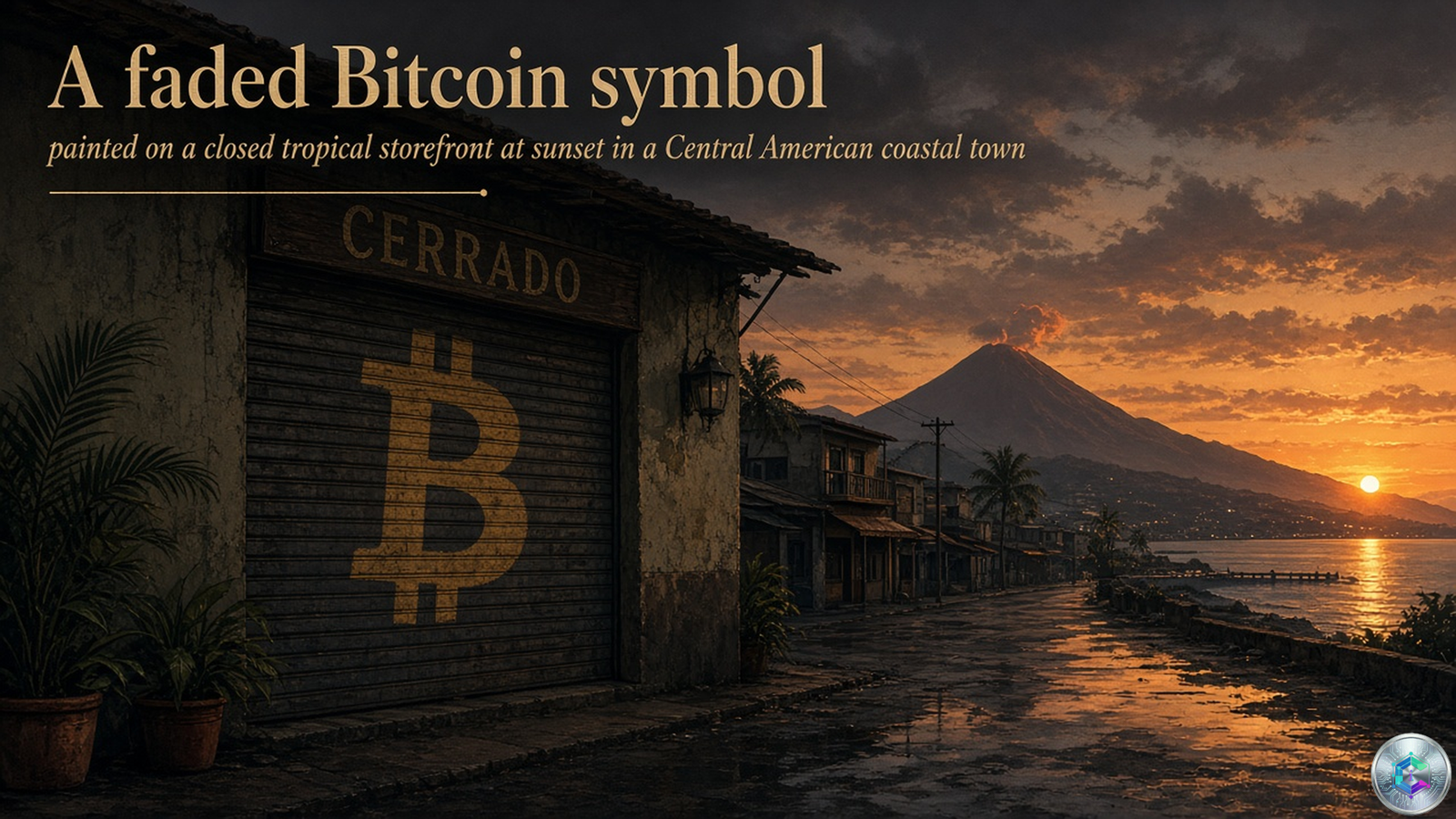
El Salvador, the first nation to grant bitcoin legal tender status in September 2021, has abandoned its everyday use. Under IMF pressure, BTC payments have all but disappeared, even as it quietly accumulates a strategic reserve.
🔑 Key takeaways
- Only 1.7% of January-February 2022 remittances went through the Chivo wallet.
- The IMF conditioned its USD 1.4 billion aid on ending bitcoin’s legal tender status.
- The deal was sealed in February 2025; merchants are no longer required to accept BTC.
- El Salvador still holds 6,050 BTC, worth roughly USD 600 million at current prices.
- About 70% of the population opposed bitcoin as a means of payment, polls showed.
A historic rollout under Bukele
On September 7, 2021, President Nayib Bukele officially adopted bitcoin as legal tender, alongside the U.S. dollar. The stated goal was to slash the cost of remittances, which account for 22% of Salvadoran GDP. Bukele promised “millions of dollars in savings” and a boost to the domestic economy.
To kick-start adoption, the government rolled out a series of incentives. An electronic wallet called Chivo Wallet was created, and every adult citizen who downloaded the app received the equivalent of USD 30 in bitcoin. According to El País, the public budget devoted to the policy ran between USD 200 million and USD 400 million, including a USD 150 million conversion fund designed to absorb BTC/USD price swings. The app was downloaded four million times in a country of 6.5 million people.
Symbolically, the government unveiled Bitcoin City at the foot of the Conchagua volcano, powered by geothermal energy and pitched to bitcoin miners. To fund it, the administration announced the so-called Volcano Bonds for USD 1 billion, initially slated for March 2022 but postponed indefinitely.
Disappointing adoption on the ground
Despite the financial incentives and political fanfare, bitcoin barely registered as a payment method. The president of El Salvador’s central bank (BCR) reported that of the USD 1.125 billion in remittances received in January-February 2022, only USD 19 million (1.7%) flowed through Chivo. The same source noted that less than 2% of remittances were routed through cryptocurrencies between January and November 2023.
Polls confirmed public distrust: roughly 70% of the population opposed bitcoin as a means of payment. Luis Mejillon, a 28-year-old Salvadoran, summed up the skepticism:
“I don’t trust it, for three reasons. One, it’s a volatile currency. Two, bitcoin lends itself to money laundering. Three, we could become a narco-state.”
Luis Mejillon, Salvadoran resident
Field evidence backs that rejection. Jon Atack, a Bitcoin Core developer, described paying his bill in BTC at a restaurant in El Zonte, the famed “Bitcoin Beach.” He noted that the transaction drew the staff’s curiosity because it was the first of its kind in weeks. According to him, such transactions had become “virtually nonexistent.” Bitcoin’s volatility finished the job: many users preferred their bank card to an asset that could drop in value before conversion to dollars.
IMF pressure and the February 2025 deal
The IMF began criticizing bitcoin’s legal status as early as January 2022, calling it a source of financial instability, a threat to financial integrity and a risk for consumer protection. Facing a public debt of USD 31 billion (around 85% of GDP), El Salvador had little choice but to knock on the Fund’s door.
In 2024, the IMF offered USD 1.4 billion in assistance with one clear condition: end bitcoin’s recognition as legal tender. President Bukele accepted the deal in February 2025, while publicly insisting the government would keep buying BTC. Since then, merchants are no longer required to accept bitcoin payments: the legal-tender experiment is over.
| Indicator | Value | Period |
|---|---|---|
| El Salvador public debt | USD 31 billion | 2024 |
| Debt / GDP | ~ 85% | 2024 |
| Conditional IMF aid | USD 1.4 billion | 2024 |
| Remittances via Chivo | 1.7% | Jan-Feb 2022 |
| Remittances via crypto | < 2% | Jan-Nov 2023 |
Reserves intact, paper losses real
Despite abandoning day-to-day bitcoin use, El Salvador still holds a sizable reserve. The national bitcoin office reports 6,050 BTC, valued at roughly USD 600 million at current prices, up from 2,300 BTC previously cited in media reports — a sign that accumulation has quietly continued.
Past purchases, however, generated significant losses. In early 2022, on USD 86.6 million invested, the state had already booked a USD 16.2 million loss (-18.7%) in just two months. By June 2022, the bitcoins acquired by the government were worth only half their purchase price.
Bukele is now banking on “exponential appreciation” fueled, he says, by U.S. President Donald Trump’s support for the bitcoin ecosystem. A speculative bet that contrasts with the daily reality of a population still loyal to the U.S. dollar for everyday transactions.
Conclusion: a monetary lab closed
El Salvador’s experiment shows the limits of imposing a volatile asset top-down as a medium of exchange. Without organic demand, a trained merchant network and protection against price swings, bitcoin failed to displace the dollar, deeply anchored in local habits. The IMF compromise closes a monetary utopia — but leaves the country exposed to the future value of its BTC stockpile.
Two scenarios loom: a sustained bitcoin rally that would turn El Salvador’s 6,050 BTC into a strategic asset, or a prolonged stagnation that would turn this policy into a fiscal millstone. Either way, it stays a textbook example of the pitfalls of declaring one as a national currency.
Sources
- Cryptoast — El Salvador abandons bitcoin as a means of payment
- Perspective — Assessment of bitcoin adoption in El Salvador
- RFI — El Salvador drops bitcoin as official currency
- Le Grand Continent — Monetary surrealism: bitcoin in El Salvador
- BBC Afrique — El Salvador and bitcoin
- RTBF — Why the IMF urges El Salvador to drop bitcoin
This article is published for informational and educational purposes only. It does not constitute investment advice. Do your own research (DYOR) before making any decision.

