


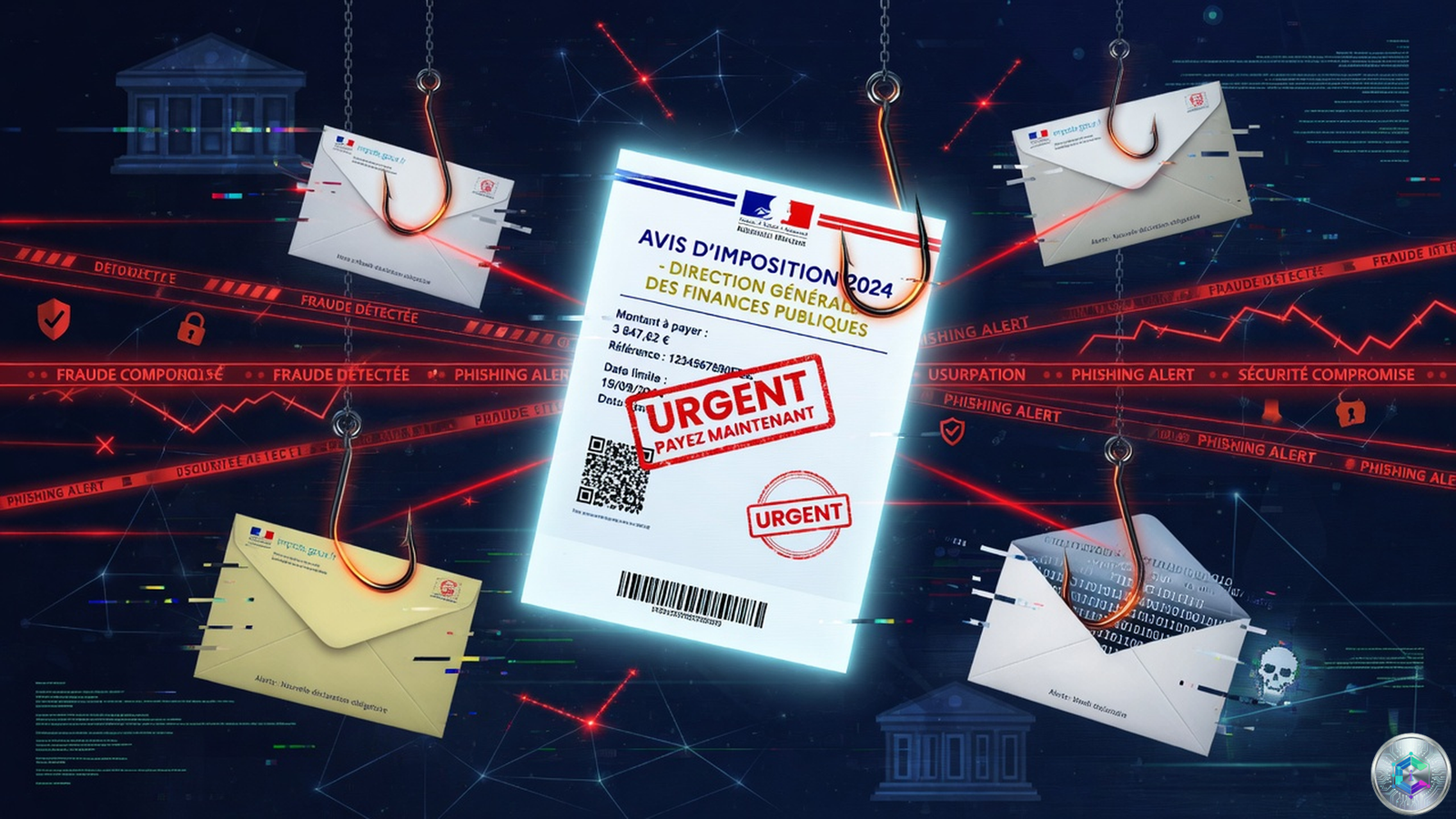
The DGFiP breach has exposed the fiscal data of 678,000 taxpayers, paving the way for highly targeted phishing campaigns. Faced with the rise of AI-powered scams, France’s Ministry of Economy, the Banque de France, and the FBF are responding with a new national awareness campaign.
🔑 Key Takeaways
- 678,000 French taxpayers affected by the DGFiP hack
- Manipulation fraud reaches €179 million in H1 2024 (-2%)
- 54% of French citizens report a bank data scam attempt
- Toll road SMS scams surged 900% in one year
- A new national campaign mobilizes Bercy, Banque de France, and the FBF
A breach with worrying fiscal ramifications
The hack of the Direction générale des Finances publiques (DGFiP) compromised the tax data of 678,000 French taxpayers, creating fertile ground for cybercriminals. The Kruptos account on X quickly warned of imminent, “highly credible” phishing campaigns exploiting updated, verifiable information from the leak.
Scammers now hold concrete elements — identity, address, tax status — to craft personalized messages. SMS for unpaid fines, refund emails, fake bank advisors: every scenario becomes plausible and difficult to distinguish from an authentic official communication.
“These scam campaigns will leverage very convincing and up-to-date data from the leaked information.”
Kruptos, cybersecurity-focused account on X
Fraud figures in France
The semi-annual report from the Observatory for the Security of Payment Methods (OSMP) offers a nuanced picture. Manipulation fraud — including card payments with strong customer authentication and fraudulent transfers from online banking — stood at €179 million in H1 2024, down 2% from H1 2023.
| Indicator | H1 2024 Value | Change vs H1 2023 |
|---|---|---|
| Manipulation fraud | €179M | -2% |
| French targeted by bank scam | 54% | -3 pts |
| Actual victims | 1 in 10 | stable |
| Banking data considered sensitive | 91% | rising |
| Fear of bank data breach | 85% | rising |
| Fear of online scams | 81% | rising |
The “French People and Cybersecurity – Wave 4 – 2025” barometer by Toluna Harris Interactive for the FBF confirms a collective awareness. 91% of French citizens consider their banking data sensitive, a record since 2023, ahead of identity, contact, or location data.
Generative AI as a scam accelerator
Generative AI is reshaping the cybercrime landscape. 85% of respondents to the FBF barometer believe it enables more sophisticated scams, while 62% see it as a lever for detection and protection. This perception is reflected in the numbers: according to McAfee, toll road SMS fraud surged 900% in one year in 2025.
The modus operandi is now well-oiled: an SMS informs of an unpaid toll with a payment link redirecting to a phishing site collecting card details, driver’s license number, and social security number. In some cases, fraudsters trigger large-scale identity theft.
AI-assisted romance scams are also on the rise. A McAfee study found that more than one in four people report being approached, or knowing someone approached, by an AI chatbot impersonating a real person on a dating or social media app.
Institutional response and best practices
France’s Ministry of Economy, the Banque de France, the FBF, and the OSMP have joined forces for a new national awareness campaign. Spots on major national radio stations, ads in the daily press, and digital outreach lay out the essential reflexes to adopt.
Preventive behaviors are progressing: 88% of French citizens ignore calls from unknown numbers, 77% use a unique password for their bank account, 70% enable two-factor authentication, and 73% verify website security. Seniors aged 60 and over report a victimization rate 10 points below the national average, a sign of sometimes stricter vigilance.
The institutional message is unambiguous: no bank advisor will request a code or password; the Banque de France never solicits bank details; the tax administration never sends refund emails without a login to the authenticated portal; the DGFiP never sends SMS for unpaid fines. In case of doubt, specialists recommend logging in directly to the official impots.gouv.fr site and contacting your bank directly.
Canada and Belgium: same threat, two responses
France is not an isolated case. In Canada, the Canadian Anti-Fraud Centre (CAFC) reports that only 5% of frauds are reported to authorities. In Ontario, insurance fraud reaches CAD 1.6 billion per year. An Interac survey shows 7 in 10 Canadians claim to recognize phishing, while 96% fail in practice to identify a fraudulent method.
In Belgium, the Federal Police launched the #SCAM campaign (“Stay connected, but act with discernment”), which reached nearly 2,390,708 people. A national Phishing unit has been created within the Federal Police to structure the response.
“This is an important and necessary step in the fight against phishing.”
Eric Snoeck, General Commissioner of the Belgian Federal Police
Conclusion: data becomes the top security stake
The DGFiP hack acts as a wake-up call: fiscal, banking, and identity data now constitute the raw material for mass fraud. The convergence of data leaks, generative AI, and social engineering creates an unprecedented cocktail that national awareness campaigns are trying to neutralize through education and the spread of best practices. For affected taxpayers, the absolute priority is to treat any unsolicited message with suspicion and to contact their bank or tax authority directly through official channels. In the medium term, the challenge will go beyond awareness: it will require a redesign of authentication methods and a more systematic sharing of weak signals between financial institutions, telecom operators, and regulators.
Sources
- Cryptoast — Tax site hack: massive scam campaigns expected
- Banque de France — National awareness campaign
- FBF — Toluna Harris Interactive 2025 barometer
- Belgian Federal Police — #SCAM campaign
- Radio-Canada — Ontario fraud fight
- McAfee — 2025 scam retrospective
This article is published for informational and educational purposes only. It does not constitute investment advice. Do your own research (DYOR) before making any decision.

