

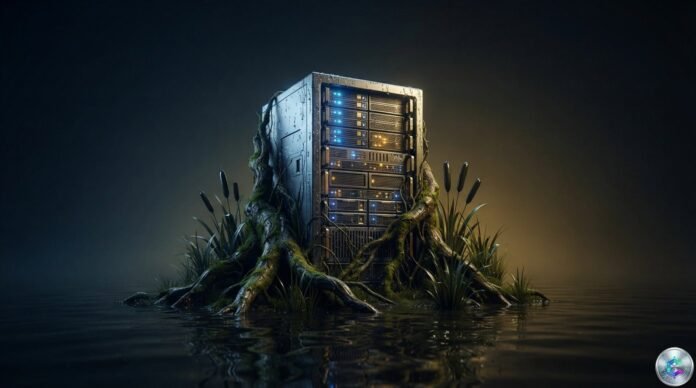
Amazon is expanding its data center footprint in Virginia’s Loudoun County, an area known as “Data Center Alley.” Internal documents obtained by The Washington Post show the e-commerce giant may have downplayed the environmental impact of its project on hundreds of cubic meters of wetlands. The investigation reignites the debate over the ecological footprint of digital infrastructure.
🔑 Key takeaways
- Amazon is developing a large data center project in Loudoun County, dubbed “Data Center Alley”
- Internal documents contradict the company’s claim of “no significant impact” on wetlands
- Hundreds of cubic meters of wetlands would be filled in or diverted, according to independent engineers
- Data centers consume massive amounts of water for server cooling
- Amazon has pledged to reach carbon neutrality by 2040 under the Climate Pledge initiative
Amazon’s project in the heart of “Data Center Alley”
Loudoun County, located northwest of Washington D.C. in Virginia, hosts one of the densest concentrations of data centers in the world. The region, officially dubbed “Data Center Alley” by industry players, already holds the bulk of Amazon Web Services’ (AWS) capacity on the U.S. East Coast, alongside infrastructure from Microsoft, Google and Meta.
According to internal documents reviewed by The Washington Post, Amazon is accelerating the rollout of new buildings to meet surging demand for compute capacity driven by generative AI and cloud services. The project envisions multiple data center campuses on parcels currently forested or wetland, often adjacent to residential neighborhoods.
The investigation draws on regulatory filings, internal environmental reviews and emails exchanged between Amazon managers and environmental engineers. It highlights a gap between the group’s public statements and the technical assessments contained in its own files.
Wetlands at risk: what the documents reveal
In its submissions to local authorities in Loudoun County, Amazon stated that its project would have “no significant impact” on surrounding wetlands, in line with the thresholds set by the federal Clean Water Act. However, several independent analyses reviewed by The Washington Post reach a different conclusion.
Environmental engineers specializing in wetland assessments identified several hundred cubic meters of wetlands that would be filled, drained or diverted to clear space for the new facilities. These ecosystems play a critical role: they filter stormwater runoff, host rich biodiversity and mitigate flooding in a region increasingly hit by extreme rainfall events.
“We take our environmental responsibility very seriously and work closely with regulators to comply with all legal requirements.”
Amazon spokesperson, written statement
Amazon’s spokesperson also stressed that the company “evaluates each site carefully” and would offset residual impacts through restoration programs. Critics, however, argue that such offsets rarely replicate the ecological complexity of the habitats they replace, and that the net loss in biodiversity remains hard to quantify.
Water, energy and the hidden costs of the cloud
Beyond direct wetland destruction, data centers place significant strain on water and energy resources. Server cooling requires large volumes of water, typically drawn from aquifers or municipal systems. In a region like Virginia, where summer droughts are becoming more frequent due to climate change, this consumption directly competes with agricultural and domestic uses.
On top of that comes a massive carbon footprint: a large data center can consume as much electricity as tens of thousands of households. To power its sites, Amazon relies on a local energy mix still heavily dependent on natural gas in the PJM grid (the regional transmission organization covering the U.S. East Coast), despite its public commitments to renewable energy.
| Environmental criterion | Amazon’s stated position | Independent finding |
|---|---|---|
| Wetlands affected | “No significant impact” | Several hundred m³ at risk |
| Water consumption | Within permit limits | Increased pressure on resources |
| Carbon emissions | Net zero targeted by 2040 | Local grid still fossil-heavy |
| Ecological offsetting | Restoration programs in place | Net biodiversity loss |
This tension between industrial growth and climate commitments is not unique to Amazon. The entire cloud sector faces a structural dilemma: demand for compute power, supercharged by generative AI, is rising faster than the decarbonization of electricity grids.
A tightening regulatory environment
The revelations come as several U.S. states tighten their regulatory framework around data center expansion. In Virginia, local officials have recently called for a moratorium on new construction in certain saturated areas. The federal government, through the Environmental Protection Agency (EPA), has also opened multiple probes into water withdrawals by hyperscale operators (very large cloud providers such as AWS, Microsoft and Google).
For environmental groups, the issue goes beyond Amazon alone. They are calling for greater transparency in impact assessments and a public inventory of wetlands affected by digital infrastructure projects across the country. Amazon, for its part, points to its “Water+” program and investments in less water-intensive cooling technologies, but has so far declined to publish detailed data.
Conclusion: the difficult equation of “green” cloud
The expansion of data centers in Virginia illustrates a contradiction that is becoming increasingly visible in the digital economy: the race for compute capacity, supercharged by artificial intelligence, is colliding with the physical and ecological limits of the territories that host it. As long as cloud capacity growth outpaces both grid decarbonization and natural habitat restoration, controversies like the one uncovered by The Washington Post will keep multiplying.
For Amazon, the stakes are now as much reputational as regulatory. As enterprise customers demand audited carbon reports and regulators tighten their oversight, the credibility of the group’s climate pledges will hinge on its ability to align its public statements, internal impact studies and the operational reality of its construction sites.
Sources
This article is published for informational and educational purposes only. It does not constitute investment advice. Do your own research (DYOR) before making any decision.

