

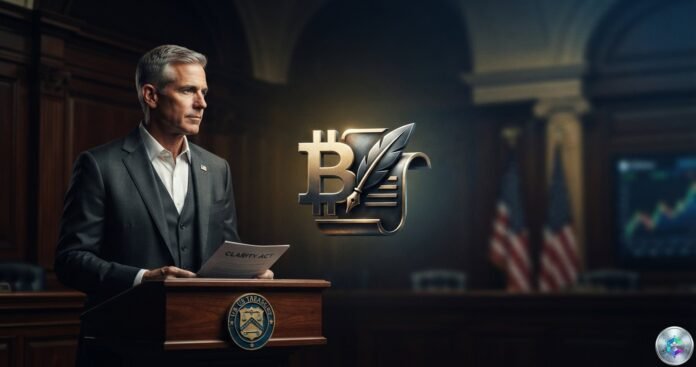
On October 31, 2025, US Treasury Secretary Scott Bessent posted a Satoshi Nakamoto quote on X to revive the CLARITY Act vote, in the middle of the 11th federal shutdown and a congressional budget standoff.
🔑 Key takeaways
- Treasury Secretary Scott Bessent celebrated the 17th anniversary of the Bitcoin white paper on X on October 31, 2025.
- He quoted a Satoshi Nakamoto line from July 29, 2010 to pressure Senate Democrats.
- The backdrop is the 11th federal shutdown in US history, ongoing since October 1.
- The CLARITY Act would align crypto-asset intermediaries’ regulation with traditional financial institutions.
- The crypto community remains split, between Bitcoin Core critics and calls to expand the Strategic Bitcoin Reserve.
A historical quote in a tense budget context
Bessent seized October 31, 2025 — the 17th anniversary of Satoshi Nakamoto publishing the Bitcoin white paper on the cryptography mailing list at metzdowd.com — to deliver a political message with two aims. On one hand, he praised the resilience of the Bitcoin network, describing it as a system that “never shuts down.” On the other, he took a jab at Senate Democrats, accusing them of blocking the CLARITY Act at a moment when the United States needs it most.
The statement landed in a particularly strained budget climate: since October 1, 2025, the US has been enduring its 11th federal shutdown, described as the longest “full” shutdown ever recorded. Roughly 900,000 federal employees have been furloughed without pay, the result of Congress failing to pass FY2026 appropriations.

The CLARITY Act at the heart of America’s crypto strategy
The CLARITY Act, the centerpiece of the political fight, aims to tighten the regulatory and compliance obligations of crypto-asset intermediaries. The bill seeks to put these actors on an equal footing with traditional financial institutions, while clarifying the legal status of developers, who would no longer be treated as money transmitters.
The Blockchain Regulatory Certainty Act, cited by Washington lobbyists, would codify a long-standing Treasury Department policy: non-custodial developers and builders are not subject to the registration requirements of the Bank Secrecy Act. This policy has held steady across administrations, Democratic and Republican alike.
“Democrats are playing political games while a major win for American leadership is within reach.”
Scott Bessent, US Treasury Secretary
Bessent defended the text as the fruit of “thousands of hours of bipartisan negotiations” and compromises between the Senate Banking and Agriculture Committees. He closed his call to vote by quoting Satoshi Nakamoto, written on July 29, 2010: “If you don’t believe me or don’t get it, I don’t have the time to try to convince you, sorry.”
Strategic Bitcoin Reserve and GENIUS stablecoins
The Trump administration’s crypto strategy extends well beyond the CLARITY Act. In July 2025, after President Trump signed the GENIUS Act (Guiding and Establishing National Innovation for U.S. Stablecoins), Bessent called stablecoins (tokens pegged to a fiat currency, here the US dollar) “a revolution in digital finance.” He argued that a native dollar rail on the internet could reinforce the greenback’s reserve currency status while expanding access to dollar payments globally.
In August 2025, the Treasury Secretary said on X that Bitcoin surrendered to the United States would feed a Strategic Bitcoin Reserve, and that the Treasury would explore budget-neutral ways to accumulate more. The posture reflects a vision in which digital assets become a geopolitical and budgetary tool aligned with defending the dollar.
Split reactions across the crypto community
Bessent’s post triggered sharply divided reactions. Luke Dashjr, a long-time Bitcoin Core developer, claimed Bitcoin is “weaker than ever,” pointing to debates around recent software versions. Researcher Eric Wall replied sarcastically that “Bitcoin is dead after the release of Core v30,” mocking recurring catastrophe predictions tied to each upgrade.
| Actor | Position | Main angle |
|---|---|---|
| Luke Dashjr | Technical critic | “Weaker than ever” |
| Eric Wall | Sarcastic | Recurring “Bitcoin is dead” cycle |
| Simon Dixon | Macro bull | Hedge against monetary debasement |
| Fred Krueger | Buyer | Treasury should accumulate BTC |
| Gabor Gurbacs | Institutional | Bitcoin “on the balance sheet” |
| Matthew Sigel | Institutional | Signal of growing interest |
Investor Simon Dixon reframed Bessent’s remarks as a critique of monetary policy, arguing Bitcoin’s purpose is protection against political debasement. Trader Fred Krueger quipped that the Treasury should buy more for the Strategic Bitcoin Reserve, while digital asset strategist Gabor Gurbacs urged putting Bitcoin “on the balance sheet.” Matthew Sigel said the Treasury Secretary’s quote marked a strong signal of growing institutional interest in cryptocurrencies.
Who is Satoshi Nakamoto?
Satoshi Nakamoto is the pseudonym behind Bitcoin. In 2008, he wrote the founding white paper and then published the reference implementation of the software. He is credited as the designer of the first blockchain and the first to solve the double-spending problem for a digital currency. Active until mid-2010, he reportedly mined 20,000 blocks among the earliest on the chain, amassing close to one million bitcoins.
At a Bitcoin price of $125,000 in 2025, his potential fortune is estimated at roughly $131 billion. In April 2026, a New York Times investigation by journalist John Carreyrou concluded that cryptographer Adam Back is the creator of Bitcoin. That identity remains unconfirmed, however, and Satoshi Nakamoto is, to this day, still treated as a pseudonym.
Conclusion
By invoking Satoshi Nakamoto to accelerate the CLARITY Act vote, Scott Bessent has crossed a symbolic threshold: a US Treasury Secretary explicitly leans on the founding figure of Bitcoin to pressure Congress. The move illustrates the growing convergence between US budget policy and the crypto ecosystem, where Bitcoin becomes an authority argument in the legislative debate.
Whether political pressure translates into a vote before the shutdown ends, or whether the bill stays frozen until federal activity resumes, remains the open question. The current momentum suggests a possible acceleration once Congress reopens, but the timeline is entirely contingent on the budget standoff being resolved.
Sources
This article is published for informational and educational purposes only. It does not constitute investment advice. Do your own research (DYOR) before making any decision.

