

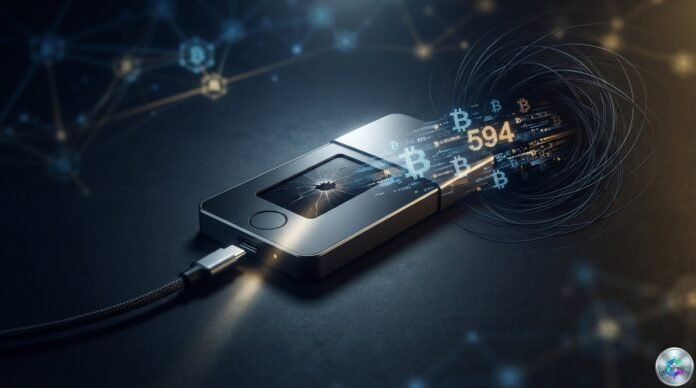
A failure in the random number generator of the Coldcard firmware allowed an attacker to drain 594 bitcoins from approximately 500 wallets in under 25 minutes on Friday, July 31, 2026. The incident, attributed to a flaw introduced in March 2021, reignites debate over the security of the hardware wallet software supply chain.
🔑 Key takeaways
- 594 BTC (~$38M) drained between 01:31 and 01:56 UTC on July 31, 2026
- Flaw in Coldcard firmware 4.0.0 released in March 2021
- ~500 single-signature wallets affected, each holding more than 0.15 BTC
- 562 BTC consolidated into a single address, still inactive
- Bitcoin above $64,000: no notable correction recorded
The flash attack: timeline of a methodical drain
The operation unfolded in an extremely tight window. Between 01:31 and 01:56 UTC—a mere 25 minutes—1,324 bitcoin segments (UTXOs) belonging to some 500 distinct addresses were transferred up to 594 BTC. The distribution across three consecutive blocks betrays an automated execution, almost certainly orchestrated by a script that pre-computed the compromised private keys ahead of time.
Each targeted wallet was single-signature and held more than 0.15 BTC—a threshold suggesting targeted pre-selection rather than an opportunistic sweep. According to Block’s analysts, many of these UTXOs had been dormant for years, and their age nearly matches the period during which the defective firmware was installed: 2021 to 2026.
| Block | Time window | Volume (BTC) | Target |
|---|---|---|---|
| Block A | 01:31–01:39 | ~210 | Dormant UTXOs |
| Block B | 01:40–01:48 | ~190 | Recent wallets |
| Block C | 01:49–01:56 | ~194 | Final consolidation |
| Total | 25 minutes | 594 (~$38M) | 500 addresses |
At the tail end, 562 BTC were consolidated into a single address that has not moved since, suggesting the attacker has not yet attempted to introduce the funds on centralized exchanges—an unusual delay for a theft of this size, likely aimed at letting the dust settle before any stablecoin conversion.
The technical flaw: a silently bypassed RNG
The root cause lies in a commit dated March 1, 2021, included in the 4.0.0 firmware distributed that month. According to Block’s Bitcoin engineering and security teams, a configuration parameter instructed the device to ignore its own hardware random number generator (TRNG). Worse, a check in the support library only tested for the existence of the parameter, not its activation state.
Result: key generation silently fell back to a basic software substitute, fed by the chip serial number and the clock registers. Neither element is confidential—the serial number is factory metadata, and clock values constitute a temporal state an attacker can restrict or measure on a device they own. The random seed thus became predictable, and the entire key space tied to that seed could be enumerated offline well before the July 31 attack.
“Mk4, Q, and Mk5 are not affected according to our preliminary analysis.”
Coinkite, Coldcard manufacturer
Exposure depended on the firmware active at the time of initial wallet creation, not the date of hardware purchase. In practice, users who generated a seed on an Mk3 running firmware 4.0.1 or later are affected. Block indicated it had shared its findings with Coinkite, whose team acknowledged them, while qualifying their respective analyses as preliminary. Block noted it published without full exploit confirmation because exploitation was already underway.
Beyond seeds: paper wallets and derived keys
Exposure is not limited to standard seeds. The same faulty generator produced:
- the private keys of Coldcard paper wallets (where the output becomes the key directly, without further BIP32 derivation)
- seed split masks used for distributed multisig storage
- device cloning keys, used to duplicate one Coldcard to another
- so-called key teleportation transfers between Coinkite devices
This generalization mechanically expands the risk surface for users who relied on non-standard backup architectures between 2021 and 2026—notably air-gapped storage enthusiasts combining an Mk3 with paper prints.
BTC market and lost coins: a quiet echo on price
On the market side, bitcoin traded above $64,000 during the early Asian hours following the attack. The $38 million theft did not trigger a notable correction or unusual volatility on exchanges. This lack of reaction is explained by the relative size of the haul against the network’s capitalization, and by the fact that the consolidated funds have not yet been introduced into selling circuits.
The incident fits a longer-term trend: the irreversible loss of bitcoins. According to Chainalysis estimates published in early 2025, between 2.3 and 3.7 million bitcoins are permanently lost, representing roughly 11 to 18% of the 21 million cap. Approximately 19.8 million BTC have already been mined, but once inaccessible tokens are deducted, the actually usable quantity stands between 15.8 and 17.5 million.
“Lost coins only make everyone’s coins worth slightly more. Think of it as a donation to everyone.”
Satoshi Nakamoto, Bitcoin creator
Conclusion: transparency and fund migration
The Coldcard affair illustrates an underestimated risk: a silent failure of a random number generator can remain latent for five years before being exploited at scale. For affected users, the immediate priority is to transfer funds to a wallet generated on patched firmware, or to another hardware wallet (Mk4, Q, Mk5, or a competing alternative).
Looking ahead, the episode calls for reflection on independent firmware audits for hardware wallets and on coordinated disclosure between Block, Coinkite, and other sector actors. The fact that Block made its findings public before being able to fully validate exploitability—out of moral obligation in the face of an active attack—raises questions about security patch cadence for devices deployed in the field, and about the gap between vulnerability discovery and effective remediation.
Sources
- CoinDesk – Major Bitcoin wallet flaw drains 594 BTC in 25-minute sweep
- Ledger Academy – How many bitcoins are lost
This article is published for informational and educational purposes only. It does not constitute investment advice. Do your own research (DYOR) before any decision.

