

Wall Street Hits Triple Historic Record Amid Unprecedented Economic Conditions
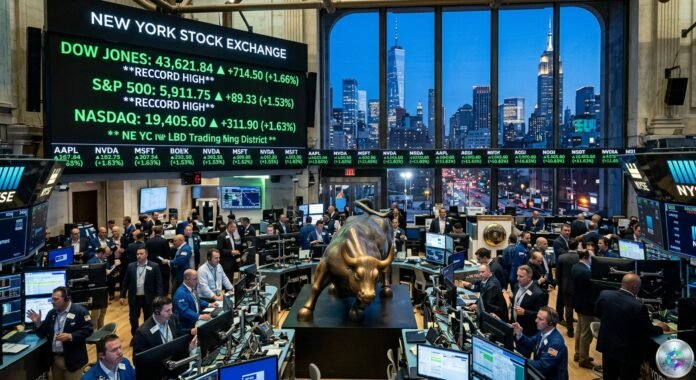
On April 30, 2026, Wall Street achieved a simultaneous triple historic record across its three major indices, with new all-time intraday and closing highs, in an unprecedented degraded economic context. The Dow Jones gained 1.62%, the S&P 500 rose 1.02%, and the Nasdaq Composite added 0.89%. These performances came as a global energy crisis, a geopolitical conflict in the Middle East, and inflation that spiked within weeks characterized the macroeconomic environment of the quarter. American household morale fell to its lowest level in three years, interest rates reached their highest in over a decade, and oil prices hit four-year highs. Paradoxically, these same macroeconomic pressures did not prevent the American indices from posting their strongest monthly performance in years, raising fundamental questions about the traditional link between the real economy and financial markets.
Background
To understand this triple record, one must go back to the foundations of American equity dynamics. The U.S. stock market has benefited since 2022 from a particular bull cycle, characterized by the return of post-pandemic inflation, restrictive monetary policy, and the emergence of generative artificial intelligence as a productivity driver. Three years after the Fed began its monetary tightening cycle, the Janet Yellen Effect and the narrative pivot around AI transformed investor expectations. On April 30, 2026, Fed Chair Jerome Powell hinted that the rate-hike cycle was firmly behind, while maintaining rates at a restrictive level. This configuration, dubbed « Powell Swan Song » by J.P. Morgan analysts, provided the perfect framework for an unexpected stock market rally in a context of macroeconomic deterioration.
Economic data for the day contributed to fueling this apparent paradox. U.S. gross domestic product grew 2.0% in the first quarter of 2026, weekly jobless claims fell to the lowest level since 1969, and personal income growth was 0.6% in March. These robust indicators offset the oil shock resulting from the Middle East conflict, which pushed barrel prices to four-year highs, with Brent crude at around $114 per barrel and WTI around $104. The prospect of a potential threat to the Strait of Hormuz, through which a portion of global oil traffic transits, added to geopolitical volatility without preventing the stock market rally from holding.
The market also benefited from a notable broadening of its base. While 2023 and 2024 were dominated by the « Magnificent Seven », the large-capitalization technology giants, April 2026’s rally was characterized by much broader participation. Mid-cap stocks, industrial stocks, and financial stocks all contributed to overall performance, suggesting a healthier and more inclusive market than previous cycles. President Donald Trump claimed credit for this rally, posting on his social network that the S&P 500 had added $7.6 trillion in market capitalization since its March low. New York Stock Exchange data confirm this trend, with 465 new highs against only 56 new lows during the session, an imbalance reflecting marked investor optimism.
Americans also benefited from a complete reversal of the yield curve, long inverted and perceived as a precursor recession signal. This reversal, which occurred recently, significantly reduced economic slowdown expectations. The labor market, with weekly jobless claims at their lowest since 1969, confirms the American economy’s resilience against external headwinds. The growing integration of generative AI into industrial processes and services has also begun to produce tangible productivity gains, partially offsetting rising labor and material costs.
The Facts
Closing figures for April 30, 2026 are unequivocal. The Dow Jones Industrial Average closed at 49,652.14 points, up 790.33 points, or 1.62%. The S&P 500 reached 7,209.00 points, gaining 73.05 points, or 1.02%. The Nasdaq Composite closed at 24,892.31 points, rising 219.07 points, or 0.89%. The Russell 2000 crossed the symbolic 2,800 level for the first time, reflecting broad participation in the rally. These three closing levels constitute absolute all-time records for the American indices. Market participation was remarkable, with 4,097 advancing issues against 991 declining issues on the NYSE, a ratio of 4.1 to 1 in favor of the bulls. The VIX, a volatility indicator, remained below 18, reflecting sustained if watchful optimism.
Monthly performances were equally exceptional. The S&P 500 posted its strongest monthly percentage gain since November 2020. The Nasdaq achieved its largest monthly gain since April 2020. The Dow Jones recorded its strongest monthly advance since November 2024. For the month of April 2026 alone, the Nasdaq surged 19.8%, a performance level exceeding all monthly gains recorded during the 1999-2000 dot-com bubble, a comparison not lost on the most experienced analysts. Nine records were set during the last 12 trading sessions, a pace of gains that surprised even the most optimistic strategists.
Corporate earnings on the day played a leading role in this rally. Caterpillar surged 9.9% after hitting a record high, benefiting from strong demand for its construction and power generation equipment. Alphabet rose 10.0% after reporting a record quarter for its cloud computing unit, a concrete illustration of the productivity gains generated by AI. Eli Lilly jumped 9.8% after raising its annual profit forecast on sustained demand for its weight-loss drugs, confirming the market potential of obesity treatments. Meta Platforms fell 8.7% and Microsoft dropped 3.9%, both groups worrying investors with the scale of their artificial intelligence spending without measurable return on investment yet. Amazon gained 0.8%, marking a record month for the group in a context of resilient consumption despite the inflationary environment.
Market data confirms the broad health of the rally. On the NYSE, 465 issues hit a new 52-week high against only 56 new lows. On the Nasdaq, 3,497 issues advanced against 1,251 declining, a ratio of 2.8 to 1. This breadth suggests the rally no longer rests solely on a small number of mega-capitalization stocks but covers the entire American sectoral spectrum, a signal that fund managers consider particularly constructive for the continuation of the cycle.
Analysis
This triple record differs from previous rallies by several unique characteristics. Market observers note that no 20% gain on the Nasdaq has ever occurred near all-time highs after a mere 10% pullback. Previous gains of this magnitude systematically followed 50% to 75% crashes in technology stocks, making this configuration particularly remarkable and closely watched by institutional investors. The chief strategist at J.P. Morgan stated: « The Fed has successfully navigated the most difficult economic tightrope in forty years. » A statement that summarizes the ground covered since the recession fears of 2022 and 2023.
Paul Nolte, Senior Wealth Adviser and Market Strategist at Murphy & Sylvest, stated: « A lot of the economic data calmed investors’ fears. You have got some pretty good earnings from a lot of different companies, and we are seeing that broaden out today. » He also noted: « Until we see some changes to the market dynamic as well as the economy, the momentum is on the bullish side. » Major asset management firms maintain their constructive stance, with both J.P. Morgan and Goldman Sachs positive on American equities, even though Goldman forecasts lower returns than 2024’s 23%, considering that current valuations leave less room for upside surprise. The Shiller Cape Ratio at 36.48 leads some critics to believe the market is now priced for perfection, a risk premium that could be revised in the event of a new geopolitical shock or less favorable economic data.
The Fed’s role in this context deserves particular attention. The Federal Open Market Committee voted by a wide majority to hold rates unchanged, the most divided vote since 1992, illustrating the complex trade-offs facing policymakers. Core PCE inflation remains above 3% year-on-year, and core PCE rose 0.3% in March. Despite this, the Fed maintains its restrictive stance, preferring to risk excessive caution rather than reigniting inflation in an already tense geopolitical context. The yield curve inversion, which had been a recessionary warning signal for several months, has fully corrected, reducing recession fears for 2026. This normalization is interpreted by markets as a sign of maturation of the American economic cycle, having moved into positive territory after three years of restrictive policies.
Market Reactions
Market reactions were nuanced across sectors. Communication services and industrial stocks led sectoral gains, while technology was the only declining sector. This sectoral bifurcation is interpreted positively by market observers, as it suggests the rally no longer depends solely on technology giants but is supported by a broader economic base. The Russell 2000, the index of American mid-cap stocks, gained 2%, reflecting this broadening of the rally beyond mega-capitalization technology stocks. The « Magnificent Seven’s » weighting in capitalization-weighted indices remains significant, but April’s dynamic suggests a shift in favor of cyclical stocks and mid-cap names.
Bond signals also helped support the market. U.S. Treasury yields eased after tension highs recorded in early week, suggesting potential relief from geopolitical risk in the short term. The 10-year yield stands around 4.39% and the 2-year yield around 3.89%, levels that remain restrictive but are no longer perceived as major obstacles for equities. This relative easing in rates helped support equity valuations, particularly in rate-sensitive sectors such as real estate and utilities.
The oil market remains a factor for vigilance. With Brent crude at around $114 per barrel, the risk of a renewed inflation spike in the energy sector cannot be ruled out, which could complicate the Fed’s task and weigh on the equity rally. Geopolitical tensions in the Middle East, particularly the risk of closure of the Strait of Hormuz, remain asymmetric risk factors in the terminology of fund managers. Iran warned of retaliation if the United States abandons the ceasefire and renews attacks, adding to overall geopolitical uncertainty. WTI crude lost 2.97% on April 30, suggesting the oil market is beginning to factor in some form of normalization even in a context of sustained geopolitical tensions.
Outlook
In the medium term, two scenarios seem to emerge. The base case, favored by J.P. Morgan strategists, assumes maintenance of current momentum thanks to labor market solidity, the Fed’s successful transition to a neutral policy, and productivity gains from artificial intelligence. In this scenario, the S&P 500 could continue rising toward new highs in the second quarter of 2026, even if the pace of gains should be slower than in April. The alternate scenario, put forward by Goldman Sachs analysts, forecasting increased volatility in the second half of 2026 due to elevated valuations and persistent geopolitical uncertainty, cannot be excluded. Elevated valuations, as measured by the Shiller ratio, constitute the main point of vigilance for the months ahead.
The coming corporate earnings season will be a major test for the rally. Five of the « Magnificent Seven » are due to report in the coming weeks, and investor expectations regarding their AI spending remain extremely sensitive. While Caterpillar and Alphabet results were well received thanks to their ability to demonstrate concrete return on investment, Meta and Microsoft’s decline illustrates the divide emerging within the technology sector itself between companies that manage to monetize AI and those struggling to demonstrate financial gains proportional to their investments. America’s energy transition, with reduced dependence on oil imports and a pivot toward renewable energy, constitutes a structural factor that could mitigate the impact of future oil shocks on the American economy. The market nonetheless remains extremely attentive to geopolitical developments in the Middle East, with each potential escalation capable of disrupting the current market trajectory.
Sources
- Wall Street : Triple Record Historique dans des Conditions Economiques Inedites — CoinAcademy
- Wall Street ends higher, S&P 500, Nasdaq notch biggest monthly gains in years — Reuters
- Wall Street Records Shattered: S&P 500 and Dow Surge to New All-Time Highs — South Florida Reporter
- Stock market news for April 28, 2026 — CNBC

