


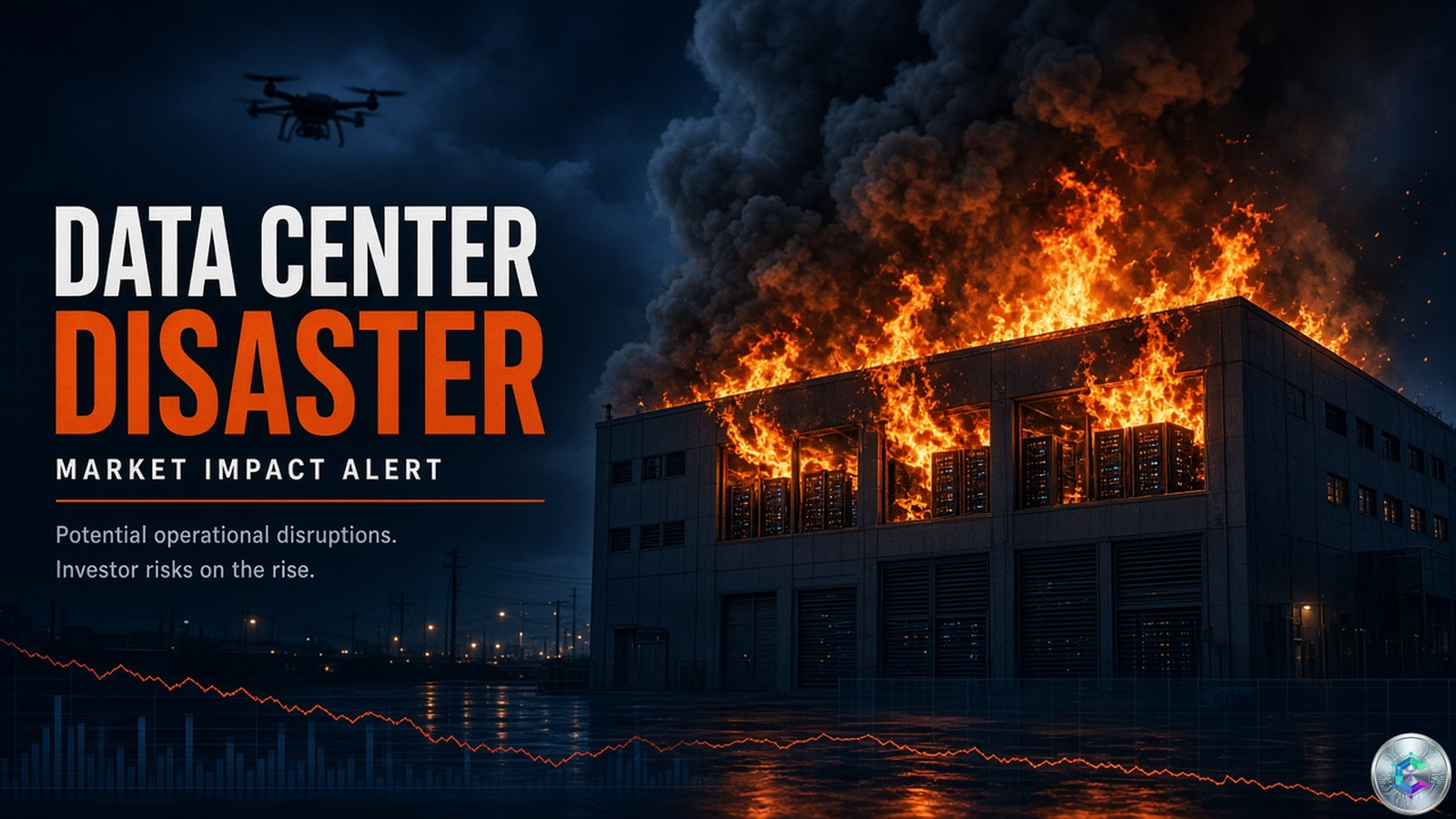
A Ukrainian drone strike hit the Yandex datacenter in Sasovo, Ryazan region, roughly 400 km southeast of Moscow, in the early hours of October 8, 2026, triggering a massive fire and marking the first confirmed attack on Russian digital infrastructure since the start of the full-scale invasion of Ukraine in February 2022.
🔑 Key takeaways
- Ukrainian drone strike on October 8, 2026, around 1:31 a.m. local time, targeting the Yandex datacenter in Sasovo (Ryazan region)
- First confirmed attack on Russian data infrastructure since the start of the full-scale invasion in February 2022
- Site hosts two supercomputers (Chervonenkis and Lyapunov) equipped with Nvidia A100 GPUs, used to train YandexGPT
- Widespread outage hit Yandex services, several major Russian platforms and the Rapira crypto exchange
- 58,268 complaints logged in 24 hours by Detector404; Yandex shares down 3.4% on the Moscow Exchange
A targeted strike on a strategic node
According to reporting by Newsweek and UK outlet The Register, the attack occurred in the early hours of Thursday, October 8, 2026, at around 1:31 a.m. local time, causing a violent fire inside the industrial complex. The targeted site combines two sensitive functions: it hosts one of Yandex’s five major datacenters in Russia, as well as the Sasta machine tool factory, a sanctioned supplier to Russia’s military-industrial complex.
Regional authorities confirmed a fire at an industrial facility. It remains unclear whether the primary target was the factory or the IT infrastructure: Yandex had moved into these former premises back in 2014. In a statement carried by state agency Tass, the group acknowledged a fire following a strike and warned that some services would be unavailable for users.
On the stock market, Yandex shares lost more than 3.4% in early trading on October 8 on the Moscow Exchange, pricing in the operational uncertainty now hanging over the group.
AI-grade supercomputers at the heart of Russia’s AI push in jeopardy
The Sasovo datacenter hosts tens of thousands of servers, including two major supercomputers: Chervonenkis and Lyapunov. These systems rely on Nvidia A100 GPUs and have been heavily used to train AI models, including YandexGPT, one of Russia’s leading large language models. A third supercomputer, Galushkin, is located in Vladimir.
Chervonenkis, the most powerful of the three, ranked 19th in the global Top500 in 2021 at 21.53 FP64 PFLOPS. Crippled by Western sanctions that prevent Yandex from upgrading its hardware, it now sits only at the 101st position. If destruction is confirmed, these machines will likely be lost for good, forcing Yandex to pivot toward Chinese infrastructure for future model training runs.
“If Chervonenkis and Lyapunov are destroyed, Yandex will have no choice but to turn to Chinese suppliers, the only entities still willing to ship high-end GPUs under sanctions.”
Independent analyst quoted by The Register
Widespread outage: a domino effect across Russia’s digital ecosystem
The strike disrupted Yandex’s entire IT network, prompting the company to recommend that clients shift to alternative failover zones. While its main consumer-facing services officially remained operational, many users reported interruptions on Yandex Mail, Disk, Documents, Pay and Market.
Monitoring service Detector404 recorded no fewer than 58,268 complaints within 24 hours, underscoring the scale of the outage.
| Category | Services / companies affected |
|---|---|
| Yandex services | Mail, Disk, Documents, Pay, Market |
| E-commerce / corporate | Ozon, Wildberries, T-Bank, 1C, Astral |
| Public services / transport | Russian Railways, Moscow-region bus operator, Spartak Moscow football club |
| Media and others | RIA Novosti, Vesti, Interfax, Cian, Litmarket, Rapira exchange |
Several Russian state media outlets (RIA Novosti, Vesti, Interfax) also suffered outages after their infrastructure partner went offline, as reported by RBC. A bus operator in the Moscow region suspended online ticket sales, highlighting the dependence of certain essential services on Yandex’s cloud.
A bilateral digital war in full escalation
The Sasovo strike comes amid a sharp intensification of attacks against digital infrastructure on both sides of the conflict. Since September 23, 2026, Russian strikes have destroyed or damaged datacenters belonging to at least eight Ukrainian companies, including Virtual Systems, MiroHost, CosmoNova, DataGroup and CityHost. Moscow justifies the strikes by claiming these facilities process data for Ukrainian military intelligence.
Among the Ukrainian sites hit, popular BitTorrent trackers 1337x and NordicQuality temporarily went offline. In parallel, another Ukrainian drone strike hit the Gazprom Neftekhim Salavat refinery in Bashkiria, roughly 1,300 km from the front line, triggering a new fire at one of Russia’s largest refining and petrochemical complexes (150 product grades). The facility had already been struck on September 24 by drones launched by Ukraine’s Security Service (SBU), according to the Kyiv Independent.
Outlook: toward fragmented wartime clouds
Ukraine generally does not confirm strikes on Russian territory and has not commented on the Sasovo attack; the Ukrainian Ministry of Defense did not respond to Newsweek’s requests. In the medium term, Kyiv is accelerating the relocation of part of its digital infrastructure underground, while several Russian companies are studying deployments in countries considered allies by Moscow.
Those options would, however, be limited to a handful of states, with China at the top of the list. The potential loss of the Chervonenkis and Lyapunov supercomputers, combined with the impossibility of replacing them under sanctions, could therefore accelerate Russia’s technological dependence on Asian suppliers while permanently reshaping the geography of cloud services in the conflict zone.
Sources
This article is published for informational and educational purposes only. It does not constitute investment advice. Do your own research (DYOR) before making any decision.

