


When a user places a swap order on an aggregator like Jupiter on Solana, they believe they are trading directly against public liquidity pools. In reality, their order is most likely routed to a professional market maker, a propAMM, reintroducing a traditional finance model at the heart of DeFi.
🔑 Key Takeaways
- PropAMMs represent between 15% and 27% of daily on-chain DEX volume, and over 90% of SOL-to-stablecoin swaps on Jupiter
- Jump Crypto reveals that 91.9% of propAMM executions are cheaper than the lowest institutional cost estimates on CEXs
- RFQ networks outperform AMMs on price approximately 46% of the time and reduce gas costs by up to 50%
- MEV bots extracted over $72 million from traders in the past month alone
The Invisible Order Routing Mechanism in DeFi
Jupiter functions more like a liquidity search engine than a traditional decentralized exchange. Its software compares public pools, propAMMs, and request-for-quote (RFQ) networks where professional market makers submit off-chain prices. The order is then routed to the most advantageous offer. Users see only one price, but underneath, several different types of markets compete for the same order.
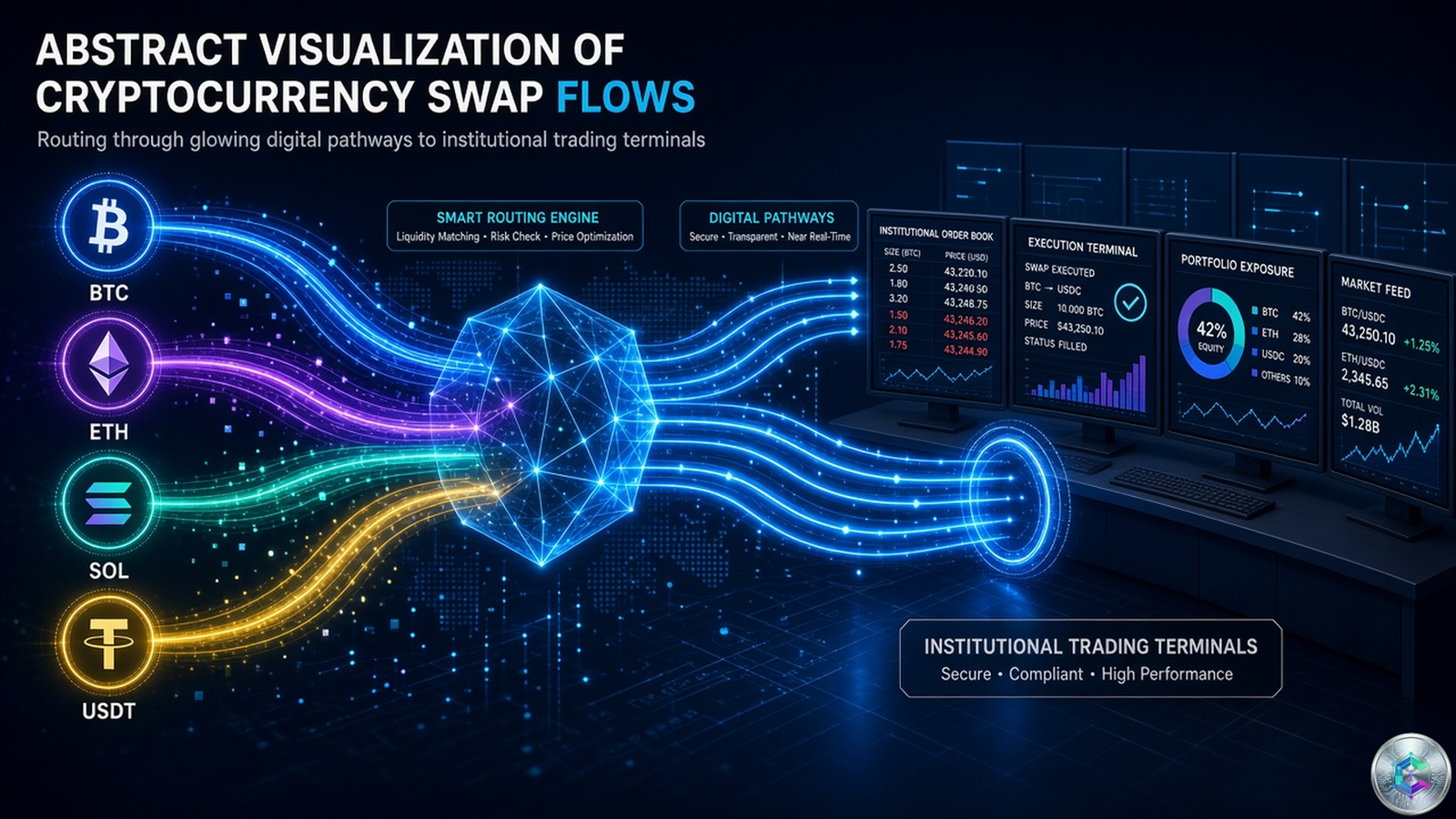
An analysis by DWF Ventures, a division of DWF Labs, a crypto market making firm, estimates that propAMMs represent between 15% and 27% of daily on-chain DEX volume. For SOL-to-stablecoin trades routed through Jupiter, DWF assesses their share at over 90%. This specific figure illustrates a broader phenomenon: a form of trading that does not exist in most DeFi users’ mental model has become significant enough to shape how the most active markets operate.
PropAMMs versus Public AMMs: The Price War
Jump Crypto examined approximately 20 million propAMM fills in March. The study reveals that 91.9% of these executions were cheaper than the lowest institutional cost estimates available on centralized exchanges (CEX) such as Binance, Coinbase, OKX, and Bybit. The median SOL-USDC execution settled at 0.72 basis points of the reference CEX midpoint.
« For certain trades, propAMMs offer significantly better execution than traditional centralized venues. »
Jump Crypto, propAMM fills study, March 2025
The difference between a propAMM and a public AMM lies in distinct mechanisms. A public AMM uses automatic pricing formulas and relies on thousands of external depositors to provide liquidity. This creates the so-called « loss-versus-rebalancing » problem: a passive pool may repeatedly trade at an outdated price against arbitragers already aware of the new rate. A propAMM reverses this dynamic: a professional trading firm supplies the market with its own inventory and continuously updates its prices via private software connected to external markets.
| Criteria | Public AMM | PropAMM |
|---|---|---|
| Liquidity source | External depositors (shared pool) | Proprietary market maker inventory |
| Price discovery | On-chain (automatic formula) | Off-chain (software connected to markets) |
| Code transparency | Open-source | Closed-source |
| Public deposits | Yes | No |
| Inclusion access | Permissionless | Permissioned |
RFQ Infrastructure: When Professional Market Makers Enter the Scene
Request-for-quote (RFQ) networks represent another component of this transition. On 0x’s RFQ network, an application requests private off-chain prices from professional market makers, compares these offers with public AMM liquidity, and returns the route offering the best outcome.
For heavily traded pairs like USDC-WETH and WBTC-WETH, 0x claims its RFQ liquidity outperforms AMMs approximately 52% of the time. Hashflow, launched in 2021, reported in March 2025 that market makers provided over $500 million in liquidity, with RFQ swap volume exceeding $25 billion and more than 20 interfaces using it.
« RFQ systems beat AMMs on price approximately 46% of the time. Additionally, RFQ transactions reduce gas costs by up to 50% compared to AMM swaps. »
Hashflow and 0x, comparative data 2025
Hidden Costs: MEV and the Loss of Transparency
Despite these execution price improvements, hidden costs persist. In the past month alone, MEV (Maximal Extractable Value) bots extracted over $72 million from traders, according to data from 0x and Hashflow. These attacks include front-running and sandwich attacks, which exploit transaction exposure in the public mempool. Public AMMs remain particularly vulnerable to these practices.
This shift toward professional market makers is part of a broader context of traditional finance entering blockchain rails. Nasdaq announced that its venture capital arm agreed to invest $100 million in Payward, the parent company of Kraken, to develop Nasdaq Equity Tokens. The London Stock Exchange Group (LSEG) announced on September 1 a partnership with Payward around public tokenized stocks, with the intention to list xStocks on LSE 24 in 2027, subject to regulatory approval.
The Parallels with Payment for Order Flow
In traditional finance, the practice of « Payment for Order Flow » (PFOF) has sparked considerable debate. An a16z analysis notes that retail investors benefited from $3.6 billion in price improvement in 2020 thanks to execution by professional market makers. The SEC imposed Reg NMS in 2005, requiring brokers to obtain the best possible execution for their clients under the NBBO (National Best Bid and Offer) framework.
« The current DeFi model, with its propAMMs and RFQ, reintroduces the PFOF dynamic, where transparency is limited to on-chain transaction verification, while price discovery and counterparty identity may remain private. »
a16z analysis on Payment for Order Flow
Conclusion: What Transparency for Tomorrow’s DeFi?
This evolution raises fundamental questions about the transparency promised by DeFi. The first generation of decentralized protocols treated openness as an integral part of the product: the pool was public, the code inspectable, liquidity came from users. The current model, with its propAMMs and RFQ networks, asks users to accept partial opacity: they can verify that a transaction occurred on the blockchain, but cannot inspect the system that decided the price or identify the market maker before execution.
When the answer becomes « not much, » the exchange begins to disappear behind the interface, turning trades into simple routers. The challenge for the ecosystem will be maintaining the execution benefits of professional market makers while preserving the verifiability and auditability guarantees that distinguish DeFi from traditional centralized finance.
Sources
- CryptoSlate – Why 90% of your DeFi trades are quietly being routed back to Wall Street
- a16z – Breaking Down the Payment for Order Flow Debate
- Hashflow – Execution Got Better, So Why Is Liquidity Still Trash?
- 0x – What Does the Best Price in DeFi Really Mean
This article is published for informational and educational purposes only. It does not constitute investment advice in any way. Do your own research (DYOR) before making any decisions.

