


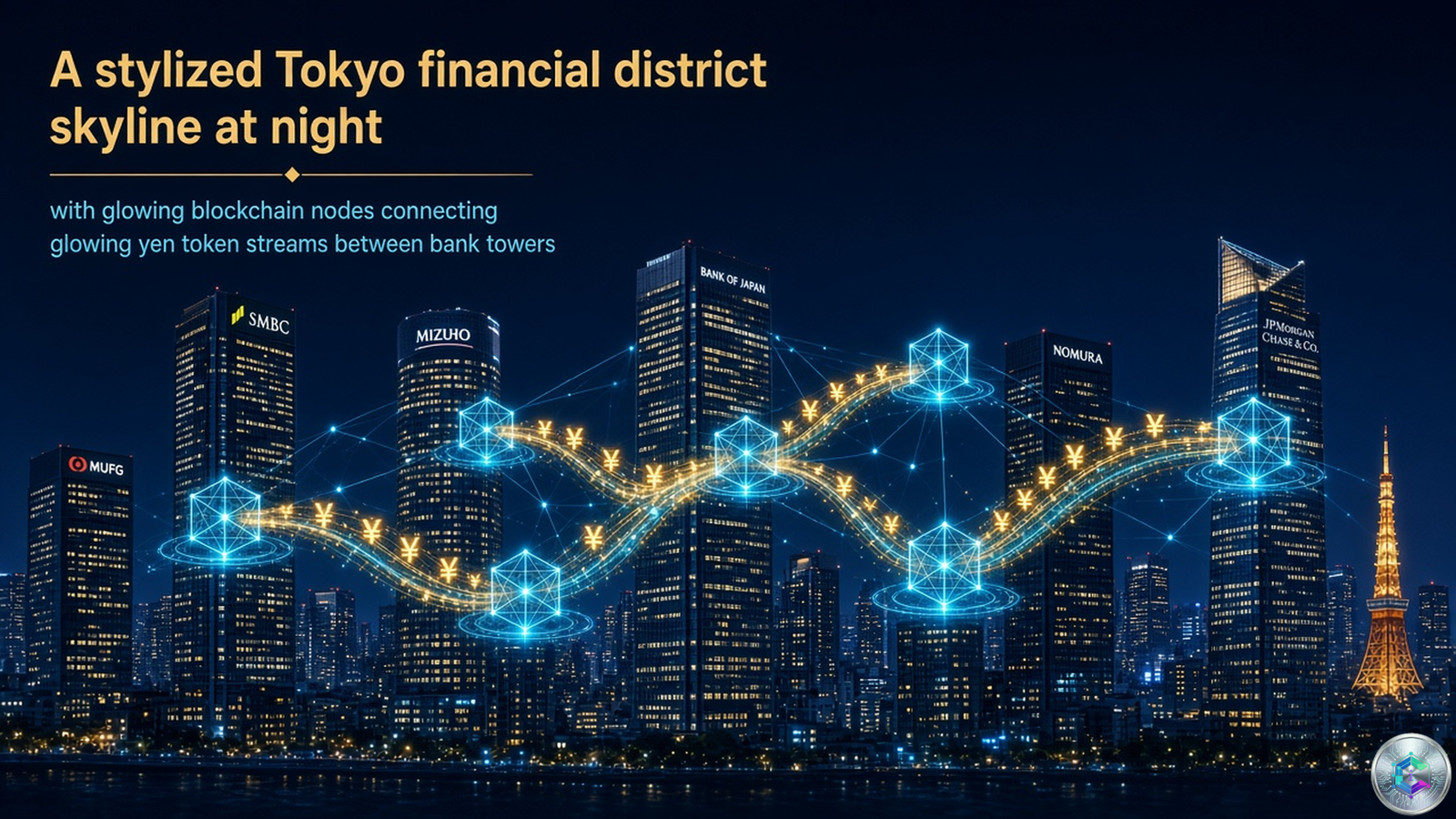
Japan’s Financial Services Agency (FSA), the Ministry of Finance and the Bank of Japan (BOJ) are preparing to launch a joint study group this summer with the country’s largest financial institutions to explore replacing traditional securities settlement systems with a blockchain-based infrastructure operating 24 hours a day, 7 days a week from the early 2030s onward. A reform that could redefine the architecture of the Japanese capital market.
🔑 Key takeaways
- An FSA–Treasury–BOJ study group will be formed in summer 2026 to design 24/7 blockchain settlement for stocks and government bonds.
- The system would be built on a wholesale CBDC: tokens representing the balances that banks hold at the BOJ.
- MUFG, SMBC and Mizuho are already piloting tokenized stocks and JGBs; MUFG announced a proof-of-concept on the Canton Network in August 2026.
- Goal: replace the current T+2 cycle for stocks and T+1 for JGBs with near-instant settlement, operational by the early 2030s.
- Japan wants to avoid losing institutional investors to the US and Europe, where tokenized securities are advancing fast.
Project timeline and governance
According to information reported by the Nikkei and confirmed by several sources, a joint working group will be set up during the summer of 2026. It will bring together the FSA, the Ministry of Finance, the BOJ and Japan’s largest financial institutions around a single roadmap. A development plan is expected as early as the beginning of 2027, followed by a full operational framework in subsequent years. If the plans are formally approved and tests proceed as planned, the system could be operational in the early 2030s.
The project could fit within a multi-year strategic investment framework starting with fiscal year 2027. No technology has yet been selected and no formal decision has been published by the agencies involved. A study group, however, represents the earliest stage that a Japanese policy initiative can occupy, which gives a sense of the road that still lies ahead.
For now, the reference timeline breaks down as follows:
| Milestone | Indicative date |
|---|---|
| Launch of the joint study group | Summer 2026 |
| Development plan | Early 2027 |
| Reference fiscal year | FY 2027 |
| Full operational framework | Late 2020s |
| Targeted go-live | Early 2030s |
A wholesale CBDC as the technical backbone
The envisioned mechanism involves converting part of the balances that banks hold at the BOJ into digital tokens on a blockchain network. These tokens would function as a wholesale central bank digital currency (wholesale CBDC), a digital representation of the yen used only between financial institutions and not by retail users. This approach sidesteps the recurring criticisms attached to retail CBDCs, particularly around surveillance and bank disintermediation.
In the current system, stock trades on the Tokyo Stock Exchange (TSE) settle two business days after execution (T+2), while Japanese government bond (JGB) transactions settle the next day (T+1). The new infrastructure would compress those delays to near zero, allowing investors to reinvest the proceeds of their sales almost instantly, including outside traditional banking hours.
“Tokenization of financial assets is no longer a research topic; it is a matter of monetary sovereignty and market competitiveness.”
Senior analyst, Japanese megabank
Existing pilots and parallel projects
The foundations of this project rest on several initiatives already underway. Mitsubishi UFJ Financial Group (MUFG), Japan’s largest bank, announced in August 2026 a proof-of-concept for on-chain JGB repo transactions via the Canton Network. The system aims to enable near-instant settlement operating 24/7. Japan’s three megabanks, MUFG, SMBC and Mizuho, are already running a joint pilot on tokenized stocks and JGBs.
Separately, Nomura, in partnership with the BOOSTRY platform, issued Japan’s first domestic digital bond in 2025. The issuance featured a delivery-versus-payment (DVP) settlement mechanism in T+1 and matures in March 2030. The BOJ also expanded its blockchain settlement sandbox in March 2026, a controlled testing program running through 2028.
A few recent milestones illustrate this momentum:
| Initiative | Player(s) | Detail |
|---|---|---|
| On-chain JGB repo | MUFG | Proof-of-concept on Canton Network, announced August 2026 |
| Tokenized stocks and JGBs pilot | MUFG, SMBC, Mizuho | 24/7 settlement tested across the three megabanks |
| First domestic digital bond | Nomura + BOOSTRY | Issued 2025, T+1 DVP, maturity March 2030 |
| Blockchain sandbox | BOJ | Expanded March 2026, program runs through 2028 |
International dimension: the Agorá project
The BOJ is also participating in the Agorá project, an initiative led by the Bank for International Settlements (BIS) bringing together seven central banks and more than 40 financial institutions to test tokenized cross-border payments. Japan’s blockchain infrastructure could serve as a foundation for this international effort. The domestic system could also be extended to international transfers, according to the Nikkei, which would position Tokyo as a regional hub for tokenized settlement in Asia.
Technical challenges and liquidity stakes
Instant settlement is not without costs. Compressing the cycle to zero eliminates netting opportunities, meaning firms must hold the full amount of cash and securities needed at the moment of the transaction rather than at the end of a batch process. This mechanically increases liquidity requirements for market participants, a sensitive topic for brokers and brokerage firms.
Japan’s largest banks are also pushing for trading frameworks built around stablecoins, arguing that their use would reduce friction, lower transaction costs and keep the entire transaction lifecycle inside a single technological environment. Japanese regulators will therefore have to orchestrate three layers: the wholesale CBDC, asset tokens and stablecoins.
Why Japan is moving now
Japan is seeking to modernize its settlement systems to preserve the competitiveness of its markets while the United States and Europe advance their own tokenized securities infrastructures, with Wall Street pushing toward 24/7 tokenized stock markets. According to a Nomura and Laser Digital survey published in April 2026, nearly 80% of Japanese institutional investors plan to allocate funds to crypto within three years. Japan risks losing those investors to other jurisdictions if reforms stall.
Demographics also play a determining role. Japan’s population is aging and its workforce is shrinking, putting pressure on financial institutions to do more with less. Automating settlement processes that currently require large back-office teams is not only a technological upgrade but a demographic necessity. Separately, the FSA also asked crypto exchanges this month to strengthen anti-fraud measures against investment scams and romance scams, underscoring that retail crypto regulation and institutional tokenization are advancing in parallel.
Conclusion: a real-world test for tokenized finance
If Japan sticks to its timeline, the early 2030s will mark the first migration of a national stock and sovereign bond market to a systemically relevant blockchain infrastructure backed by a wholesale CBDC. The bet is ambitious: preserve monetary stability, absorb operational complexity and prevent capital from fleeing to faster jurisdictions. Three scenarios are emerging: a phased rollout by 2030–2032 if MUFG, SMBC and Mizuho’s pilots succeed; a delay to 2035+ if interoperability between the CBDC, stablecoins and asset tokens breaks down; or a partial adoption limited to specific segments, such as JGBs and repo, before any broader generalization.
In any scenario, Tokyo is setting a marker: tokenization of financial markets is no longer a trading-floor concept, but a project coordinated by the central bank itself.
Sources
- CoinDesk – Japan Plans Blockchain Settlement Network for Stocks and Government Bonds
- KuCoin News – Japan Aims for Blockchain-Based Real-Time Settlements by 2030s
- The Next Web – Japan Blockchain Settlement for Stocks and Bonds
- Yahoo Finance – Japan Eyes 24/7 Blockchain Settlement
- Reuters – Japan Eyes Blockchain Instant Stock and Bond Settlement
- Nikkei Asia – Japan to Trial Real-Time Stock and Bond Settlements with Blockchain Tech
This article is published for informational and educational purposes only. It does not constitute investment advice. Do your own research (DYOR) before making any decision.

