

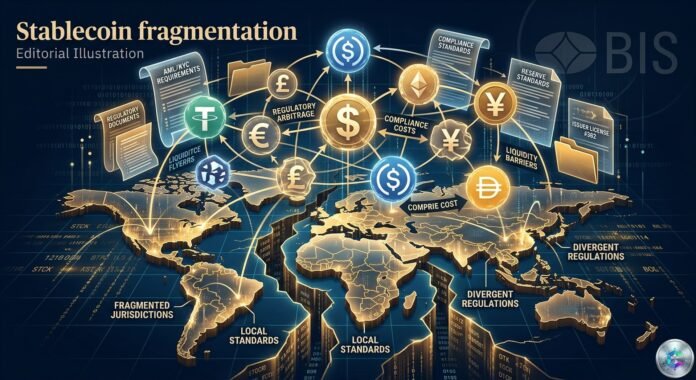
Global Stablecoin Rules Slow Down as BIS Warns of Fragmentation Risks
Work on establishing international standards for stablecoins has ground to a halt over the past year, leaving central banks in a state of uncertainty while the issuers of this 320 billion dollar market remain largely unregulated on a global scale. This situation is deeply worrying for monetary authorities, who fear that regulatory gaps could trigger severe market fragmentation and widespread regulatory arbitrage. The issue was at the heart of discussions during a recent G20 conference, where Pablo Hernández de Cos, General Manager of the Bank for International Settlements (BIS), issued an urgent call for international cooperation to prevent the absence of common standards from ultimately threatening global financial stability at a time when cryptocurrencies are taking an increasingly prominent place in cross-border financial flows.
Context
Stablecoins, the cryptocurrencies designed to maintain a fixed parity with a reference currency such as the US dollar, have grown exponentially to reach a global market capitalization of 320 billion dollars, according to DeFiLlama data. Tether (USDT) and Circle (USDC) largely dominate this segment, together representing the vast majority of assets in circulation with a truly global presence that far exceeds the American borders where these instruments were created. This rapid expansion has outpaced regulators’ ability to oversee the sector, creating a deep gap between the economic reality of these instruments and their legal status in most jurisdictions, leaving millions of users in legal uncertainty that shows no signs of resolution.
Stablecoins potentially offer significant opportunities for the global financial system. They provide the ability to tokenize assets, enable advanced programmability and atomic settlement of transactions, while considerably improving cross-border payments and offering convenient access to foreign currencies for millions of unbanked people in emerging economies. Yet these advantages come with major macroeconomic risks that central banks can no longer ignore, particularly their potential impact on credit supply, financial stability, and fiscal policy for governments. Stablecoins also raise serious concerns for financial integrity and can facilitate regulatory circumvention, increasing dollarization risks for emerging economies as their residents turn to foreign-currency-denominated instruments to protect themselves against local inflation.
The Facts
On April 20, 2026, Pablo Hernández de Cos delivered a speech titled « Stablecoins: Framing the Debate » at a seminar organized by the Bank of Japan as part of the G20 meetings. In this highly anticipated address, he recalled that the development of global standards for stablecoins had experienced a notable slowdown over the previous twelve months, leaving dangerous regulatory blind spots widening even as transaction volumes increased. This alarming finding led the BIS General Manager to solemnly call on regulators worldwide to step up cooperation to prevent divergent regulatory frameworks from causing harmful market fragmentation that could ultimately turn stablecoins into a vector of instability rather than a tool for modernizing payments.
The Bank for International Settlements published a report explicitly comparing stablecoins to exchange-traded funds (ETFs) rather than traditional currencies, citing three main reasons: their lack of universal acceptance as a means of payment in the real economy, their capacity to generate credit expansion similar to that of commercial banks, and the absence of direct central bank support in the event of a confidence crisis. This classification has profound implications for the future regulation of these instruments, as it suggests that requirements reserved for securities could legitimately be applied to them, considerably increasing compliance costs for issuers who will need to revise their economic model if they want to remain competitive.
On the American legislative front, several texts are advancing in parallel with varying fortunes. The Digital Asset Market Clarity Act passed the House of Representatives last year and is now before the Senate for consideration, with uncertain prospects for assembling a bipartisan majority in a charged political context. Regarding specifically the stablecoin sector, the GENIUS Act is also progressing through Congress, with intense negotiations underway among senators over stablecoin yield modalities that lie at the heart of disagreements between advocates of strict banking regulation and defenders of a more permissive framework to foster American innovation. On April 8, 2026, the US Treasury Department published a joint proposed rule with FinCEN and OFAC to implement the GENIUS Act’s requirements regarding anti-money laundering and sanctions compliance, establishing that stablecoin issuers will be treated as financial institutions under the Bank Secrecy Act. Simultaneously, the FDIC approved on April 7, 2026 a notice of proposed rulemaking to establish a prudential framework for FDIC-supervised stablecoin issuers, including specific requirements concerning reserve assets, redemption conditions, and capital and risk management standards aimed at preventing bank runs.
In Europe, the MiCA regulation (Markets in Crypto-Assets Regulation) entered full application on December 30, 2024, establishing the world’s first comprehensive regulatory framework for crypto-assets, including stablecoins. As of March 2026, 19 electronic money token (EMT) issuers have been authorized across 11 European countries, demonstrating concrete momentum in regulatory adoption even though the path to full harmonization remains long. France alone authorized 26 percent of European stablecoin issuers, making it one of the most advanced countries in sector compliance with new European requirements, demonstrating the French regulator’s ability to attract international players despite a sometimes complex regulatory environment.
Analysis
The slowdown in work on international standards reflects the inherent difficulties of regulatory coordination in a sector that is, by its very nature, global and cross-border, escaping any single jurisdiction. Harmonization attempts on fundamental divergences between national approaches: while the European Union has adopted a proactive and structured stance with MiCA, the United States remains entangled in a complex legislative process where the interests of the traditional banking sector, attached to strict rules on deposit protection and financial stability, clash with those of the crypto industry, which demands an innovative and flexible framework to avoid being deprived of the competitive advantages conferred by their technological head start.
The BIS warning regarding fragmentation risks is particularly relevant given the simultaneous emergence of distinct regulatory frameworks that create fertile ground for regulatory arbitrage. The European Union, the United States, Singapore, and the United Arab Emirates have each developed their own approach, creating a fragmented landscape where stablecoin issuers may be tempted to arbitrage between the most permissive jurisdictions to maximize their returns while avoiding the strictest constraints. This situation presents a real systemic risk: if stablecoins increasingly resemble banking products without being subject to the same controls, a confidence crisis could have cascading repercussions throughout the entire financial system, as the 2008 money market fund crisis demonstrated the dangerous interconnections between different segments of the financial system.
The proposals formulated by the BIS to reduce these risks deserve particular attention as they outline the contours of a future international regulatory framework for stablecoins. These include limiting interest payments on stablecoins to eliminate their competitive advantage over traditional bank deposits, providing central bank lending facilities access for issuers to prevent liquidity crunches during market stress, and establishing deposit insurance-type mechanisms to protect users against losses in case of issuer default. These measures would aim to reduce run risks while preserving the role of these instruments in digital payments. They do, however, imply a profound transformation of the current economic model of issuers, who derive a significant portion of their revenues from investing reserves in productive securities, and could call into question the viability of some players who built their model on the remuneration of stablecoin deposits.
Market Reactions
The stablecoin market remains dominated by two major players who concentrate the vast majority of volumes and represent a considerable strategic stake for the global financial system: Tether on one side and Circle on the other, which together control more than 90 percent of the 320 billion dollars in circulation with a truly global presence. This extreme concentration limits the immediate impact of regulatory divergences on daily users, but creates systemic interdependence with the traditional banking sector that deserves close monitoring by regulatory authorities. The latest Polymarket data indicates that market operators price the probability of a major stablecoin depegging before December 31, 2027 at only 4 percent, suggesting relative confidence in short-term sector stability, although this type of bet may significantly underestimate the risks of extreme events that are by definition difficult to anticipate.
Reactions from institutional actors remain mixed and reflect the fault lines of the regulatory debate that deeply divide the financial sector. On one side, firms like Fireblocks are actively working to enable euro-backed stablecoin issuance for a consortium of twelve European banks, demonstrating the growing interest of the traditional banking sector in these digital payment instruments that could radically transform international clearing circuits. On the other side, doubts persist regarding the ability of DeFi protocols to effectively protect user funds against hacks and technical exploits, as demonstrated by several major incidents involving decentralized lending platforms in the first quarter of 2026 that resulted in losses of several hundred million dollars and shook confidence throughout the decentralized ecosystem.
Outlook
Medium-term, the regulatory trajectory of stablecoins will largely depend on the ability of major economies to find common ground on the fundamental principles of their framework, a considerable challenge in a geopolitical context marked by trade tensions and strategic rivalries between the world’s leading economies. The G20, through the Financial Stability Board (FSB) chaired by Bank of England Governor Andrew Bailey, plays a central role in this coordination that could shape the future of the sector for the decade to come. The current slowdown in work suggests, however, that tight deadlines are unlikely in the short term, leaving the sector in a state of prolonged uncertainty that could deter institutional investment in the ecosystem and slow the adoption of blockchain technologies for cross-border payments.
Several points of vigilance deserve particular attention from investors, users, and regulatory authorities alike. First, the evolution of American legislation on stablecoins, particularly ongoing debates surrounding yield limitations and DeFi oversight, could redefine the competitive balance of the sector globally and influence European issuers’ decisions regarding their transatlantic development strategy. Second, authorization decisions for MiCA-regulated issuers will continue to shape the European landscape through the final compliance deadline of July 1, 2026, with significant implications for market consolidation and the likely disappearance of several smaller players unable to meet the capital requirements imposed by European regulation. Third, the rise of central bank digital currency (CBDC) projects could ultimately question the relevance of private stablecoins for cross-border payments, creating additional competitive pressure on a sector already facing regulatory difficulties and a questioning of its economic model by regulatory authorities worldwide.
Sources
- Global stablecoin rulemaking slows as BIS urges cooperation — CoinDesk
- BIS warns stablecoins resemble ETFs, risk fragmentation without global rules — Crypto Briefing
- BIS urges global cooperation for stablecoin rules to avoid severe fragmentation — The Full FX
- White House releases stablecoin yield report, GENIUS Act regulations advance — Paul Hastings
- MiCA Regulation Q1 2026: EU Stablecoin Compliance Guide — The Future of Money

