


Developers from Ethereum and Base have ended their collaboration to unify their account abstraction proposals. Announced on September 14, 2026 by Derek Chiang, researcher at Ethlabs and founder of ZeroDev, the split opens a period of uncertainty for wallets and decentralized applications that will now have to support two distinct transaction architectures.
🔑 Key takeaways
- Teams behind EIP-8130 (Base) and EIP-8141 (Ethereum) failed to find common ground after weeks of talks.
- No technical solution could satisfy both sides without compromising on core objectives.
- EIP-8141, co-authored by Vitalik Buterin, is flagged as a must-ship for Ethereum’s Hegotá upgrade planned for 2027.
- EIP-8130, written by Coinbase engineer Chris Hunter, is already live on Base’s vibenet devnet and targets the OP Stack.
- Wallets will bear the cost of the resulting fragmentation, with ERC-4337 remaining as a compatibility fallback.
A fundamental disagreement on priorities
The collaboration between the authors of the two competing proposals — EIP-8130 led by Base and EIP-8141, known as Frame Transactions — collapsed after several weeks of negotiations. Both camps had attempted to define a common standard allowing account abstraction to function on both Ethereum layer 1 and Base layer 2.
« I’m sad to report that the AA collaboration between 8130 and 8141 (Frames) failed last week, and Base and Ethereum will now go separate ways to implement different account abstraction standards. »
Derek Chiang, Ethlabs researcher and ZeroDev founder
According to Chiang, every technical solution examined would have required one side or the other to compromise its fundamental objectives. He added: « While we identified a number of technical solutions, they all required one side or the other to make at least a small compromise on its fundamental goals. So we went our separate ways, leaving the burden on wallets to handle the resulting fragmentation. »
Matt Garnett, an Ethereum core developer, framed the divergence in terms of competitive pressure pushing L2s to ship features faster than L1: « Market pressure forces them to deliver features at a pace L1 can’t match, so incompatibilities pile up. Time will tell whether that’s a strength or a weakness. »
What is account abstraction?
Account abstraction is a concept that allows crypto wallets to behave more like web2 applications. It aims to remove friction points such as the need to hold ETH to pay gas fees (transaction fees on Ethereum), enable password-based login instead of seed phrases, and allow multiple operations to be bundled into a single transaction.
Today, the ERC-4337 standard delivers these features as a layer on top of the Ethereum Virtual Machine (EVM, the runtime that executes smart contracts). Both EIPs aimed to integrate account abstraction natively at the protocol level rather than keep the heavier, less flexible overlay approach.
For Ethereum L1, priorities are summarized by the acronym CROPS: Censorship and capture resistance, Open-source software, Respect for privacy, and Security. These constraints push toward permissionless, extensible account models and transaction designs capable of supporting privacy systems and future post-quantum signatures (schemes resistant to attacks from quantum computers).
EIP-8141 vs EIP-8130: opposing philosophies
EIP-8141, the Frame Transactions proposal, was tagged « must-ship » by the Ethereum Foundation’s Protocol cluster in a tiered list published in early September, ahead of Ethereum’s Hegotá upgrade planned for 2027. Derek Chiang is one of its authors, alongside Vitalik Buterin among others.
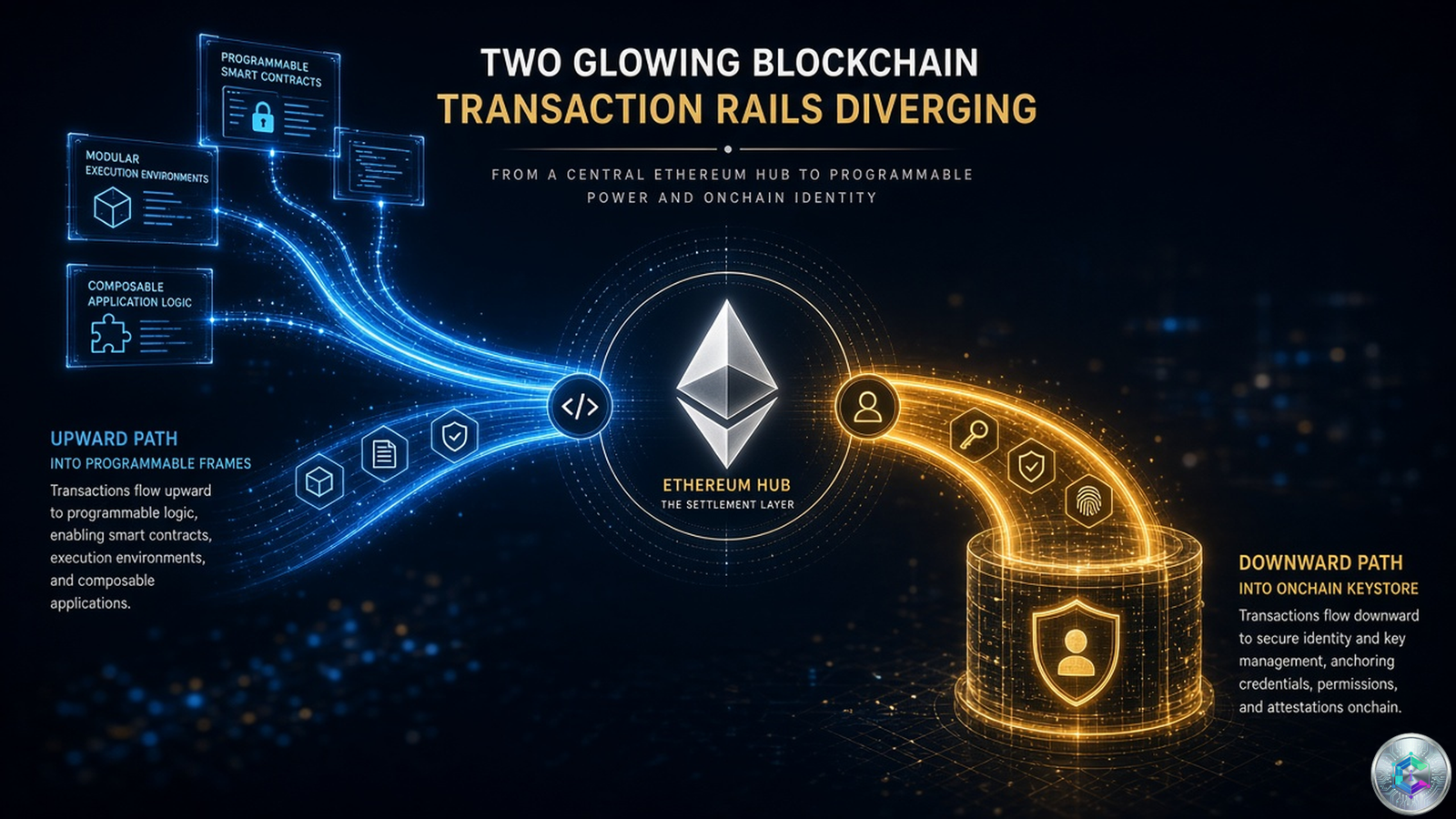
EIP-8141 breaks a transaction into programmable « frames » that separately handle sender validation, gas payment approval, and execution of user actions. The goal is to make an account simply an address whose behavior is defined by code, enabling permissionless extensibility and preparing for post-quantum resistance. Vitalik Buterin called EIP-8141 an « omnibus that gathers and resolves every remaining problem AA was supposed to address » in an X post in February. On September 5, he added that the proposal had « made a lot of important progress » in recent months and was « getting close to optimal. »
EIP-8130, meanwhile, was drafted by Chris Hunter, an engineer at Coinbase. It introduces a new transaction type paired with an onchain « Keystore » that together deliver account abstraction: custom authentication, batched calls, and gas fee sponsorship. The keystore is designed to store each account’s approved signers and authenticators.
EIP-8130 is currently being tested on Base’s vibenet devnet and is designed for adoption across the OP Stack, the modular framework powering Optimism, Base, and many other rollups (layer-2 networks that batch transactions before settling on Ethereum). The proposal claims gas cost reductions of up to 63% for certain transfer types compared with the current ERC-4337 approach.
EIP-8130 ships with distinct adoption profiles for L1 and L2. Its L1 profile allows authenticators outside a canonical set within defined limits, while its layer-2 profile lets high-throughput chains restrict the native transaction path to approved canonical authenticators.
| Feature | EIP-8141 (Frames) | EIP-8130 (Base) |
|---|---|---|
| Lead author | Derek Chiang, Vitalik Buterin | Chris Hunter (Coinbase) |
| Architecture | Modular programmable frames | New transaction type + onchain Keystore |
| Primary target | Ethereum L1 | Base and OP Stack |
| Test environment | Hegotá specifications | vibenet devnet |
| Gas reduction claim | Not publicly quantified | Up to 63% vs ERC-4337 |
| CROPS alignment | Full (built in natively) | Partial (L1 profile loosened) |
Ecosystem implications
The split means wallet developers and dApp builders must now support two different transaction architectures. An application built on EIP-8130 assumptions for Base will not automatically behave the same way on Ethereum mainnet if EIP-8141 ships with different transaction primitives.
Chiang nonetheless suggested that fragmentation could yield positive outcomes: « If they execute well, and if the wallet community can bridge the fragmentation, we may end up with the best possible user experience for end users. »
Gabriel Shapiro, a crypto-focused lawyer, offered a more critical read of what the divergence means for Ethereum: « L2s are great — for the crypto industry and for the people who own the sequencer. For Ethereum, they’re just sort of ‘less bad’ than competing L1s. »
Shapiro argues that networks like Base can attract users, applications, and transaction activity while capturing sequencer economics (the entity ordering and validating rollup transactions) and making product decisions around their own competitive priorities. He tied that dynamic to Buterin’s renewed focus on censorship resistance, privacy, and security, suggesting Ethereum is leaning into the qualities that distinguish layer 1 even as activity migrates to rollups.
The wider ecosystem still retains a partial compatibility path. A shared set of authenticators and ERC-4337 remain available as a transport fallback on networks that do not support the 8130 transaction type, which could let wallets hide much of the complexity from end users.
Conclusion: a deliberate split
By walking away from a shared standard, Ethereum and Base enshrine a philosophical divide between an L1 focused on long-horizon resilience (censorship resistance, privacy, post-quantum readiness) and an L2 optimized for iteration speed and user experience. The coming quarters will reveal whether the fragmentation imposes a durable cost on builders — or whether the ecosystem can layer enough abstraction on top for end users to perceive a single, seamless web3.
For investors and builders, the message is clear: watch Hegotá’s delivery in 2027 and EIP-8130’s adoption across major OP Stack rollups. Those milestones will determine which standard ends up dominating — and ultimately which vision of account abstraction becomes the reference.
Sources
- The Block
- CryptoNews
- Turnkey — Account Abstraction Explained
- Crypto Briefing
- Biggo Finance
- CryptoSlate
This article is published for informational and educational purposes only. It does not constitute investment advice. Do your own research (DYOR) before making any decision.

