


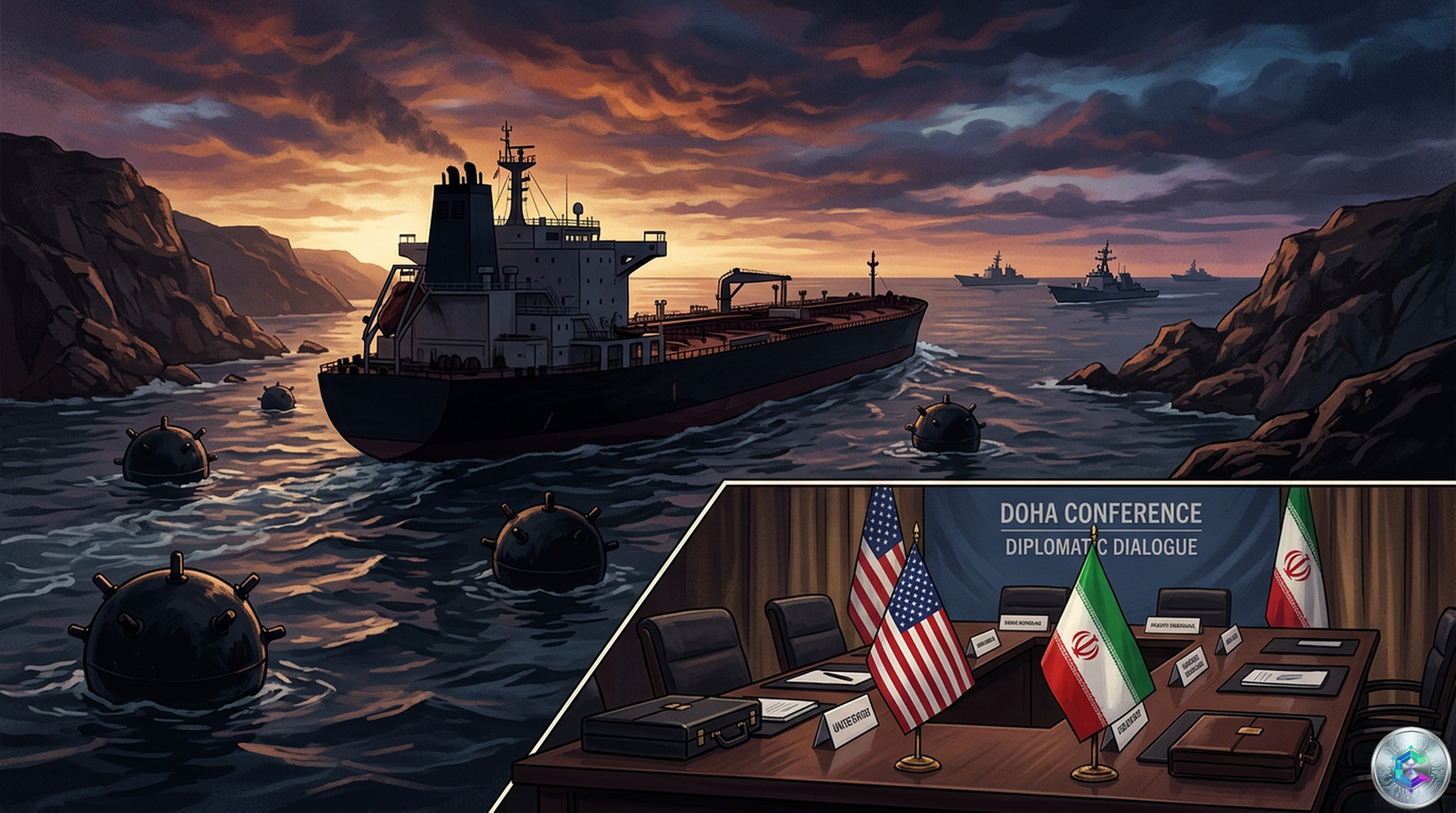
Doha-mediated talks between Washington and Tehran aim for a 60-day ceasefire and the reopening of the Strait of Hormuz, whose blockade by Iran sent Brent crude above $100 and triggered a global energy crisis.
🔑 Key Takeaways
- A 60-day ceasefire is under negotiation in Doha to reopen the Strait of Hormuz, a vital chokepoint for 20% of global oil.
- Iran commits to demining and waiving transit fees. US promises phased sanctions relief and unfreezing over $6B in Iranian assets.
- Brent crude fell 5.2% to below $100/bbl on news of negotiation progress.
- Trust remains fragile, with contradictory signals from Washington and Tehran linking the deal to the Israel-Hezbollah conflict.
- A definitive agreement requires resolving the nuclear dossier and complex verification mechanisms.
The Doha Scene: High-Stakes Negotiations
Talks unfolded in the Qatari capital with a broad Iranian delegation led by Parliament Speaker Mohammad Bagher Ghalibaf, Foreign Minister Abbas Araghchi, and Central Bank Governor Abdolnaser Hemmati. The central banker’s presence signals that financial dimensions—frozen assets, sanctions relief, and the release of Iranian funds held in Qatar—are as central as military terms. The United States participated via indirect channels, with Qatari and Pakistani mediators serving as primary conduits.
This indirect format, while slower, was preferred after direct talks collapsed earlier in the year over uranium enrichment sequencing and sanctions rollback.
Deal Terms: A Complex Web of Commitments
The proposed agreement outlines reciprocal commitments. Iran pledges to progressively reopen the Strait of Hormuz, remove naval mines, and suspend all transit fees for 60 days. In return, the US should ease its naval blockade of Iranian ports, phase out sanctions on energy and financial sectors, and unfreeze Iranian assets abroad, including over $6 billion held in Qatari institutions.
A particularly sensitive dimension is Tehran’s explicit linkage of any ceasefire to ending « the war on all fronts, » including the Israel-Hezbollah conflict in Lebanon, reflecting a view that regional dynamics cannot be separated from the bilateral track.
| Party | Key Commitments |
|---|---|
| Iran | Progressive reopening of Hormuz, mine removal, 60-day fee suspension, demining operations. |
| United States | Easing naval blockade, phased sanctions relief, unfreezing assets (>$6B), uranium negotiations. |
« We are giving diplomacy every chance. But if it fails, we will find another way. »
Marco Rubio, US Secretary of State
Market Reaction: Brent Retreats Below $100
Financial markets, anticipating a breakthrough, responded immediately. Brent crude fell 5.2% to settle below the symbolic $100/bbl mark at around $98. WTI dropped 5.5% to $91.28. The retreat from triple-digit oil reflects market confidence that a deal would rapidly restore flows through Hormuz. Asian stock markets rallied, and US and European index futures pointed higher.
The economic context is critical. Energy disruptions from the Hormuz blockade have already driven US inflation higher, prompting the Federal Reserve to signal potential rate hikes. A successful ceasefire would remove this pressure.
Post-Agreement Brent Price Scenarios
| Scenario | Estimated Brent Price | Impact |
|---|---|---|
| Agreement implemented, quick reopening | $80 – $90 | Gradual flow normalization, lower inflation. |
| Negotiations fail, hostilities resume | $110 – $120 | Inflation spike, likely interest rate hikes. |
Washington’s Mixed Signals and the Trust Deficit
Negotiations were marked by contradictory signals from the White House. President Donald Trump first stated that « final aspects and details » were being finalized, only to reverse course the next day, saying the agreement « wasn’t even fully negotiated yet. » This pattern created significant uncertainty about the true state of play in Doha.
On the Iranian side, government spokesperson Esmaeil Baghaei expressed frustration at American « position changes » while acknowledging that « conclusions on many topics » had been reached. The trust deficit between the parties remains a defining feature of the process.
Strategic Importance of the Strait of Hormuz
The Strait of Hormuz is the world’s most critical oil transit chokepoint. Approximately 20% of global oil shipments and a substantial share of liquefied natural gas (LNG) exports pass through its waters, roughly 30 miles wide at their narrowest. Iran’s blockade, involving naval mines and a toll authority, demonstrated its capacity to choke global energy markets and extract political leverage.
Reopening the strait would not instantly restore all disrupted shipments—demining operations alone would take time—but even a credible commitment would allow markets to price in future supply normalization.
Conclusion: A Fragile First Step
The Doha talks produced no final announcement, with both sides acknowledging progress but signaling outstanding issues. A 60-day ceasefire, if implemented, would provide a window for the more difficult work of reaching a comprehensive and permanent resolution.
However, the history of US-Iran negotiations—from the JCPOA to multiple restoration attempts—suggests the gap between a temporary ceasefire and a durable final agreement is substantial. The nuclear question and the regional linkage to Lebanon remain major hurdles.
Sources
- « Iran said it has finalised ‘many issues’ of an agreement with the US, » Financial Times, May 2026
- « What may be included in proposed Iran ceasefire deal? » The Guardian, May 24, 2026
- « Trump: Iran deal to reopen Strait of Hormuz ‘largely negotiated’, » CNBC, May 23, 2026
- « US and Iran inch closer to peace deal as Trump faces criticism from GOP hawks, » The Guardian, May 2026
- « US and Iran move closer to extending ceasefire by 60 days, » Financial Times, May 2026
- Iran-USA Doha negotiations reporting, May 2026 – via Reuters and regional sources
This article is published for informational and educational purposes only. It does not constitute investment advice. Do your own research (DYOR) before making any decisions.

