

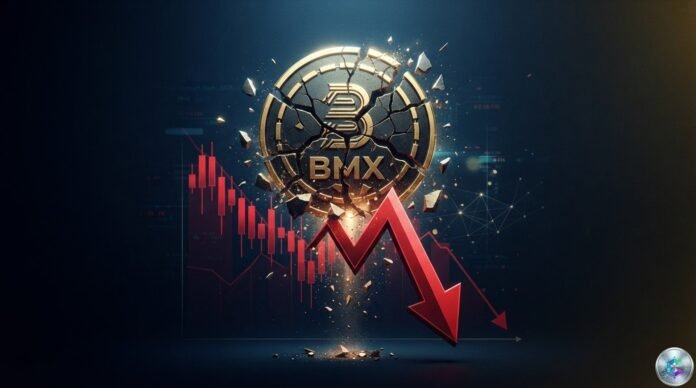
BitMart, a centralized cryptocurrency exchange serving users in more than 180 countries, announced on July 26, 2026 the orderly wind-down of its operations, nine years after its founding. Its native BMX token collapsed by approximately 58% within 24 hours, exposing the structural vulnerability of exchange tokens when their underlying utility disappears.
🔑 Key Takeaways
- BitMart will fully cease activity by January 31, 2027; the critical withdrawal deadline is August 26, 2026
- The BMX token dropped approximately 58% in 24 hours, after already losing around 70% over the past year
- The shutdown announcement comes just 3 days after BitMEX’s, marking a sector turning point
- Users must complete KYC and close all positions before August 26, 2026 at 01:00 UTC
- BitMart explicitly warns against impersonation scams during the transition period
A three-stage closure timeline
In a notice posted on X at 01:40 UTC on July 26, 2026, BitMart confirmed its decision without specifying the exact reasons. The exchange cited a thorough review of its operating conditions, the market environment, and its future strategic direction.
Immediately upon announcement, new registrations, cryptocurrency deposits, and new trading orders were suspended. Futures accounts switched to reduce-only mode, preventing the opening of new positions. All open orders not manually withdrawn are subject to automatic system cancellation.

Three dates to remember
| Date | Event |
|---|---|
| July 26, 2026, 01:30 UTC | New registrations, deposits, and orders suspended; futures accounts moved to reduce-only |
| August 26, 2026, 01:00 UTC | All trading services (spot and derivatives) officially end |
| January 31, 2027, 15:59 UTC | Complete cessation of platform operations |
Withdrawal services remain open throughout the transition period. BitMart has warned, however, that requests may undergo enhanced verification: KYC (Know Your Customer), login device and IP analysis, withdrawal address screening, source-of-funds review, Travel Rule compliance (mandatory transmission of sender/recipient information), and sanctions list checks.
« Processing times could stretch significantly if request volumes spike — a practical argument for users to act sooner rather than later. »
BitMart, official notice
Withdrawal procedures and anti-fraud guidance
BitMart recommends users complete identity verification and close all positions before August 26, 2026 at 01:00 UTC, then submit withdrawal requests before 05:00 UTC the same day. Any request submitted after this window will be routed through a separate procedure with its own documentation requirements — a process likely to be slower, more complex, and more uncertain in a wind-down context.
- No paid priority withdrawal channels are offered by the exchange.
- No « account unfreezing fees » are legitimate during the transition.
- No expedited processing options exist.
- No BitMart employee will ever ask for passwords, 2FA codes, private keys, or recovery phrases (seed phrases).
BMX: anatomy of a -58% collapse
The market’s reaction was immediate and brutal. The BMX token plunged to approximately $0.08, shedding nearly 58% in 24 hours according to CoinMarketCap data. The crash extended a twelve-month downtrend during which the token had already lost around 70% of its value.
From its all-time high of approximately $0.62 reached in June 2024, BMX has now shed around 87% of its peak value, leaving its market capitalization at roughly $26–27 million.
Why exchange tokens are structurally fragile
Unlike Bitcoin or Ethereum, whose value derives from decentralized network effects, exchange tokens are fundamentally tied to the survival and operational capacity of a single centralized platform. When that platform announces its closure, the token’s utility — as a fee-discount mechanism, staking asset, or ecosystem currency — disappears virtually overnight.
No buyback, burn, or conversion mechanism is currently planned to support BMX through the transition. For holders, the realistic outlook is that the token will retain negligible value once BitMart’s trading operations fully cease in January 2027.
From the 2021 cyberattack to BitMart’s slow erosion
The closure announcement follows years of mounting difficulties. In December 2021, BitMart suffered a major security breach: approximately $196 million in cryptocurrency was stolen after a compromised private key allowed attackers to drain two hot wallets (wallets connected to the internet) — one on Ethereum and one on BNB Chain. At the time, it ranked among the largest exchange hacks in the crypto sector.
The attackers used decentralized aggregator 1inch to swap stolen tokens for Ethereum, then routed the funds through privacy mixer Tornado Cash to obscure their trail. BitMart halted withdrawals, pledged to reimburse all affected users from its own funds, and stated that customer assets were « safe and unharmed. » Five weeks later, however, users reported significant delays, with some pointing to BitMart’s recent Series B funding round of $13.7 million at a $300 million valuation as insufficient liquidity to cover withdrawals.
In 2022, the U.S. Federal Trade Commission opened its first-ever crypto investigation into BitMart, ultimately dismissed in 2023. That same year, BitMart stopped accepting new U.S. user registrations. In 2024, the exchange terminated services for users in the Netherlands. Throughout 2025 and into 2026, users reported recurring withdrawal delays, account restrictions, and a pattern of frequent token and perpetual contract delistings — signs that the platform was struggling to rebuild trust and liquidity.
Sector context: BitMEX and the structural squeeze on mid-tier exchanges
BitMart’s closure takes on added significance in light of BitMEX’s announcement three days earlier. On July 23, 2026, BitMEX — the perpetual swap pioneer (derivatives contracts with no expiry date) founded in 2016 that helped define leveraged crypto trading — announced its own shutdown set for September 23, 2026, after eleven years of operation.
The parallels are striking: both platforms chose August 26, 2026 as the date trading effectively ends, framed their decision as strategic rather than tied to insolvency, and suspended new registrations immediately upon announcement. BitMEX was an eleven-year-old derivatives powerhouse; BitMart, an eight-year-old altcoin-heavy venue with a broad listings catalog and a large retail user base. Very different businesses, the same conclusion within 72 hours.
The four forces crushing mid-tier platforms
- Collapsing trading fees: competition has pushed spot fee structures toward zero, eroding the main revenue source of mid-tier exchanges.
- Rising compliance costs: MiCA (Markets in Crypto-Assets Regulation) in Europe, new licensing regimes in Asia-Pacific, Middle East obligations, and Travel Rule infrastructure represent substantial operational burden.
- Liquidity concentration: Binance, Coinbase, Kraken, OKX, and Bybit capture the bulk of volumes, leaving mid-tier exchanges with big-exchange compliance costs on small-exchange revenues.
- Rise of decentralized alternatives: platforms like Hyperliquid offer perpetual derivatives with comparable execution, without the custodial risk of a centralized venue.
In this environment, a mid-tier exchange operating in a half-year where Bitcoin fell approximately 33% and Ether fell approximately 50% faces a structural mismatch: large fixed costs, compressed revenues, and eroding market share. BitMart’s own H1 2026 report, published on July 17, 2026 — just nine days before the closure notice — actually highlighted 256% year-over-year growth in assets under management, alongside an acknowledgment of record spot ETF outflows and cooling trading volumes across the top ten centralized exchanges.
Conclusion: a turning point for centralized exchanges
The near-simultaneous announcements from BitMEX and BitMart mark one of the most consequential weeks in the history of centralized cryptocurrency exchanges. Two platforms with a combined twenty years of existence have both concluded that the operating environment no longer supports their continued business. This is not a story of dramatic collapse or fraudulent exit: both wind-downs appear orderly and customer funds are reportedly intact — the best possible version of this outcome.
The structural lesson is clear: assets held on an exchange represent a claim against a company, not cryptocurrency you directly control. For long-term holders, self-custody remains the most durable protection against counterparty risk. For funds that must remain on a trading venue, selection criteria have decisively shifted toward regulatory footing and balance-sheet durability. The immediate priority for BitMart users remains withdrawing funds before the August 26, 2026 deadline — and well before any potential congestion in withdrawal review queues.
Sources
- CoinDesk — Crypto exchange BitMart to shut down after nine years, BMX token crashes 58%
- FXDailyReport — BitMart Begins Orderly Shutdown Citing Operational Challenges
- CoinsProbe — BitMart Shuts Down Trading Platform: Key Dates, What Users Must Do
- CryptoTicker — BitMart Shuts Down: Second Major Crypto Exchange Closure in One Week
- Wikipedia — Bitmart
- CoinMarketCap — BitMart Token (BMX) Price Data
- CoinGecko — BitMart Token (BMX) Price Chart
This article is published for informational and educational purposes only. It does not constitute investment advice. Do your own research (DYOR) before making any decision.

