


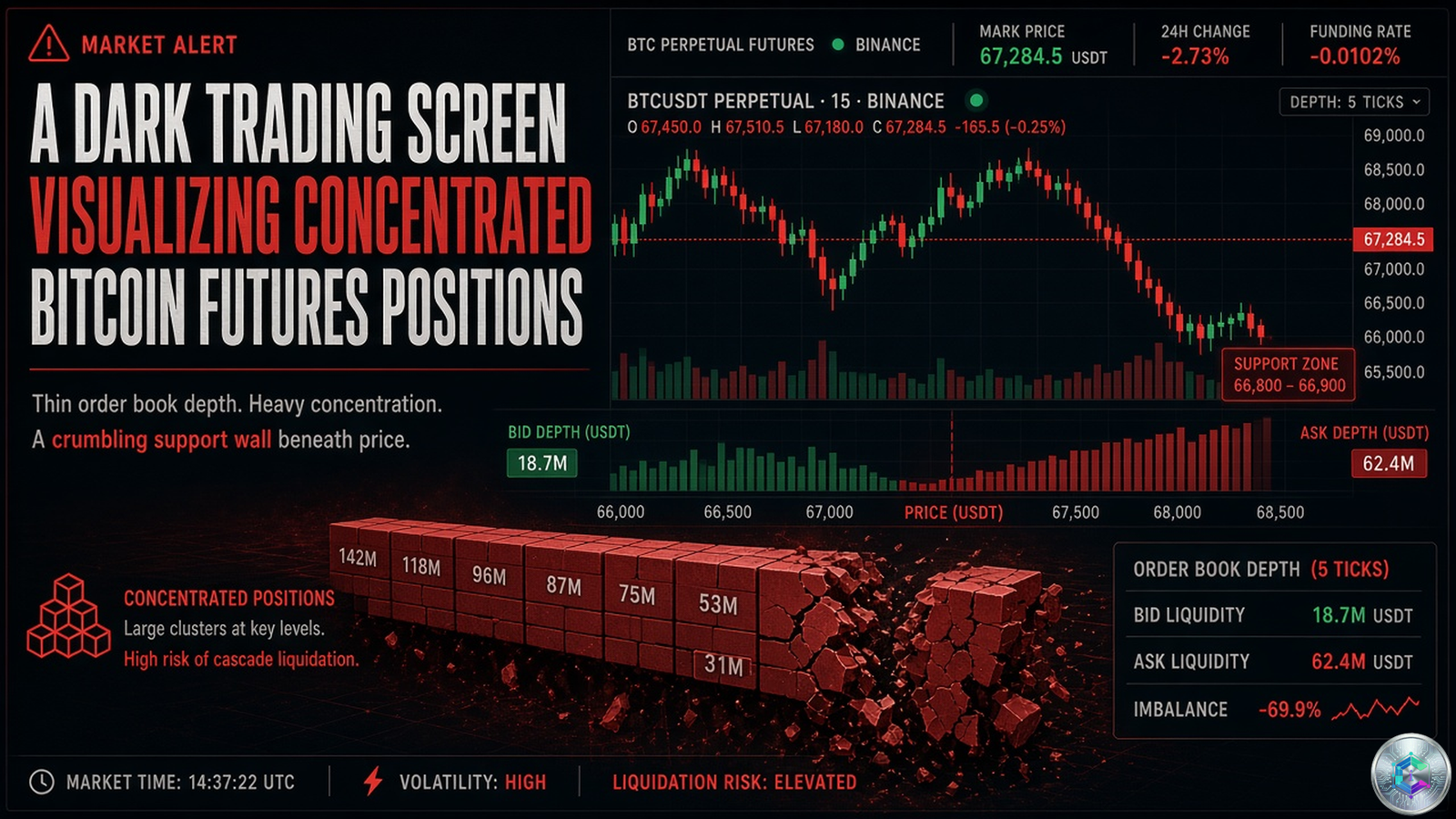
Bitcoin futures markets are showing a worrying structural imbalance: 48 billion in open interest rests on just 25 billion in daily volume. This concentration, flagged by Glassnode, evokes a crowded club with a tiny exit and rekindles fears of cascading liquidations.
🔑 Key takeaways
- Bitcoin futures open interest stands at roughly 48 billion against only 25 billion in 24-hour volume, an imbalance not seen since September of the previous year.
- Glassnode warns that the buy-wall has thinned by about one-third since its early-July peak, eroding downside support.
- The top four and eight reportable traders on CME futures hold a significant share of total open interest, per CFTC data.
- Since May 2026 the CME has operated 24/7, eliminating the weekend pause and amplifying stress-event risk.
- The historical roll yield on bitcoin futures is roughly -25% annualized since February 2018.
An unmatched imbalance between positions and liquidity
Bitcoin futures open interest sits at around 48 billion dollars according to CoinDesk, while 24-hour trading volume tops out at 25 billion dollars based on Coinglass data. This gap between outstanding positions and available liquidity has not been this wide since September of the previous year. For context, between 2019 and 2020, daily volume exceeded open interest by a factor of 2-to-1, sometimes 3-to-1.
Open interest measures the total number of outstanding contracts across the market. It changes when new positions open and old ones close. If a buyer and a seller exit simultaneously, open interest drops. If a long position is closed but offset by a new short, open interest stays flat. Volume, by contrast, simply counts the number of contracts traded over a given period.
Bitcoin was trading around 63,500 dollars at the time of writing, up 1% since midnight UTC. Spot markets are equally thin, with only 12.55 billion dollars in 24-hour volume against 25 billion on the futures side, magnifying the potential for exaggerated price swings.
Concentration of large traders on the CME
Data from the CFTC’s weekly Commitment of Traders reports show that the top four and top eight reportable traders on CME bitcoin futures hold a significant share of total open interest. That concentration means the market’s liquidity profile looks healthy in calm conditions but could deteriorate quickly under stress.
“The risk is mechanical. When open interest dominates daily volume, liquidations meet few passive orders to absorb them, and adverse moves extend further than they otherwise would. Traders have taken on substantial risk, primarily on the long side, in a market that shows no corresponding demand.”
Glassnode, on-chain analytics firm
Bitcoin futures open interest has been highly volatile in 2026. After approaching 61 billion dollars at the start of the year, it fell sharply to between 49 and 52 billion by mid-year. A partial rebound brought it back to around 50 billion in late April. A 10-billion drop over a relatively short window is not just noise: it reflects a real withdrawal of capital from the market.
| Period | Open interest (B$) |
|---|---|
| Early 2026 | ~61 |
| February 2026 | ~52 |
| Mid-2026 | 49 – 52 |
| Late April 2026 | ~50 |
| August 2026 | ~48 |
The buy-wall is thinning
The risk of amplified moves is most acute on the downside, given weakening demand and a lack of buy orders at lower price levels. Glassnode notes that the buy-wall framing the summer range peaked in early July and has thinned by about one-third since, leaving less support under price during the latest retest of the lows.
Concretely, if price retests the June low at 58,000 dollars, far fewer buyers will be waiting to step in, raising the odds of a steeper decline. Large trader participation in CME bitcoin and ether futures has hit record highs during certain periods, with Q2 2023 standing out as a notable reference for institutional engagement. Throughout 2025, market commentary repeatedly flagged crowded long positioning in bitcoin futures as a prevalent risk factor.
CME 24/7: a new stress vector
From May 2026, the CME Group extended its crypto futures and options trading to a 24/7 operational model. That change means a stress event at 3 a.m. Eastern Time on a Sunday can now trigger immediate liquidations on CME futures, amplifying moves on spot markets and perpetual swaps on offshore venues.
CME bitcoin futures, listed under the symbol BTC, are cash-settled in U.S. dollars based on the CME CF Bitcoin Reference Rate (BRR), a benchmark calculated once a day from trade flow on major spot exchanges during a one-hour window. Each contract is worth five times the BRR index, with price increments of 5 dollars per bitcoin, meaning a one-tick move equals 25 dollars. Contracts expire on the last Friday of the month and are listed for the nearest six consecutive months plus two December contracts.
Roll yield, cash-and-carry and ETF exposure
Bitcoin futures have posted a negative roll yield of roughly 25% annualized since February 2018, defined as the difference between annualized returns on rolling futures indices and spot indices. During periods of strong bullish sentiment, bitcoin futures often trade at a premium to spot, generating that negative roll yield. In risk-off or deleveraging periods, the curve can flatten or flip into backwardation (spot prices above futures prices), which has sometimes coincided with price inflection points.
A cash-and-carry trade involves buying bitcoin on the spot market while shorting bitcoin futures when they trade at a premium to spot, allowing investors to capture the price gap as the contracts converge at expiry. Returns come primarily from the futures basis rather than from the direction of bitcoin’s price.
For investors seeking bitcoin exposure through futures, exchange-traded products offer an alternative. A bitcoin futures ETF issues listed securities that provide exposure to bitcoin futures price moves. The structure requires an investment company to set up a subsidiary acting as a commodity pool, which then trades the futures. However, futures do not track spot prices exactly, and returns can diverge from spot performance. They also involve rolling costs and management fees. According to CNBC, traders are increasingly turning to perpetual bitcoin futures as a new instrument, a topic covered by reporter Tanaya Macheel on the Fast Money show on June 2, 2026.
Conclusion: a powder keg under watch
Bitcoin futures are entering a phase where mechanics matter more than sentiment. The open-interest-to-volume ratio, last seen this elevated a year ago, signals that a growing share of capital is tied up in positions that can only be unwound at a heavy price friction. Combined with a thinning buy-wall and the disappearance of the weekend pause on the CME, the cocktail creates fertile ground for exaggerated price moves, in both directions.
The coming weeks will reveal whether the market finds a new structural floor or whether a wave of forced liquidations serves as a catalyst for a renewed volatility spike in bitcoin. Either way, savvy investors will track not only price but also the evolution of open interest, the basis, and the concentration of CME positions.
Sources
- CoinDesk – The Bitcoin Futures Market Has a Crowded Club, Tiny Exit Problem
- CME Group – What Are Bitcoin Futures
- CNBC – Crypto Traders Now Using Perpetual Bitcoin Futures
- CryptoBriefing – Bitcoin Futures Concentrated Trader Risks
- CFTC – Bitcoin Futures ETF
- Bloomberg – Bitcoin: The Spot, The Future, The Financial
This article is published for informational and educational purposes only. It does not constitute investment advice. Do your own research (DYOR) before making any decision.

