


Autonomous AI agents may soon settle their own cloud, data and API bills using stablecoins and next-generation payment rails. BlackRock and Mastercard are betting on this convergence to drive digital-asset adoption at industrial scale.
🔑 Key Takeaways
- BlackRock identifies AI as a key driver of digital-asset adoption in a paper published in September 2026.
- Mastercard launched “Agent Pay for Machines” on June 10, 2026, with over 30 partners including Coinbase, Stripe and Ripple.
- The Coinbase x402 protocol showcases agentic stablecoin payments for API and compute calls.
- Cloud revenue at Amazon, Microsoft and Google could reach $1.1 trillion by 2030.
- 40% of agentic AI projects could be cancelled by 2027 according to Gartner, due to runaway costs.
BlackRock: AI as the new engine of digital assets
In a paper published in September 2026, asset-management giant BlackRock ranks artificial intelligence among the primary catalysts for crypto adoption. The core argument is a simple equation: AI provides “native intelligence for machines,” while digital assets supply the settlement infrastructure autonomous agents need to act on their decisions without human intervention.
In practice, an AI agent tasked with a mission could purchase a data query on a specialized marketplace, rent a GPU compute instance, or pay for API access without any human approving the transaction. Stablecoins (cryptocurrencies pegged to a fiat currency) emerge as the ideal tool: their predictable price makes service pricing straightforward, and blockchain networks offer round-the-clock availability, 24/7.
“AI and digital assets are naturally complementary: the former delivers machine intelligence, the latter gives those machines the means to act economically.”
BlackRock positioning paper, September 2026
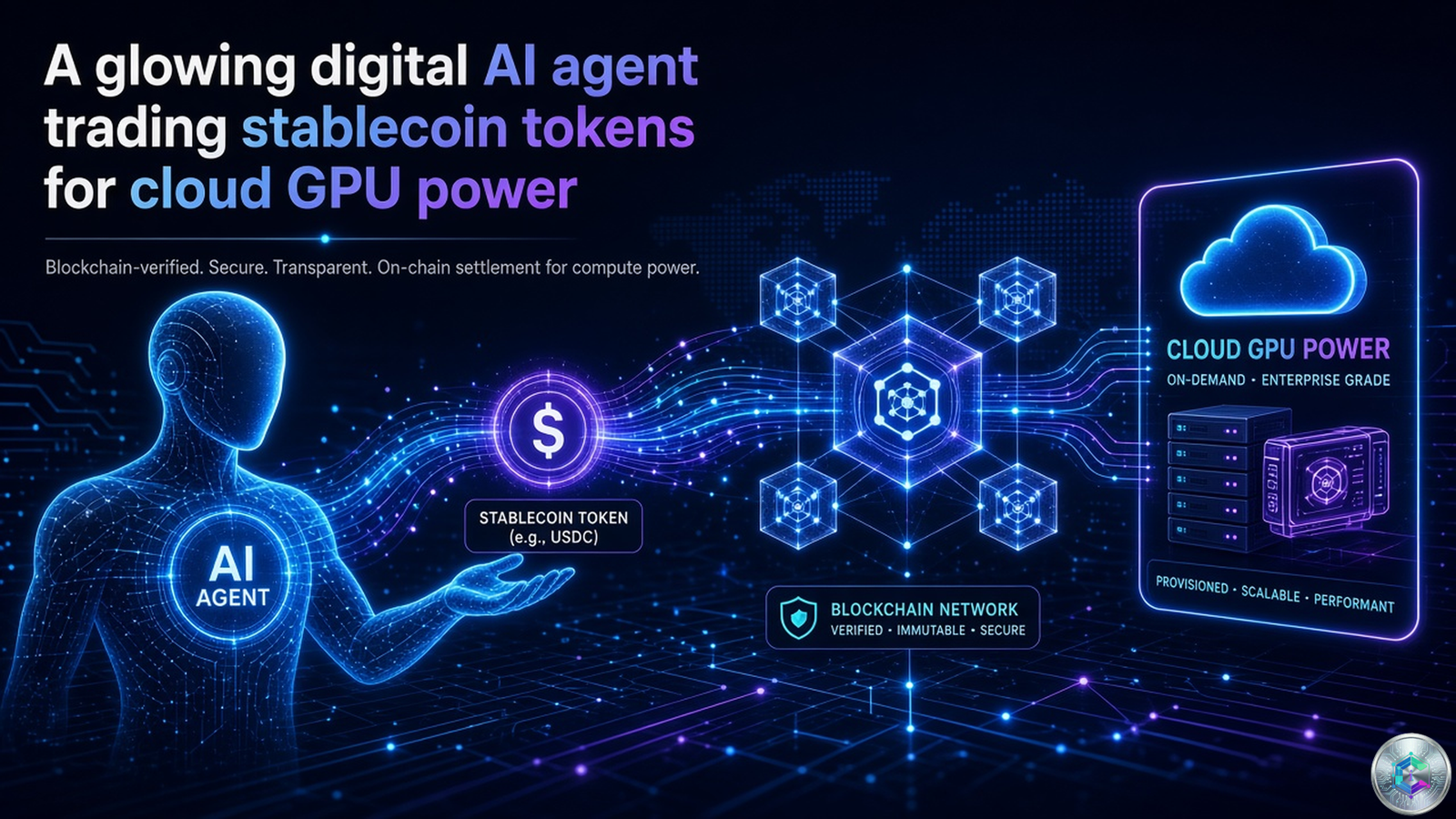
BlackRock cites the Coinbase x402 protocol as an emerging example of this agentic economy. This standard lets agents pay in stablecoins for online resources, including API calls. The firm tempers expectations, however: traditional payment networks are not standing still and are adapting their own rails to machine-driven commerce.
Compute: the next frontier
Beyond immediate payments, BlackRock sees compute as a longer-term opportunity. As demand for AI processing grows, standardized contracts on compute capacity could be traded, financed, or used as collateral via a digital-asset infrastructure. The firm cites projections that cloud revenue at Amazon (AWS), Microsoft (Azure) and Google (GCP) could reach approximately $1.1 trillion by 2030.
BlackRock notes, however, that agent-to-agent payments remain at an early stage and that liquid markets for standardized compute contracts still need to be built — a gap that players like Nosana, Spheron and Akash are already trying to fill.
Mastercard bets on machine-speed payments
On June 10, 2026, Mastercard officially launched “Agent Pay for Machines”, a service designed to enable machine-speed, always-on, high-frequency transactions. Over 30 industry players back the initiative: Adyen, Ant International, BVNK, Checkout.com, Cloudflare, Coinbase, Getnet by Santander, Global Payments, Lovable, OKX, Stripe, Tempo, alongside Aave Labs, Alchemy, Anchorage Digital, Polygon, Ripple, Solana Foundation and MoonPay, among others.
The service builds on Mastercard’s Agent Pay program launched in 2025 and adds credentialing, permissioning, transaction and multi-rail settlement capabilities. It now covers cards, accounts and stablecoins. Unlike traditional point-of-sale or person-to-merchant payments, these transactions are programmatic, always on, and executed between systems in the background of digital commerce.
“Agent Pay for Machines will create the conditions for a super-bloom of AI business models. Machine payments can enable buying and selling services between agents at fundamentally different scales than today’s payments — very high volumes, very small values, very fast, with extremely low latency.”
Jorn Lambert, Chief Product Officer at Mastercard
Stani Kulechov, founder of Aave Labs, adds: “Payments and treasury management are inseparable.” Mastercard aims to bring the trust and controls of its global network to machine-driven commerce, addressing very high volumes, very small per-unit values, high speed and extremely low latency.
Concrete use cases
Mastercard already envisions several scenarios. An entrepreneur could instruct an AI agent to build the web presence of a flower shop: the agent would automatically purchase a domain name, hosting, images and checkout pages within a set budget. A logistics agent could settle freight, book a loading-dock slot, acquire time-limited cold-chain monitoring data and pay warehouse handling fees as a shipment moves along its route.
Academic perspective and real costs
On the research side, Ramesh Raskar, professor at the MIT Media Lab and head of the NANDA project, describes a future economy where billions or trillions of AI agents collaborate and compete. He frames the current period as “the mainframe era of AI,” dominated by large centralized data centers.
“The cost of compute work is dropping fast, which will make AI efforts available to more organizations and individuals. We are moving toward the PC era of AI, and that changes everything.”
Ramesh Raskar, MIT Media Lab
Raskar identifies several key categories for this agentic economy: agent identity and discovery systems, trust and reputation services, insurance and legal services, and stablecoin-based micropayments. He stays cautious, though: “If I’m honest, nine paths out of ten will lead to a consolidation of AI agents under corporate control. The window to keep this agentic web open is closing fast.”
The hidden cost of AI agents
The financial picture shows that the real cost of AI agents often exceeds initial estimates. Model calls, token consumption, tool invocations, memory, context, retries and monitoring accumulate substantial resources. The AI inference market (running models in production) is expected to grow from $106 billion in 2025 to $255 billion by 2030, representing 65% of all AI compute by 2029.
| Metric | 2024 | 2025 | 2026 / projection |
|---|---|---|---|
| Average monthly AI spend per organization | $62,964 | $85,521 | rising |
| Average annual enterprise AI budget | $1.2M | – | $7M |
| AI inference market | – | $106B | $255B (2030) |
| Agentic AI projects cancelled (Gartner) | – | – | 40% by 2027 |
Gartner forecasts that 40% of agentic AI projects will be cancelled by 2027, due to a combination of uncontrollable costs and unreliable outcomes. Some Fortune 500 companies already report monthly AI inference bills of tens of millions of dollars. Solutions are emerging: Nosana launched a decentralized GPU marketplace in early 2025 for AI and high-performance compute workloads, offering costs below traditional cloud options.
Conclusion: toward a machine economy, not just a human one
The convergence between AI and crypto now seems acknowledged by major traditional players. While BlackRock highlights the long-term potential and Mastercard builds the multi-asset payment rails, the scenario will largely depend on the ecosystem’s ability to standardize compute contracts and offer open governance for agent identities. In the short term, agentic payments will stay confined to pilot use cases; in the medium term, volumes could shift decisively if stablecoins become the preferred medium of exchange between autonomous systems. The window to keep this “agentic web” open, as Raskar warns, is closing fast.
Sources
- CoinDesk — AI agents will soon buy their own computing power and data using stablecoins, according to BlackRock
- CryptoNews
- Mastercard — Agent Pay for Machines launch press release
- IBM Think — AI agents
- MIT Sloan — Who will own the AI agent economy
- Nosana — The real cost of AI agents
This article is for informational and educational purposes only. It does not constitute investment advice. Do your own research (DYOR) before making any decision.

